
Getting started
How to Start Trading Gold in 2026: 7 Steps for Beginners
How to start trading gold in 2026 in seven steps: read the specs, check the broker, practice on demo, size your first trade and review it every week.
10 min read
Read more →
Start with what the XAU/USD symbol means, how to work out lot size and pip value, then move on to what drives the gold price and the risks worth understanding before your first trade.
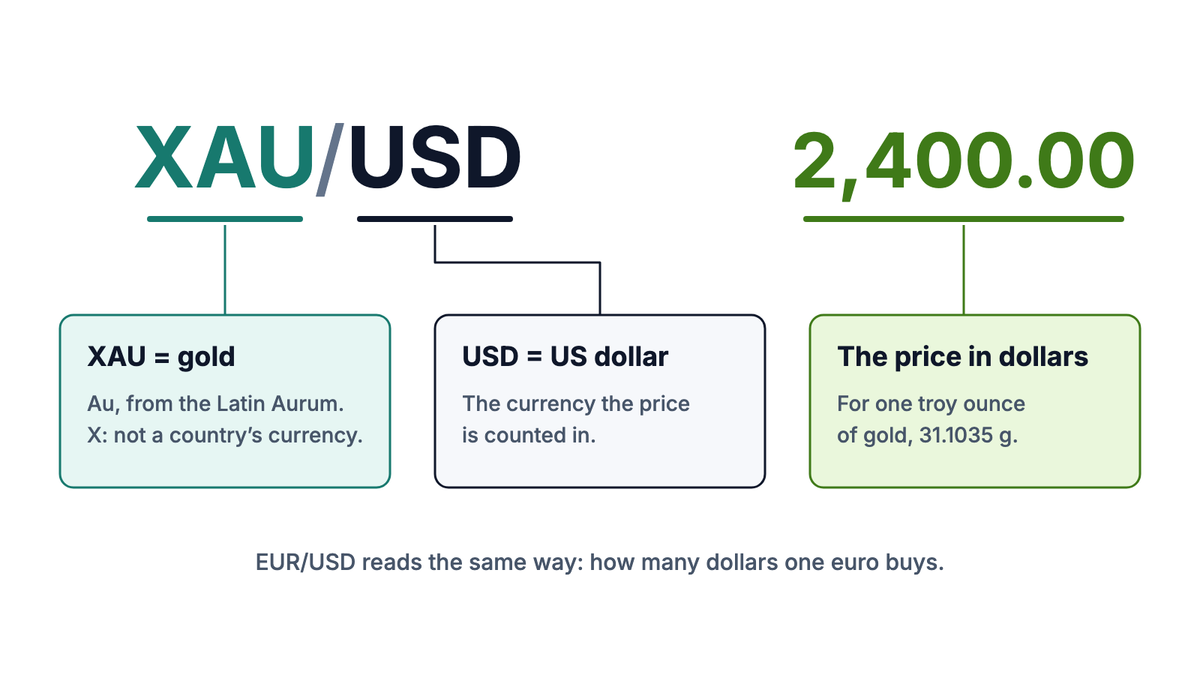
Open a trading platform and gold shows up as XAU/USD, which looks like a currency pair. That's because it is one, by design. XAU is the international code for gold under the ISO 4217 standard, the same standard used for currency codes, and USD is the US dollar. Put together, XAU/USD shows how many US dollars one troy ounce (31.1035 g) of gold is worth. It works the same way as a pair like EUR/USD, which shows how many dollars one euro buys.
So a price like 2,400.00 on the chart is the price of one troy ounce, about 31.1 g, the standard unit markets use worldwide, from London and New York to typical CFD platforms.
Good to know
The XAU code comes from the Latin word Aurum, the source of gold's chemical symbol Au. It's combined with the letter X, which ISO uses for commodities that aren't any single country's currency. Silver follows the same pattern, with the code XAG.
If you're used to buying gold by the gram or the tola from a local jeweler, this can add another layer of confusion. Local markets often quote a different unit and a lower purity than the troy ounce of pure gold behind XAU/USD. To turn an XAU/USD price into a price per gram at a given karat, use the Gold Price Converter instead of working it out yourself.
Holding physical gold is a savings method many households around the world already trust, and it suits long-term goals. It comes with real limits, though. You need a trustworthy dealer, and you face a buy–sell spread that widens for jewelry because of the making charge. You also need a safe way to store the gold.
Trading XAU/USD through a CFD (contract for difference) is a different tool for a different job. The market stays open almost 24 hours a day on trading days, and you can profit whether price goes up (buy) or down (sell). The starting capital is also far lower than buying physical gold. That's because leverage, borrowing exposure to control a larger contract with less of your own money, does most of the work.
Trading gold and holding it aren't a question of which is better. They're different financial tools for different goals and different time frames.
One difference people often overlook is the decision horizon. Holding physical gold usually ties to a view that spans years. Trading XAU/USD works on much shorter horizons, from minutes to weeks, so you deal with short-term volatility and psychological pressure far more often. That's why this article treats risk management as just as important as the basics, not only how to place a trade.
Before you pick a way to trade gold, it helps to see how different each instrument is. They vary in the capital needed, the liquidity, and whether you hold physical gold or just a contract that tracks its price.
| Type | Minimum capital | Liquidity | Physical gold? | Best for |
|---|---|---|---|---|
| Gold bars / ornaments | Around $150 and up for a 1 g bar or small coin | Moderate, you need to find a shop that buys back | Yes, physical ownership | Long-term holders who want the physical asset |
| Gold ETF | The price of one fund unit, often tens to hundreds of USD | High, during stock market hours | No, you hold a fund unit that tracks the price | Medium- to long-term investors using a brokerage account |
| Gold Futures (CME) | Tens of thousands of USD in margin for a standard contract | Very high, during CME market hours | No, it's a futures contract | Institutional traders or large accounts |
| Gold CFD (XAU/USD) | A few USD and up, depending on the minimum lot and leverage | High, almost 24 hours a day on trading days | No, it's a contract for difference | Short-term traders with limited capital |
This article, and the whole PipsMorrow curriculum, focuses mainly on Gold CFD (XAU/USD) trading, because it's the most accessible route for retail traders and it's what the course chapters reference. A key advantage of Gold CFDs is flexible position size: you can open a lot as small as 0.01. Gold futures, by contrast, fix the contract size and require much higher margin, so limited capital shuts most people out. That flexibility lets traders with limited capital still learn and practice without taking on more risk than they can handle.
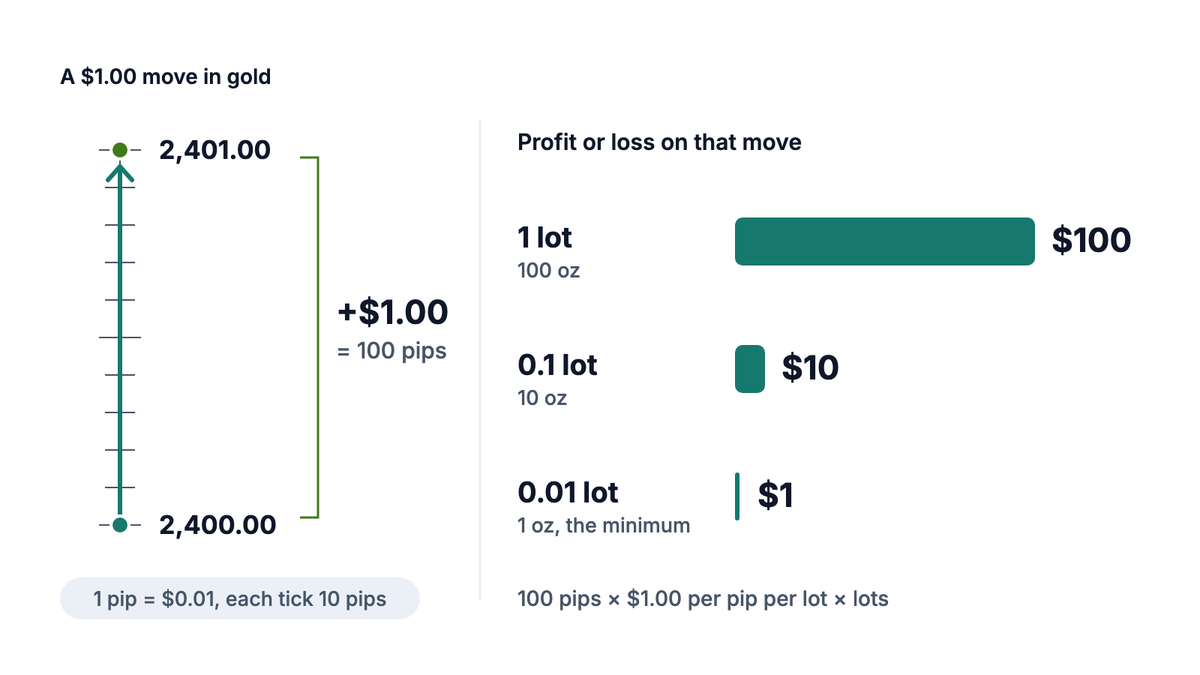
The standard XAU/USD contract always represents 100 troy ounces of gold in 1 lot, no matter which platform you trade on. This standard holds across the whole industry. The smallest unit a price can move is called a pip, which for gold equals $0.01 — for example, a move from 2,400.00 to 2,400.01 is 1 pip.
Once you know the pip value, working out profit and loss is straightforward. If the price moves a full $1.00 (100 pips), the change equals 100 pips × $1.00 = $100.00 per lot. The same formula applies whether the market rises or falls, only the direction of profit and loss flips, depending on which side of the trade you opened.
Try it yourself
You don't need to memorize the formula. Enter your own lot size and pip count in the Pip Calculator to see the value in USD update as you type.
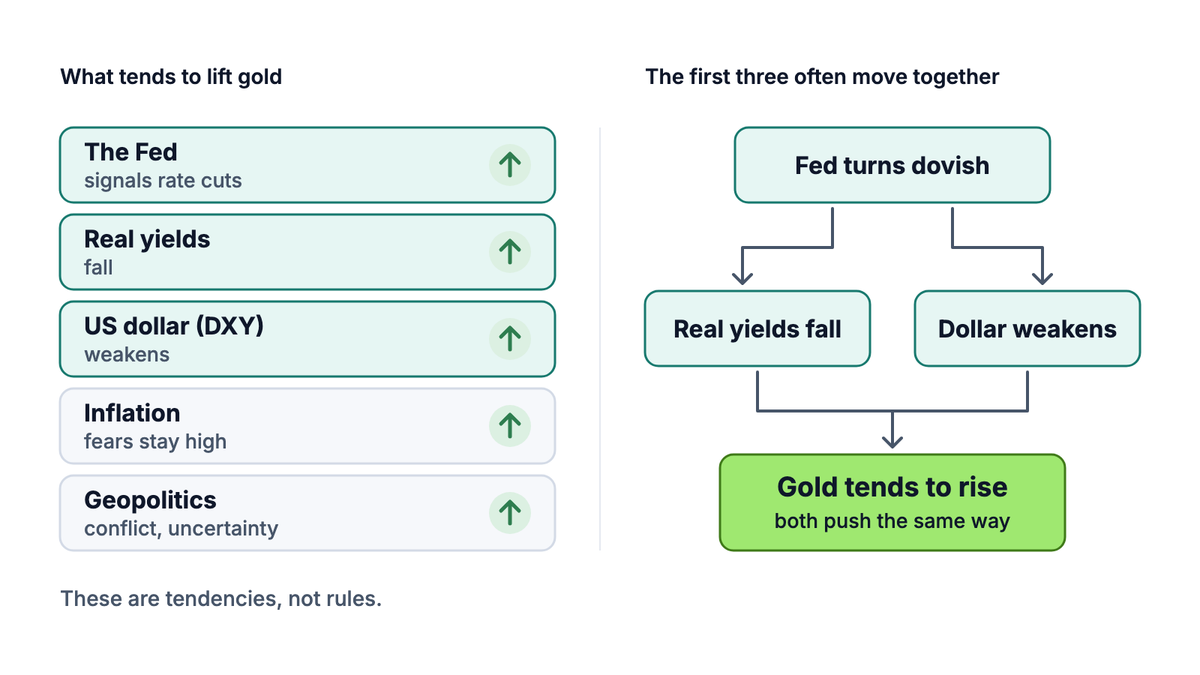
Gold prices don't move at random. A handful of key factors are what gold traders watch on a regular basis.
Start with one
You don't need to track every factor from day one. Most beginners start by learning the Fed meeting calendar, then add other factors as they get more comfortable.
One thing to watch for: these factors rarely move on their own, they usually overlap. When the Fed turns dovish, real yields tend to fall and the dollar tends to weaken at the same time, and both push gold in the same direction. Traders who see this whole picture read the market more deeply than those watching a single number.
Leverage cuts both ways: it magnifies profits and losses by the same proportion. Opening a lot size too large for your account balance is one of the top reasons accounts blow up faster than expected. The spread (the gap between the buy and sell price) can also widen around major news. So can the overnight swap, a small charge or credit for holding a position past the end of the trading day. On top of that, the emotional pressure of holding a position often causes worse decisions than a wrong chart read.
Another risk beginners often miss is trading news events without a plan. Around major economic releases, prices can move unusually fast and hard, spreads can widen temporarily, and orders may not fill at the price you expected. Having a plan for those moments matters just as much as your read on price direction.
Risk warning
Trading CFDs and forex carries a high level of risk and may result in the loss of your entire investment. Before you open any real position, work out your lot size from the risk percentage of your account balance you're willing to accept, not from how much profit you want. Try the Lot Size Calculator to size each trade to the risk you've set.
Before you open your first position with real money, work through this checklist of 5 items.
This article is just a starting point. If you want a fully structured path, from the basics through advanced risk management, the PipsMorrow curriculum covers all of it for free.
The PipsMorrow Team
A team of writers covering XAU/USD gold trading education. We focus on explaining the mechanics and risk management in a structured way, with no trade signals and no promotion of any specific broker.
Last updated
How to start trading gold in 2026 in seven steps: read the specs, check the broker, practice on demo, size your first trade and review it every week.
10 min read
Read more →How to add XAUUSD to MT5 through Market Watch, read its specification, and decode suffixes like XAUUSD.m so you pick the right gold symbol.
7 min read
Read more →XAUUSD pip value explained: what one pip on gold is worth at 0.01, 0.10 and 1.00 lots, and why brokers disagree on what a gold pip even is.
9 min read
Read more →Build on this article with the full gold trading curriculum, ordered from the basics to advanced topics, free.

