
Getting started
What Is XAU/USD Gold Trading? The Complete Guide
Get to know the XAU/USD symbol from the basics, plus how to work out lot size and the risks before your first trade.
18 min read
Read more →
How to start trading gold in 2026 in seven steps: read the specs, check the broker, practice on demo, size your first trade and review it every week.
Most guides on how to start trading gold begin with a strategy. That is the wrong end. Your first months are not about finding winning trades. They are about learning the instrument, sizing correctly and surviving long enough for any skill to show.
This guide walks you through seven steps, in order, from knowing nothing about XAU/USD to placing one small live trade and reviewing it. Every number comes from the PipsMorrow calculators, so you can check each one yourself.
Here is the whole route. Each step has a clear finish line, so you always know whether you are ready to move on.
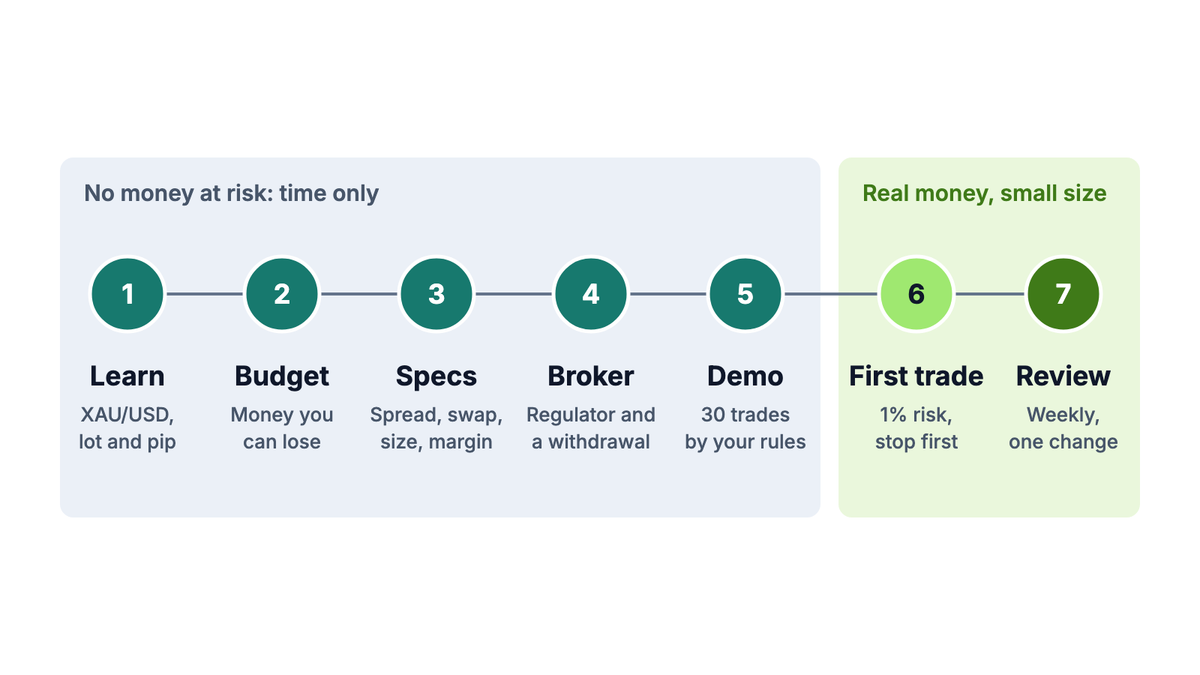
Notice that real money only appears at step 6. That order is deliberate. The cheapest mistakes are the ones you make on a demo account.
On a trading platform, gold is quoted as XAU/USD: the price of one troy ounce (31.1035 g, the standard unit for gold) in US dollars. Retail platforms usually offer it as a CFD (contract for difference). You never own metal; you gain or lose the change in price.
Three terms carry the rest of this guide. A lot is the trade size, and one standard lot of gold is usually 100 troy ounces. A pip on this site is the smallest price step, $0.01, which is worth $1.00 on one lot. Leverage lets you control a large position with a small deposit, called margin.
You do not need to master everything first. The complete guide to XAU/USD gold trading covers the symbol, the lot and what moves the price. Read it once, then come back here.
Where the price is in 2026
Gold is far more expensive than older tutorials assume. According to Trading Economics, spot gold (the price for immediate delivery) was around $4,300 an ounce on 25 Sep 2026. That followed an all-time high above $5,500 in January 2026. A higher price means a larger position value for every lot, so the examples below use $4,300.
Pick an amount you could lose entirely without it changing your month. Write it down before you open any account. This is your trading capital, and it never includes rent, emergency savings or borrowed money.
The size matters less than you might think, as long as it is not tiny. This guide uses a $2,400 account, the shared example used across the site. The next table shows why very small accounts struggle with gold.
| Account | 1% risk | Stop of $3.00 (300 pips) | Actual risk |
|---|---|---|---|
| $100 | $1.00 | 0.01 lots (the minimum) | $3.00, or 3% of the account |
| $500 | $5.00 | 0.01 lots | $3.00, or 0.6% |
| $1,000 | $10.00 | 0.03 lots | $9.00, or 0.9% |
| $2,400 | $24.00 | 0.08 lots | $24.00, or 1% |
On $100, even the smallest possible position risks three times the 1% rule on a modest stop. Below a few hundred dollars, gold forces you to break your own risk rule. That is a reason to stay on demo longer, not to skip the rule.
Every platform publishes a specification for its gold symbol. Four lines decide what a trade costs and how big it really is.
| Spec line | What it tells you | Why a beginner cares |
|---|---|---|
| Contract size | Ounces in one lot, usually 100 | Sets the money value of every pip |
| Spread | Gap between buy and sell price | You pay it on every trade, win or lose |
| Swap long / short | Overnight charge or credit per lot | Holding for days can cost more than the spread |
| Margin or leverage | Deposit needed to open a lot | Decides how close you run to a stop out |
The spread is the gap between the buy and sell price. The swap is a small charge or credit for holding a position overnight. The guide to reading a broker's gold specs goes through each line with worked costs.
Brand names are not legal entities. Find the company that will actually hold your money, then confirm it on the regulator's own register. The lesson on where your money sits explains why this matters.
Wherever you live, check the license on your national regulator's public register. Examples include the FCA in the UK, ASIC in Australia, CySEC in Cyprus, and the CFTC and NFA in the US. Many regulators also publish warning lists of unlicensed firms; the FCA, for example, keeps a Warning List of firms it believes are operating without permission. A name missing from a warning list proves nothing, because unlicensed firms often change names.
The full routine is in the lesson on how to check a broker before you deposit. PipsMorrow partners with IUX, but run this checklist on any broker, including ours.
A demo account uses virtual money on real prices. It teaches you the platform and your own rules at zero cost. It will not teach you how a real loss feels, so treat it as a rehearsal, not a test of skill.
Before your first demo trade, write your rules on one page. Keep them short enough that you could follow them tired.
Aim for at least 30 demo trades that follow the rules. The goal is not profit. It is proof that you can follow your own rules for a month without improvising.
The demo trap
Demo fills are often cleaner than live fills, and a virtual loss does not hurt. Traders who size up on demo because it is not real learn the wrong habit. Use the same balance and risk you will use live. The lesson on the limits of demo covers what demo leaves out.
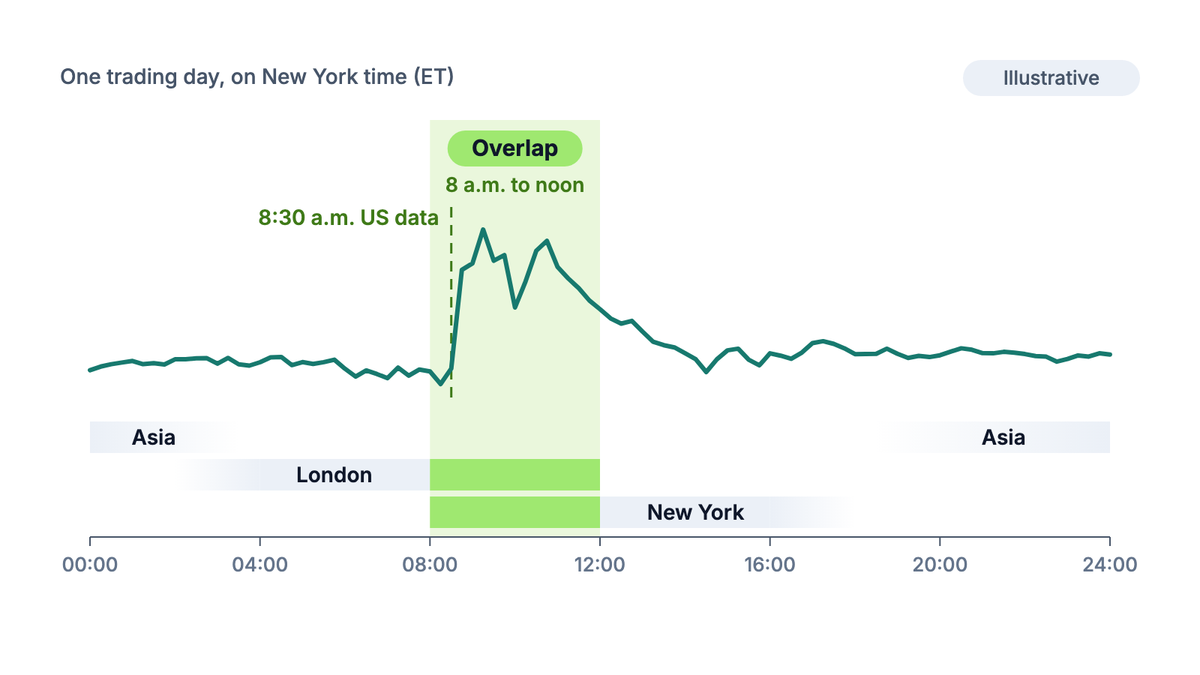
Watch the economic calendar during this step. US inflation, jobs and Fed decisions move gold hard, often at 8:30 a.m. ET (12:30 or 13:30 UTC) for data and 2 p.m. ET (18:00 or 19:00 UTC) for Fed decisions. The lesson on economic events that move gold shows which ones to mark.
This is where most beginners go wrong. They pick a lot size that feels right, then place a stop wherever the loss looks bearable. The correct order is the reverse: stop first, then size.
What each variable means:
Say you plan a buy at $4,300.00 with a stop at $4,297.60. That is a $2.40 stop, or 240 pips. With $24 of risk, the formula gives $24 ÷ (240 × $1.00) = 0.10 lots.
| Input or result | Value |
|---|---|
| Account balance | $2,400 |
| Risk per trade | 1% = $24.00 |
| Stop distance | $2.40, or 240 pips |
| Position size | 0.10 lots (10 troy ounces) |
| Loss if the stop is hit | $24.00 |
| Position value at $4,300 | $43,000 |
| Margin at 1:500 leverage | $86.00, or 3.6% of the balance |
| Leverage actually in use | About 1:18 |
Two lines in that table surprise most beginners. The margin is only $86, yet the position is worth $43,000. And although the account offers 1:500, the trade actually uses about 1:18. Available leverage is a ceiling, not a target. Your risk comes from the size and the stop, not from the leverage setting.
Try it now
Enter your balance, risk percentage and stop distance to get the lot size for gold. Then check the margin it needs before you place the order.
Place the stop in the same order ticket as the entry, never after. For the full sizing method, including what to do when the stop is wide, see how to size a position to the risk you can afford. For the order ticket itself, walking through your first trade goes step by step.
What can still go wrong
A stop loss limits the loss in normal conditions, but it is not a guarantee. Around big news or over a weekend, gold can jump past your stop and fill at a worse price. That is one more reason to keep each trade small.
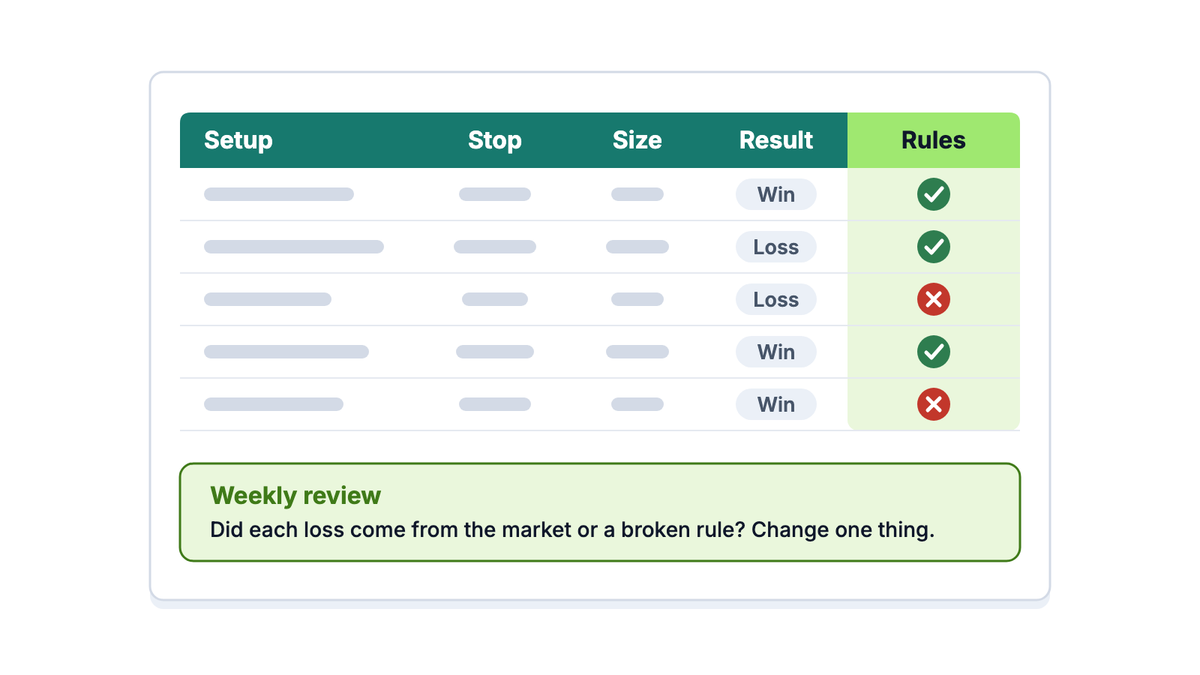
The last step turns trades into lessons. Record every trade the moment you close it: the setup, the planned stop, the size, the result and whether you followed your rules.
Then once a week, read the whole week back. Ask one question: which losses came from the market, and which came from breaking a rule? Change one thing at a time. The lesson on keeping a journal worth reading has a template.
| Mistake | What it looks like | The fix |
|---|---|---|
| Sizing from habit | Using the same lot size on every trade | Recalculate from the stop every time |
| Moving the stop | Widening it as price gets close | Set it once and leave it |
| Trading the news blind | Holding a position through a Fed decision by accident | Check the calendar before each session |
| Revenge trading | A bigger trade straight after a loss | A daily loss limit you do not argue with |
| Skipping demo | Going live after a week | 30 rule-following demo trades first |
None of these mistakes is about reading the chart. They are about process. A beginner who controls size and discipline can afford to be wrong about direction many times.
There is no legal minimum, but gold's volatility sets a practical one. On $100, the smallest 0.01 lot with a $3.00 stop risks 3% of the account. From about $500 upward, you can keep most trades near 1% risk with realistic stops.
A demo account teaches the platform, the order types and your rules. It cannot teach you how a real loss feels or how live fills differ. Use it until you follow your rules for 30 trades, then move to a very small live size.
Gold is usually most active when the London and New York sessions overlap, roughly 8 a.m. to noon ET (12:00 to 16:00 or 13:00 to 17:00 UTC, depending on US daylight saving). Major US data often lands at 8:30 a.m. ET. Convert these to your own time zone before you plan. Quieter Asian hours tend to have smaller moves, which suits practice.
Gold moves many more pips per day than a major pair like EUR/USD. That makes it less forgiving of a lot size chosen by feel. The mechanics are the same, but correct sizing matters even more.
The PipsMorrow Team
A team of writers covering XAU/USD gold trading education. We focus on explaining the mechanics and risk management in a structured way, with no trade signals and no promotion of any specific broker.
Last updated
Get to know the XAU/USD symbol from the basics, plus how to work out lot size and the risks before your first trade.
18 min read
Read more →How to add XAUUSD to MT5 through Market Watch, read its specification, and decode suffixes like XAUUSD.m so you pick the right gold symbol.
7 min read
Read more →XAUUSD pip value explained: what one pip on gold is worth at 0.01, 0.10 and 1.00 lots, and why brokers disagree on what a gold pip even is.
9 min read
Read more →Build on this article with the full gold trading curriculum, ordered from the basics to advanced topics, free.

