
Getting started
Lot Size in Forex: Standard, Mini and Micro Lots
Lot size in forex is the trade size you choose. See what standard, mini and micro lots are, what 1 lot is worth per pip, and how to pick one for your risk.
8 min read
Read more →
How to size a position on gold to the risk you can afford: a five-step routine, worked numbers on a $2,400 account and the traps that turn 1% into 10%.
A 1% risk rule can quietly become a 10% risk on gold. It happens when the stop is counted in the wrong unit, and nothing on the screen warns you. Knowing how to size a position is not about the formula. It is about feeding it the right numbers every time.
This is a practical companion for XAU/USD. The lesson on position sizing from a fixed risk explains why the method works. Here you get the five-step routine for gold, worked on the site's shared $2,400 account, plus the traps that break it.
Run these five steps before every gold trade, in this order. Skipping one is how a sound rule turns into an oversized position.
What each variable means:
A pip here is the smallest price step on gold, $0.01. A lot is the trade size, and one standard lot is usually 100 troy ounces (31.1035 g each). Check your platform's contract size first; the guide to reading a broker's gold specs shows where it is.
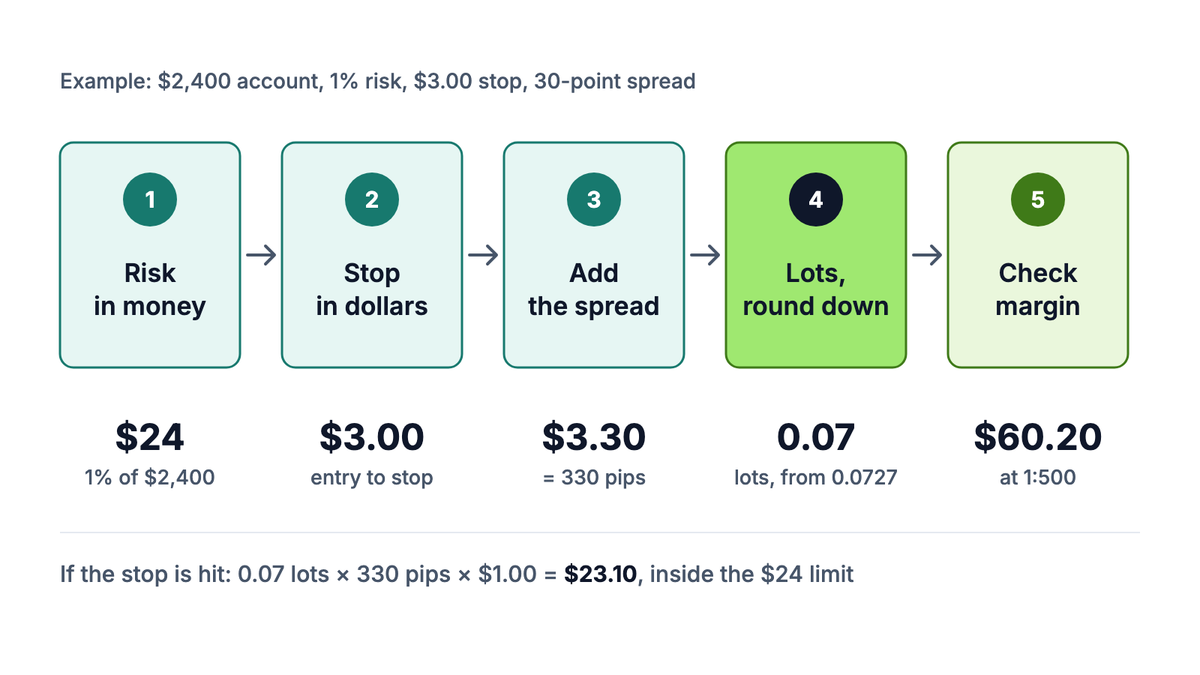
The account holds $2,400. At 1% risk, every trade may lose at most $24. Only the stop changes between rows.
| Stop on the chart | In pips | Lot size | Loss if stopped | Margin at 1:500, gold $4,300 |
|---|---|---|---|---|
| $2.40 | 240 | 0.10 | $24.00 | $86.00 |
| $3.00 | 300 | 0.08 | $24.00 | $68.80 |
| $5.00 | 500 | 0.04 | $20.00 | $34.40 |
| $12.00 | 1,200 | 0.02 | $24.00 | $17.20 |
Look at the $5.00 row. The formula gives 0.048 lots, which rounds down to 0.04 and risks $20 instead of $24. Rounding down leaves a little risk unused, which is the safe direction. Rounding up to 0.05 would risk $25, just over the rule.
Your chart usually shows the bid price. A buy fills at the higher ask and closes at the bid, so the spread adds to your real stop distance. With a 30-point spread, a $3.00 chart stop is really $3.30.
| Method | Stop used | Lot size | Loss if stopped |
|---|---|---|---|
| Chart distance only | 300 pips | 0.08 | $26.40 (1.1%) |
| Chart distance plus spread | 330 pips | 0.07 | $23.10 (0.96%) |
On a sell, it works the other way round. You enter at the bid, but the stop triggers when the ask reaches it. Place the stop the spread's width beyond the chart level, and measure the distance from entry to that price.
The gap is small on one trade. Across a year of trades, sizing that always overshoots by 10% adds up. Include the spread and your rule stays true.
Try it now
Choose Gold (XAU/USD), enter your balance, risk percentage and stop, and the calculator returns the rounded lot size and the actual risk in dollars. You can enter the stop as a price distance to skip the pip conversion.
Gold's daily range is wide, so a stop on a daily chart can easily be $30 or more. On a small account, that creates a problem the formula cannot fix: the correct size is smaller than the smallest lot you can open.
| Stop | Formula says | Smallest you can trade | Actual risk |
|---|---|---|---|
| $30.00 (3,000 pips) | 0.008 lots | 0.01 lots | $30.00, or 1.25% |
| $50.00 (5,000 pips) | 0.0048 lots | 0.01 lots | $50.00, or 2.1% |
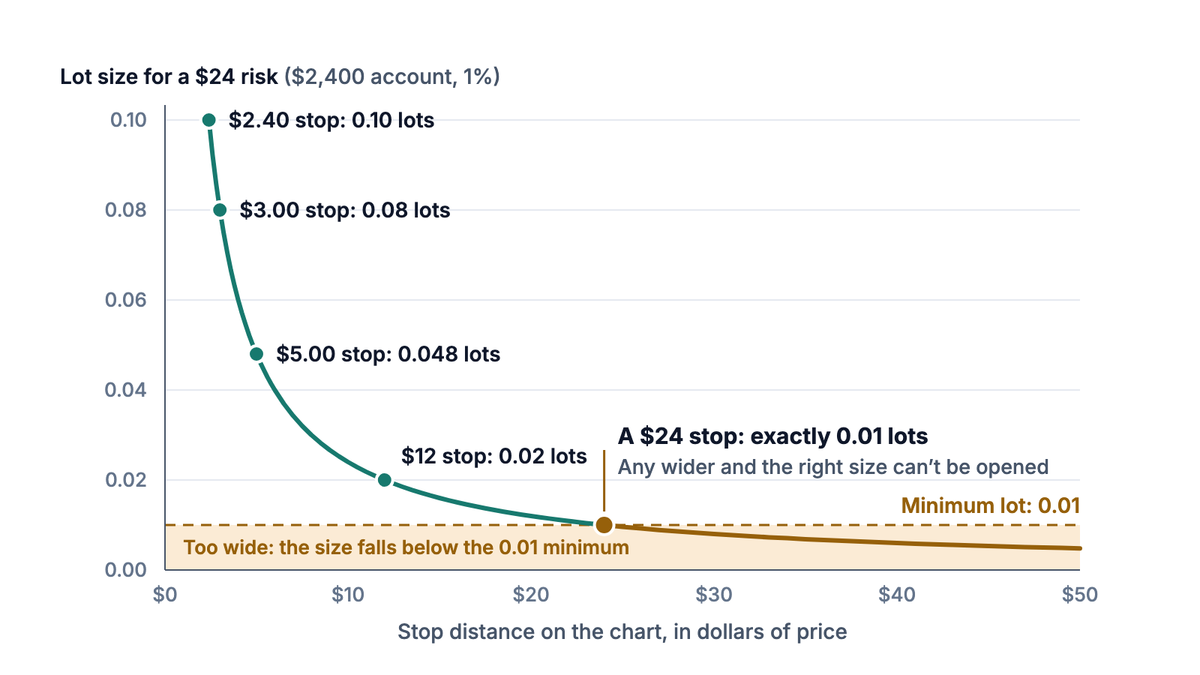
When this happens, you have three honest choices.
The wrong fix
Do not tighten the stop until the numbers work. A stop moved to fit the size sits inside normal price noise and gets hit before the idea is tested. The lesson on where a stop belongs covers how to place it from structure or volatility.
Some platforms and educators call a $0.10 move one pip on gold. Suppose you want a $5.00 stop but type "50 pips" into a calculator that counts $0.01 pips. It returns 0.48 lots for a $24 risk.
The real stop is $5.00, or 500 pips on that calculator. At 0.48 lots, hitting it loses $240, or 10% of the account. One unit error, and the 1% rule is ten times too large. Always convert the stop to dollars of price first.
Gold stops vary a lot from setup to setup. A lot size that was right for a $2.40 stop is twice too big for a $5.00 stop. Recalculate every time, and recalculate from the current balance. After a drop to $1,920, 1% is $19.20, and a $3.00 stop gives 0.06 lots, not 0.08.
Two gold trades at 1% each are one 2% bet on the same metal. A long gold trade and a short US dollar trade often move together too. The lesson on correlated exposure shows how to cap the total.
What sizing cannot control
A stop loss limits the loss in normal conditions only. Around major US data or over a weekend, gold can gap past the stop and fill at a worse price. Correct sizing keeps that gap survivable; it does not remove it.
The routine works with any percentage. The percentage itself should come from how much of a losing streak you can live with. Every trader meets a streak of ten losses eventually, so start there.
| Risk per trade | Risk on $2,400 | Size at a $3.00 stop | After 10 losses in a row | Gain needed to recover |
|---|---|---|---|---|
| 0.5% | $12 | 0.04 lots | $2,282.66 (down 4.9%) | 5.1% |
| 1% | $24 | 0.08 lots | $2,170.52 (down 9.6%) | 10.6% |
| 2% | $48 | 0.16 lots | $1,960.97 (down 18.3%) | 22.4% |
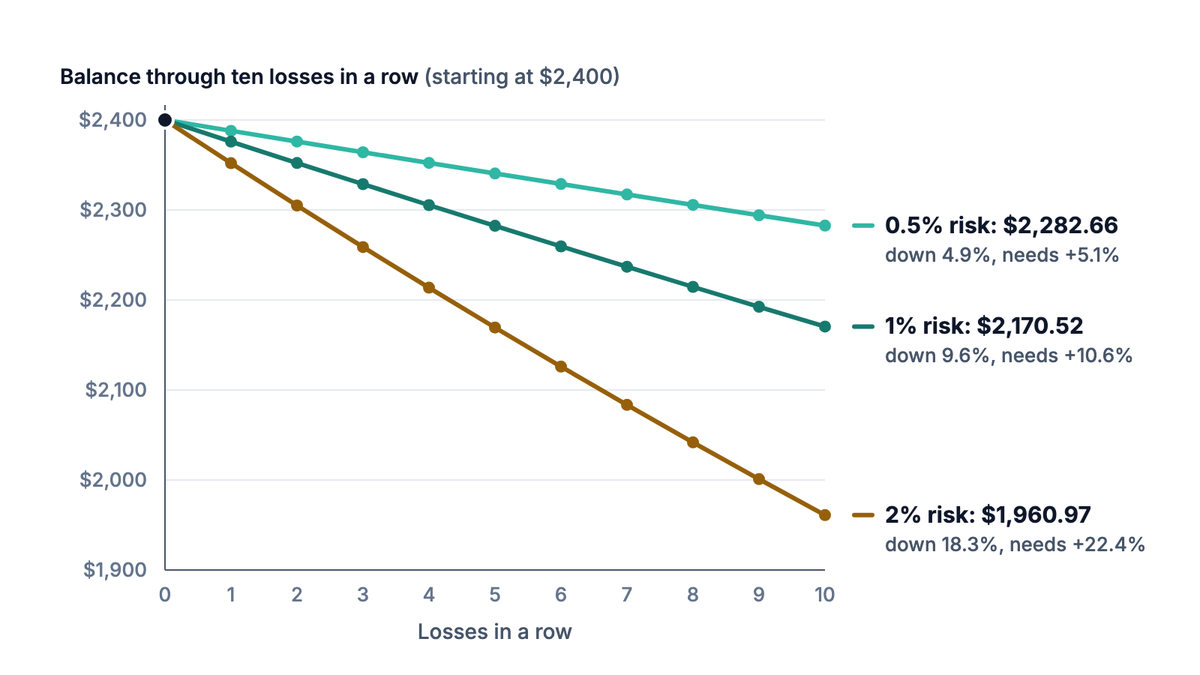
At 2%, ten losses cost almost a fifth of the account and need a 22% gain to repair. That is why 0.5% to 1% suits gold for most traders, especially while learning. The lesson on risk of ruin shows how the gap between percentages grows.
Model your own streak with the drawdown calculator. For how this fits into a first live trade, see the step-by-step guide to starting gold trading.
It depends on your stop, not the balance alone. At 1% risk, $10 over a $3.00 stop is 0.03 lots, which risks $9. Over a $10.00 stop, the right size is 0.01 lots.
Divide your risk in money by the stop in pips times $1.00, the pip value per standard lot. Then round down to the 0.01 step. For $24 and a $3.00 stop, that is $24 ÷ 300 = 0.08 lots.
No. Leverage changes the margin a trade locks up, not how much you lose at the stop. The size comes from risk and stop distance; leverage only decides whether you have enough margin to open it.
It can feel small because gold moves fast, but that speed is the reason to keep it small. At 1%, ten straight losses cost about 9.6% of the account. At 2%, the same streak costs about 18.3%.
The PipsMorrow Team
A team of writers covering XAU/USD gold trading education. We focus on explaining the mechanics and risk management in a structured way, with no trade signals and no promotion of any specific broker.
Last updated
Lot size in forex is the trade size you choose. See what standard, mini and micro lots are, what 1 lot is worth per pip, and how to pick one for your risk.
8 min read
Read more →What is drawdown in trading? It is the fall from an account's peak to its next low. Learn to measure it and why a 50% loss needs a 100% gain to recover.
10 min read
Read more →XAUUSD pip value explained: what one pip on gold is worth at 0.01, 0.10 and 1.00 lots, and why brokers disagree on what a gold pip even is.
9 min read
Read more →Build on this article with the full gold trading curriculum, ordered from the basics to advanced topics, free.

