
Tools
How to Size a Position on Gold: 5 Steps With Real Numbers
How to size a position on gold to the risk you can afford: a five-step routine, worked numbers on a $2,400 account and the traps that turn 1% into 10%.
8 min read
Read more →
Lot size in forex is the trade size you choose. See what standard, mini and micro lots are, what 1 lot is worth per pip, and how to pick one for your risk.
In forex trading, lot size is the size of one trade: how many units of a currency you buy or sell. It is not a plot of land. A standard lot is 100,000 units, and the size you pick decides how many dollars each pip (the smallest usual price step) is worth.
That makes lot size the single setting that controls how much a trade can win or lose. This guide covers the standard, mini and micro lot, what 1 lot is worth, and how to match the size to the money you can afford to risk. If you only want a number, the lot size calculator does the sum for you.
Currencies trade in fixed bundles called lots. A lot is the standard unit of trade size on your platform. When you click buy on 1.00 lots of EUR/USD, you are buying 100,000 euros against US dollars.
The number you type into the volume box is the lot size. It does not say how much money you put up. The deposit is the margin, which depends on your leverage (the ratio that lets a small deposit control a larger position).
Lot size matters because it multiplies every price move. A 20-pip move is the same on the chart whether you trade 1.00 lots or 0.01 lots. Your profit or loss is not the same at all.
Lot size in forex is not land
Searches for the term often return plots of land. In trading it only ever means trade volume. The lesson on pips, lots and contract size builds the same idea step by step.
Three names cover most of what you will see. Standard lot size in forex is 1.00 lot, or 100,000 units of the base currency (the first currency in a pair). The smaller ones are fractions of it.
Some brokers also offer a nano lot of 0.001, or 100 units. Not every platform allows it, so check the minimum volume before you plan around it.
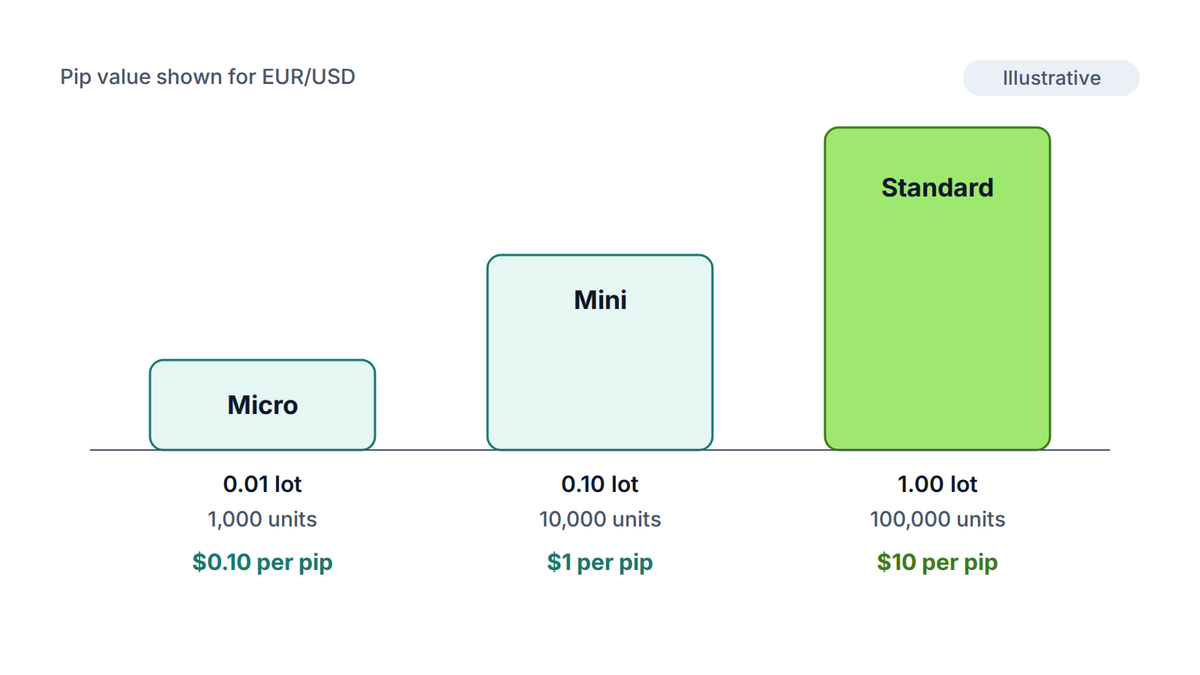
The question "how much is 1 lot in forex" has two answers. In units, 1 lot is 100,000 of the base currency. In dollars per pip, it depends on the pair, and on any pair quoted in US dollars, such as EUR/USD, it is $10 per pip.
The chart below uses EUR/USD at 1.1000 and a 1:500 leverage account. It shows the pip value, the result of a 20-pip move, and the margin each size needs.
| Lot type | Lots | Units | Value of 1 pip | Result of a 20-pip move | Margin at 1:500 |
|---|---|---|---|---|---|
| Standard | 1.00 | 100,000 | $10.00 | $200.00 | $220.00 |
| Mini | 0.10 | 10,000 | $1.00 | $20.00 | $22.00 |
| Micro | 0.01 | 1,000 | $0.10 | $2.00 | $2.20 |
Notice that the three rows scale together. Ten times the lots means ten times the pip value, ten times the swing and ten times the margin. Nothing else about the trade changes.
Pairs that do not end in USD pay the pip in another currency, which your platform converts to your account currency. On USD/JPY at 147.50, one pip on a standard lot is worth about $6.78. The pip size on yen pairs is also different: 0.01 rather than 0.0001.
Gold uses another contract again. One standard lot of XAU/USD is usually 100 troy ounces (a troy ounce is about 31.1 g), and a $0.01 step pays $1.00 per lot. At an assumed gold price of $4,300, a $3.00 move is 300 pips and pays as follows.
| Lot size | Ounces | Result of a $3.00 move | Margin at 1:500 |
|---|---|---|---|
| 1.00 | 100 | $300.00 | $860.00 |
| 0.10 | 10 | $30.00 | $86.00 |
| 0.01 | 1 | $3.00 | $8.60 |
The guide to reading a broker's gold specs shows where to find the contract size on your platform.
Your risk on a trade is the stop distance times the pip value. Only the lot size is fully under your control, so it is the lever that decides how big a loss you accept.
Take a stop loss 20 pips away on EUR/USD. The table shows what happens at each size on the site's shared example, a $2,400 account.
| Lot size | Loss at a 20-pip stop | Share of $2,400 |
|---|---|---|
| 1.00 | $200.00 | 8.3% |
| 0.10 | $20.00 | 0.83% |
| 0.01 | $2.00 | 0.08% |
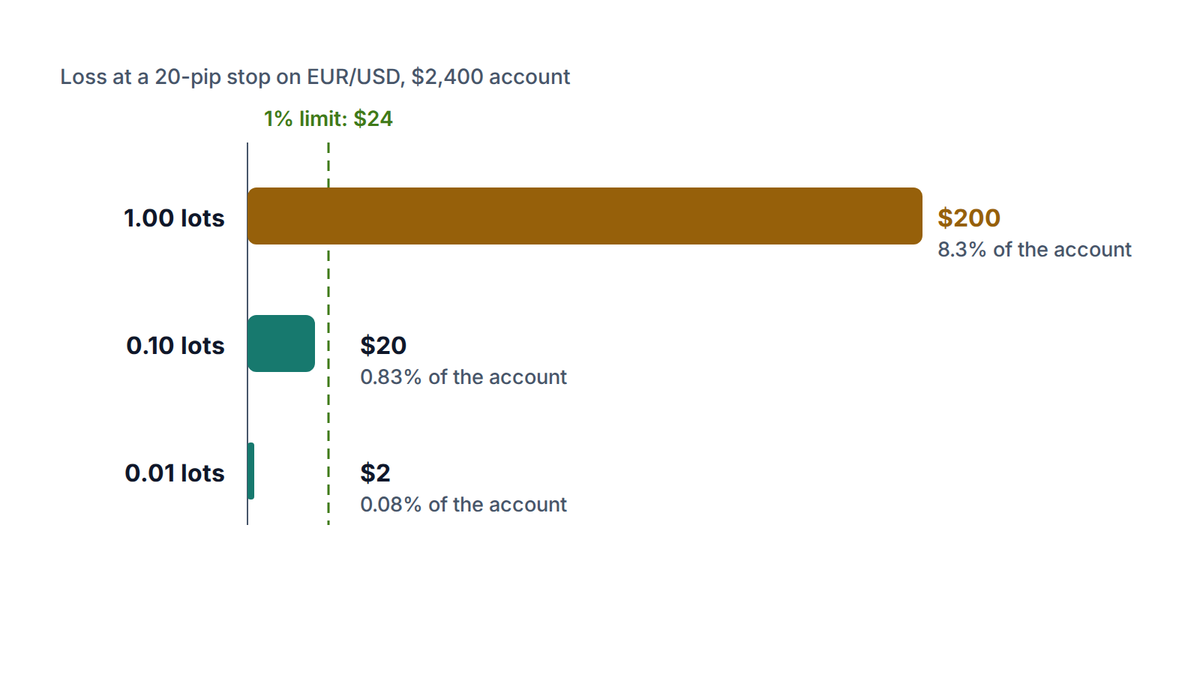
One standard lot on a $2,400 account puts 8.3% at stake on a single 20-pip stop. Most risk rules cap a trade at 1% to 2%, so a beginner with this balance belongs in mini or micro territory.
Leverage is not the same as risk
At 1:500, a standard lot needs only $220 of margin on this account, so the platform will let you open it. That says nothing about whether you should. The loss at your stop is set by the lot size and stop distance, not by leverage.
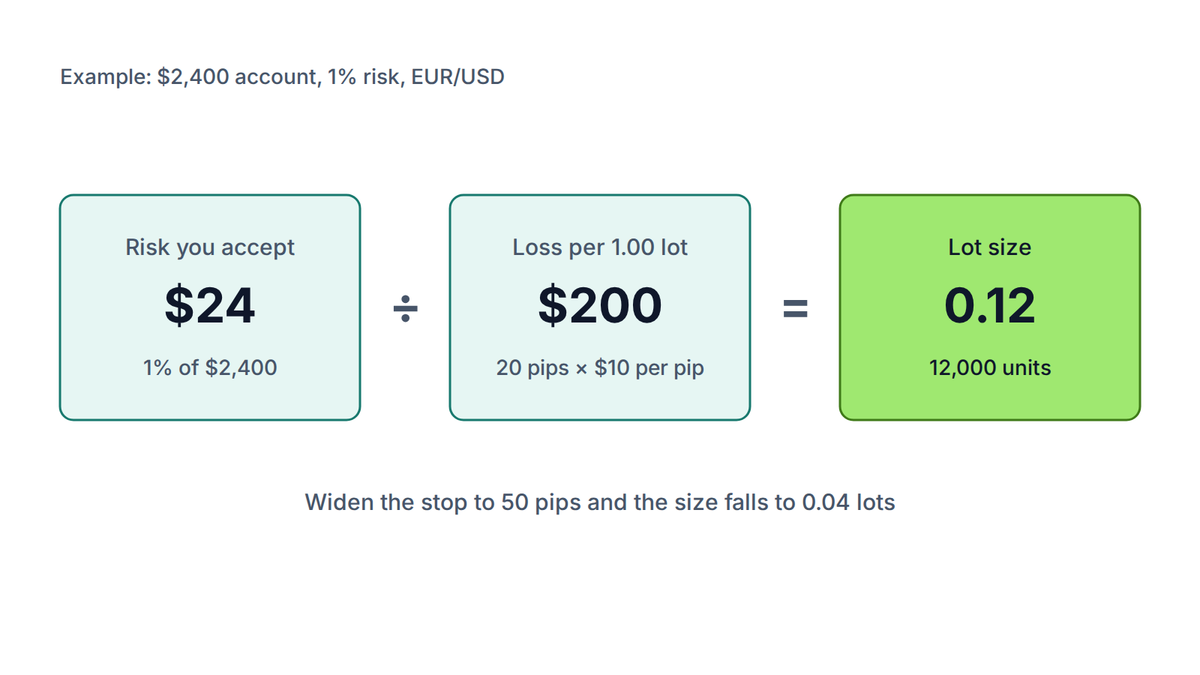
Do not choose a lot size and then see what it costs. Choose the loss you accept, then let the stop distance decide the size. The method takes four steps.
What each variable means:
With a 20-pip stop on EUR/USD, that is $24 ÷ (20 × $10) = 0.12 lots, which is 12,000 units. The calculator confirms it risks exactly $24. Widen the stop to 50 pips and the answer shrinks to 0.04 lots, risking $20.
| Stop on EUR/USD | Lot size for $24 | Units | Actual loss if stopped |
|---|---|---|---|
| 20 pips | 0.12 | 12,000 | $24.00 |
| 50 pips | 0.04 | 4,000 | $20.00 |
Try it now
Enter your balance, risk percentage, pair and stop in pips. The calculator returns the lot size, the units and the real risk in dollars. Then check the deposit in the margin calculator.
The full reasoning behind the method is in the lesson on position sizing from a fixed risk. For gold, with its own pip rules, see how to size a position on gold.
On most platforms 0.01 means 0.01 of a standard lot, which is 1,000 units. It does not mean one unit. On a cent account, the platform may show balances in cents, so a 0.01 lot there behaves differently. The lesson on account types explains the difference.
A size that was right for a 20-pip stop is far too large for a 50-pip stop on another day. Recalculate every time. Recalculate from your current balance too, since 1% of a smaller account is a smaller number.
Doubling the lot size to win back a loss turns a normal losing run into a deep one. Ten losses in a row at 1% risk cost about 9.6% of an account. The same run at 5% costs roughly 40%.
Most brokers set a floor, often 0.01 lots. If your stop is so wide that the correct size is below that, the smallest trade already risks more than your rule. Skip the trade or use a smaller account unit; do not tighten the stop to make the numbers fit.
It is the volume of a single trade, measured in lots. One standard lot is 100,000 units of the base currency, so 0.10 lots is 10,000 units. The lot size decides how much each pip is worth.
One lot is 100,000 units of the base currency. On pairs quoted in US dollars, a one-pip move on 1 lot is worth $10. The cost to open it is the margin, which is $220 on EUR/USD at 1.1000 and 1:500 leverage.
There is no fixed number. It depends on your stop and your risk rule. On a $2,400 account risking 1% over a 20-pip stop, the size is 0.12 lots. On a $200 account with the same rule and stop, it is 0.01 lots.
Only if your broker offers it. Some allow nano lots of 0.001, and cent accounts let you trade smaller amounts of real money. Check the minimum volume in the contract specifications before you plan around it.
The PipsMorrow Team
A team of writers covering XAU/USD gold trading education. We focus on explaining the mechanics and risk management in a structured way, with no trade signals and no promotion of any specific broker.
Last updated
How to size a position on gold to the risk you can afford: a five-step routine, worked numbers on a $2,400 account and the traps that turn 1% into 10%.
8 min read
Read more →XAUUSD pip value explained: what one pip on gold is worth at 0.01, 0.10 and 1.00 lots, and why brokers disagree on what a gold pip even is.
9 min read
Read more →What is drawdown in trading? It is the fall from an account's peak to its next low. Learn to measure it and why a 50% loss needs a 100% gain to recover.
10 min read
Read more →Build on this article with the full gold trading curriculum, ordered from the basics to advanced topics, free.

