
Brokers
What Is Spread in Forex? Costs, Commission and Swap
What is spread in forex? Learn how to read bid and ask, calculate the spread in dollars, judge a good spread, and add commission and swap to the total.
10 min read
Read more →
Gold contract specifications, line by line: contract size, digits, spread, swap, margin and hours, with each one turned into dollars per trade.
Two platforms can show the same gold price and still charge you very different amounts to trade it. The difference hides in the gold contract specifications, a short table most traders never open. Seven lines in it decide what one lot is, what a trade costs and how long you can afford to hold it.
This guide reads those lines one at a time and turns each into dollars on a real-sized trade. It uses the site's shared example: a $2,400 account, 0.10 lots and 1:500 leverage, with gold at $4,300. All spec values below are illustrative, not any broker's actual terms.
There are two places, and it pays to check both. The broker's website usually has a contract specifications page per account type. The trading platform has its own version, and that one reflects what your account actually uses.
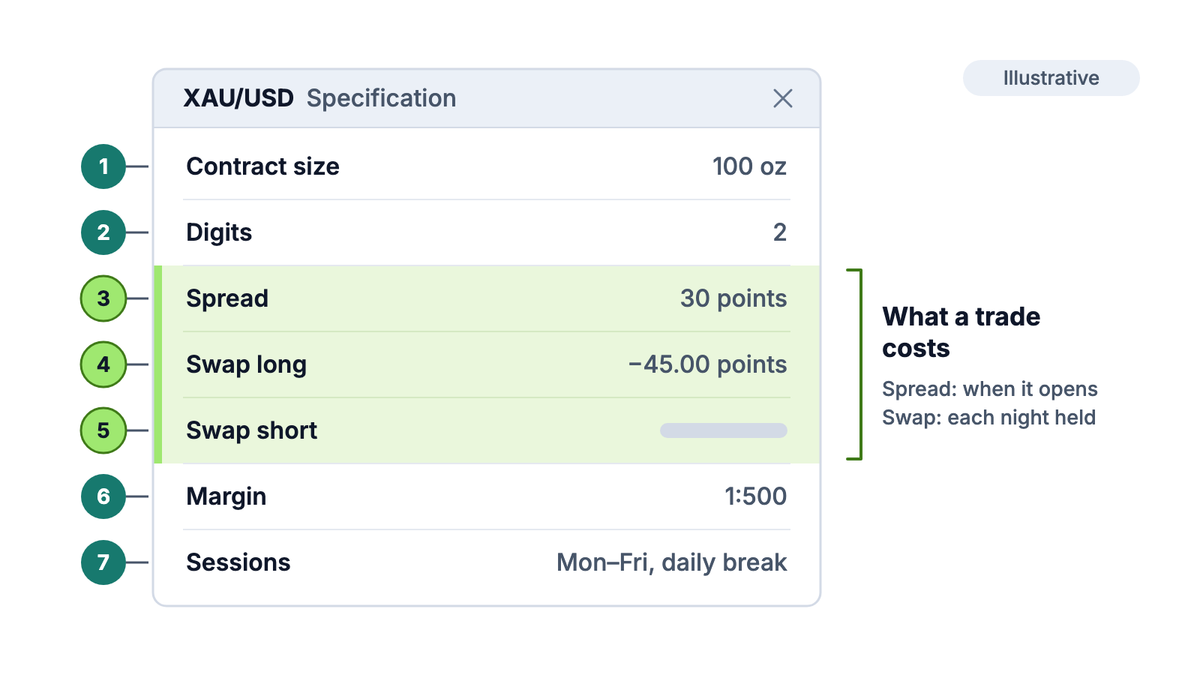
Spec sheets differ between account types at the same broker. Always read the one for the account you will trade on, not the headline marketing page.
The contract size is how many troy ounces (31.1035 g each) one lot represents. On most XAU/USD CFD (contract for difference) specs, it is 100 ounces. Do not assume it, though. Read the number, because every other calculation depends on it.
What each variable means:
With 100 ounces, one lot moves $1.00 for every $0.01. At 0.10 lots, that is $0.10 per $0.01, or $10 for a full $1.00 move in the price.
Here the industry disagrees with itself. The digits line tells you how many decimals the price shows. On a two-decimal quote like 4300.25, the smallest step is $0.01. PipsMorrow calls that step a pip, the smallest price unit used to count moves.
Many platforms call the same $0.01 step a point, and some educators call $0.10 a pip. A "30-pip stop" can therefore mean $0.30 or $3.00, a tenfold difference. On a three-decimal quote, a point shrinks again to $0.001.
| Price shows | Smallest step | "30" of them means | On 0.10 lots |
|---|---|---|---|
| 4300.25 (2 digits) | $0.01 | $0.30 | $3.00 |
| 4300.25, counted in $0.10 pips | $0.10 | $3.00 | $30.00 |
| 4300.251 (3 digits) | $0.001 | $0.03 | $0.30 |
A habit that removes the confusion
Think in dollars of price, not in pips or points. "The spread is $0.30" and "the stop is $3.00" mean the same thing on every platform. Convert to pips only when a calculator asks for them.
The same spec area lists the minimum lot and the lot step, typically 0.01 each. A 0.01 lot is one ounce, the smallest position most accounts can open. The lesson on trading XAU/USD on a forex platform covers these units in more depth.
The spread is the gap between the price you can buy at and the price you can sell at. You pay it the moment a position opens, because you buy at the higher price and could only sell at the lower one.
Spec sheets show spread in one of three ways: a typical or average figure, a minimum, or "floating". A minimum spread is a best case, not a promise. The live quote is what counts.
| Spread quoted | In price | On 0.01 lots | On 0.10 lots | On 1.00 lot |
|---|---|---|---|---|
| 12 points | $0.12 | $0.12 | $1.20 | $12.00 |
| 30 points | $0.30 | $0.30 | $3.00 | $30.00 |
| 60 points | $0.60 | $0.60 | $6.00 | $60.00 |
Now compare that with a risk budget. On the $2,400 account, 1% risk is $24. A 30-point spread on 0.10 lots is $3.00, or one-eighth of the whole budget, paid before the trade moves. The smaller your stop and target, the larger that share becomes.
Spreads are not fixed through the day. They tend to widen at the daily rollover, when liquidity is thin, and around big US releases such as CPI, jobs data and Fed decisions. Most brokers roll over at the New York close, 5 p.m. ET (21:00 or 22:00 UTC, depending on US daylight saving), which many platforms show as midnight server time.
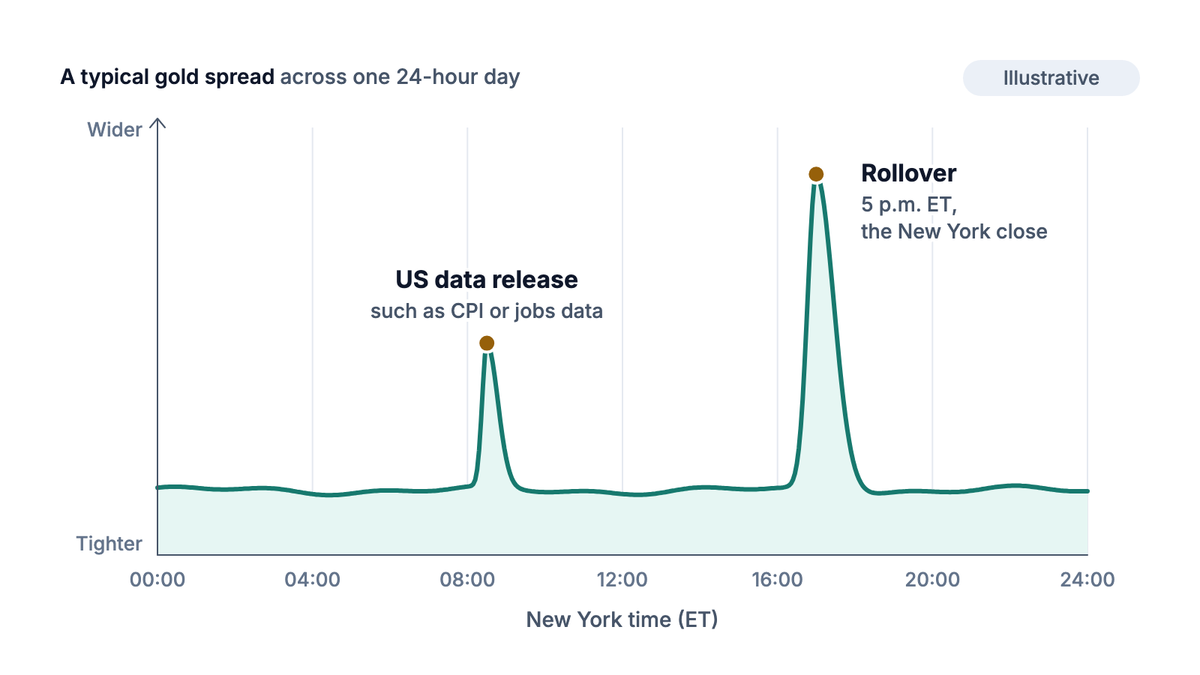
The lesson on how to check a broker before you deposit shows how to record the live spread yourself at the hours you trade. That record beats any figure on a marketing page.
The swap is a charge or credit applied to any position still open at the daily rollover. On gold, holding a buy position usually costs money, because the position is financed like a loan in US dollars. The spec sheet shows two numbers, swap long for buys and swap short for sells.
Check the swap type line too. In MetaTrader 5, swaps can be set in points, in money or as an annual interest rate. The same number means different things under each type.
Say the sheet shows swap long of -45.00 in points. On a two-decimal quote with a 100-ounce lot, each point is $1.00 per lot per night. So 0.10 lots costs 45 × $1.00 × 0.10 = $4.50 per night.
| Held over | Nights charged | Swap on 0.10 lots |
|---|---|---|
| One ordinary night | 1 | -$4.50 |
| The triple-swap night | 3 | -$13.50 |
| Monday to Friday close | 6 | -$27.00 |
Look at the last row. Holding 0.10 lots for one trading week costs $27 in swap, more than the entire $24 risk budget. For anyone holding gold for days, swap matters more than spread.
Some sheets state swap as an annual percentage of the position value. At $4,300, 0.10 lots is worth $43,000. An illustrative -5% a year, divided over a 360-day year, costs about $5.97 per night. Because it scales with price, this cost rises as gold gets more expensive.
Swap-free accounts
Some brokers offer swap-free accounts. They often replace swap with a fixed fee or a wider spread after a set number of days. Read the replacement terms before assuming holding is free. The lesson on account types covers the catch.
The margin line says how much deposit a position needs. It may be written as leverage (1:500), as a percentage (0.2%) or as a fixed amount per lot. Gold often has its own leverage limit, lower than the account's headline figure. Leverage is the ratio between position value and the deposit, called margin, that holds it open.
| Leverage on gold | Margin rate | Margin for 0.10 lots at $4,300 | Share of $2,400 |
|---|---|---|---|
| 1:500 | 0.2% | $86.00 | 3.6% |
| 1:200 | 0.5% | $215.00 | 9.0% |
| 1:100 | 1% | $430.00 | 17.9% |
Lower leverage does not make a trade riskier or safer on its own. It changes how much margin sits locked up, and so how much room you have before a margin call. The lesson on leverage and margin explains the stop out level, the other margin line on the sheet.
Try it now
Enter gold's price, your lot size and the leverage from your spec sheet to see the margin a trade locks up. Use the Pip Calculator to turn a spread or swap in points into dollars.
A fair comparison uses one trade size and one holding period, then adds every cost. Here are two illustrative accounts, both with the same -45 point swap long.
| 0.10 lots, buy | Account A | Account B |
|---|---|---|
| Spread | $3.00 | $1.20 |
| Commission | $0.00 | $0.70 |
| Closed the same day | $3.00 | $1.90 |
| Held Monday to Friday close (6 nights swap) | $30.00 | $28.90 |
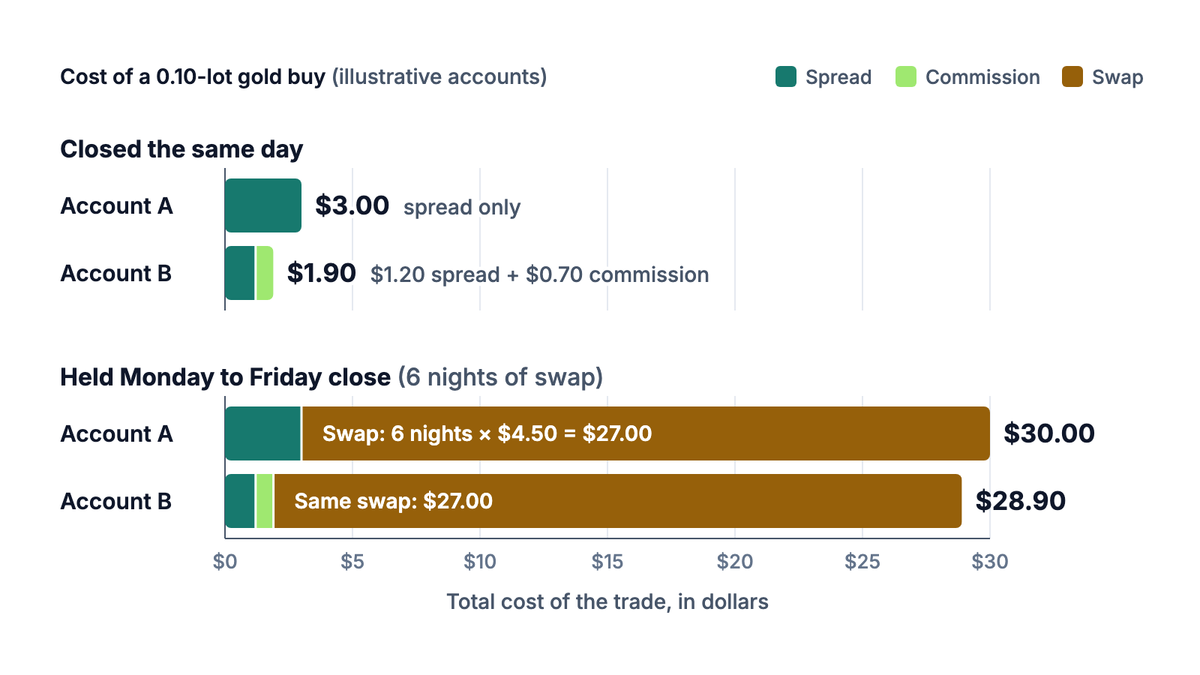
The lesson is simple. Match the comparison to how you trade. A day trader should weigh spread and commission. A swing trader should weigh swap first. The full cost breakdown is in the lesson on what a trade really costs.
Once you know your costs, the next question is size. The guide on sizing a position to the risk you can afford picks up from here.
Usually, but not always. Most XAU/USD CFD specifications use 100 troy ounces per lot, while some account types use a different size. Read the contract size line on your own platform before you calculate anything.
Both conventions exist. PipsMorrow and many platforms count the $0.01 step, while some educators call $0.10 a pip. Convert any pip or point figure to dollars of price first, and the confusion disappears.
A gold CFD buy is financed like a US dollar loan, so the holder pays interest each night. Sell positions can receive a credit or pay a smaller charge. The exact figures change with interest rates, so check the sheet regularly.
There is no fixed number, because gold spreads move with price, liquidity and news. Compare the live spread at the hours you actually trade, and set it against your risk per trade. A spread that eats a large share of your stop is too wide for that strategy.
The PipsMorrow Team
A team of writers covering XAU/USD gold trading education. We focus on explaining the mechanics and risk management in a structured way, with no trade signals and no promotion of any specific broker.
Last updated
What is spread in forex? Learn how to read bid and ask, calculate the spread in dollars, judge a good spread, and add commission and swap to the total.
10 min read
Read more →XAUUSD pip value explained: what one pip on gold is worth at 0.01, 0.10 and 1.00 lots, and why brokers disagree on what a gold pip even is.
9 min read
Read more →How to add XAUUSD to MT5 through Market Watch, read its specification, and decode suffixes like XAUUSD.m so you pick the right gold symbol.
7 min read
Read more →Build on this article with the full gold trading curriculum, ordered from the basics to advanced topics, free.

