
Brokers
Gold Contract Specifications: 7 Lines That Set Your Costs
Gold contract specifications, line by line: contract size, digits, spread, swap, margin and hours, with each one turned into dollars per trade.
9 min read
Read more →
What is spread in forex? Learn how to read bid and ask, calculate the spread in dollars, judge a good spread, and add commission and swap to the total.
What is spread in forex? It is the gap between the price you can buy at and the price you can sell at. That gap is the first cost of every trade you place, and you pay it the moment you open a position.
This guide shows how to read the two prices, how to calculate the spread in pips and dollars, and what counts as a good spread. It then adds commission and swap, so you can see the full cost of a trade before you place it.
Every forex quote has two prices. The bid is what you receive if you sell. The ask is what you pay if you buy. The ask is always a little higher than the bid, and the difference is the spread.
Think of a currency exchange booth at an airport. It buys euros from you at one rate and sells them to you at a higher one. The booth keeps the difference. In forex, that difference is quoted in pips (a pip is the standard price step, 0.0001 on most pairs and 0.01 on yen pairs).
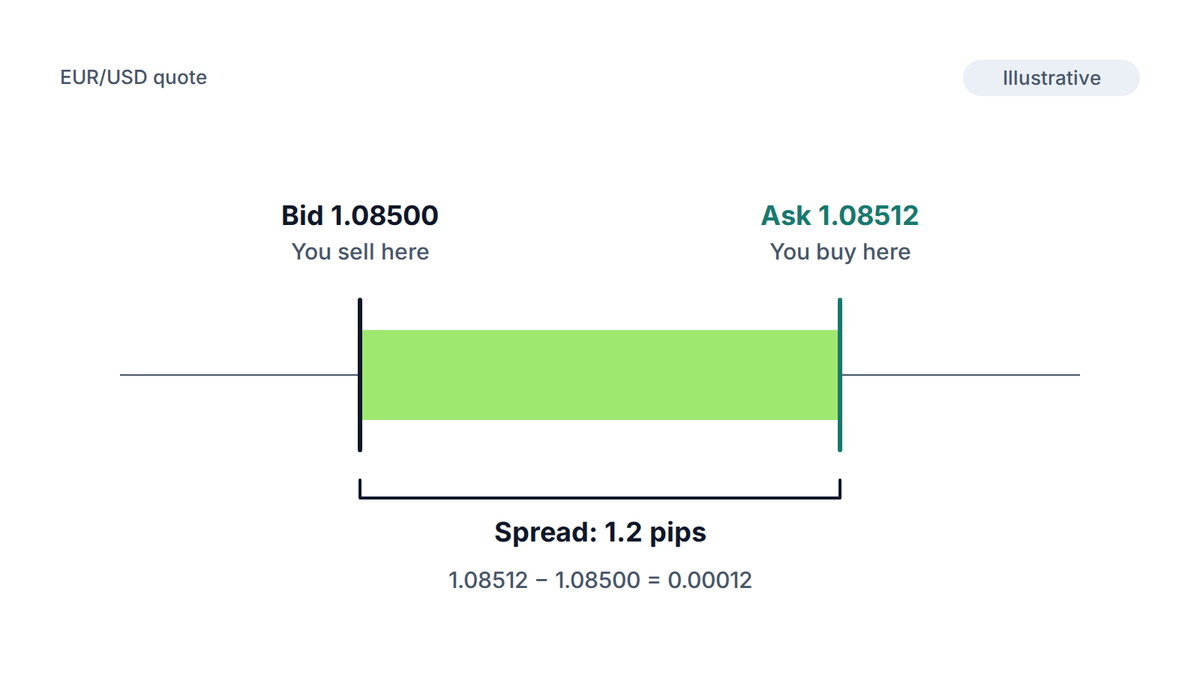
This is also why a trade starts slightly negative. If you buy at 1.08512, the price you could sell at right now is 1.08500. The market has to rise by the spread before you reach break-even. The guide to pips in forex covers the unit in more detail.
Your broker sets the quote you see, based on prices from its liquidity providers (the banks and dealers that supply prices) plus any markup it adds. The spread is not a fee line on a statement. It is built into the price, which is why many beginners miss it.
A fixed spread stays the same whatever the market does. A variable (floating) spread moves with liquidity, so it is tight when the market is busy and wide when it is thin. Most accounts today use variable spreads, so the number on the platform changes through the day.
Calculating the spread takes two steps. First subtract the bid from the ask to get the gap in price. Then divide by the pip size to turn it into pips.
What each variable means:
With EUR/USD at 1.08500 bid and 1.08512 ask, the gap is 0.00012. Divide by 0.0001 and the spread is 1.2 pips. On USD/JPY at 147.500 bid and 147.512 ask, the gap is 0.012, and dividing by 0.01 gives the same 1.2 pips.
A spread in pips is only half the answer. To see what it costs you, multiply it by the value of a pip at your position size (the position size is measured in lots, where 1.00 lot is 100,000 units).
What each variable means:
At 0.12 lots on EUR/USD, a pip is worth $1.20. A 1.2-pip spread therefore costs 1.2 × $1.20 = $1.44. At 1.00 lot the same spread costs $12, and at 0.01 lots it costs $0.12. The spread in pips did not change; only your size did.
| Lot size | Value of 1 pip | Cost of a 1.2-pip spread |
|---|---|---|
| 1.00 | $10.00 | $12.00 |
| 0.12 | $1.20 | $1.44 |
| 0.10 | $1.00 | $1.20 |
| 0.01 | $0.10 | $0.12 |
Try it now
Enter the pair, your lots and the spread as the number of pips. The result is the dollar cost of the spread, so you can compare two quotes at your own size.
There is no single number that makes a spread good. A spread is good when it is small compared with the move you are trying to capture, and when it stays small at the times you trade.
Here is the test. Divide the spread by your target distance. A 1.2-pip spread on a 10-pip target takes 12% of the move before you earn anything. On a 50-pip target it takes 2.4%.
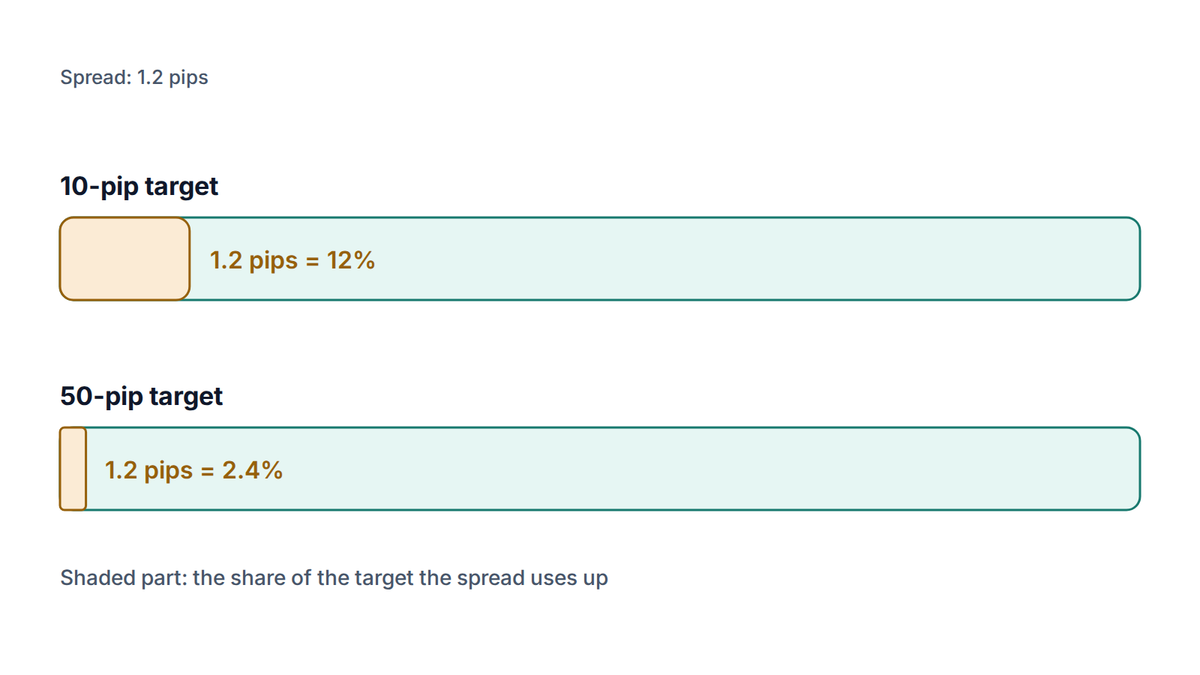
That is why short-term traders care about spread far more than people who hold for days. If you aim for small moves many times a day, the spread is paid again on every trade and becomes your largest cost.
Don't judge a spread by its headline
A broker's advertised spread is usually the best figure on the quietest, most liquid pair. Watch the live spread on your platform at the hours you actually trade, and judge it on the pair you actually trade.
The spread is one of three possible costs. The other two are commission and swap. Not every trade pays all three, so it helps to know when each one applies.
| Cost | When you pay it | How it is charged |
|---|---|---|
| Spread | Once, when you open | Built into the price, in pips |
| Commission | On accounts that charge it, per lot traded | A set dollar amount per lot, shown on your statement |
| Swap | Each night a position stays open past rollover | A debit or a credit, in dollars per lot |
Some accounts quote a very tight spread and charge a fixed commission per lot instead. Commission is usually stated per lot per side, or as a round-turn total for opening and closing. Check which one your broker means before comparing.
Swap (also called rollover) is the interest difference between the two currencies in a pair. It is applied if you keep a position open past the daily cutoff, around 5 p.m. New York time. Depending on the pair, the direction and the interest rates, it can cost you or pay you.
Swap is charged three times on Wednesday night, because that rollover covers the weekend as well. A trade closed before the cutoff pays no swap at all. The carry trade guide explains why rate differences matter.
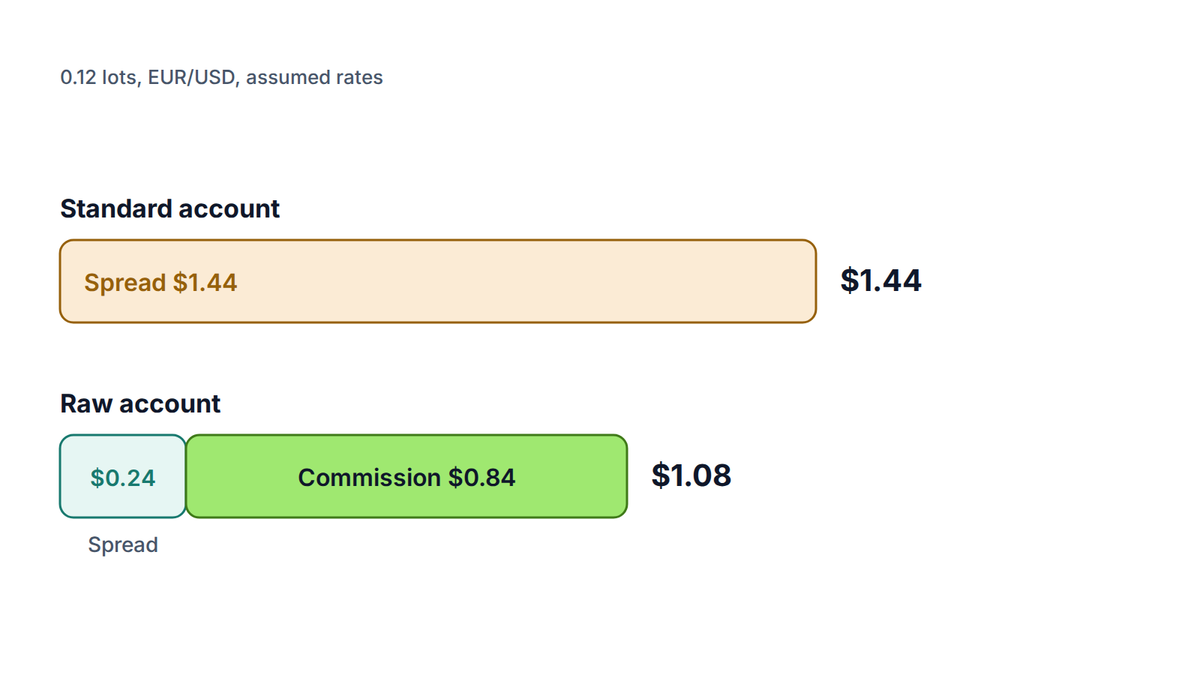
Let us compare two assumed accounts on EUR/USD at 0.12 lots, where a pip is $1.20. The commission and swap figures below are made up for the example. Your broker's numbers will differ, so replace them with the ones on your own platform.
On the standard account, the entry cost is 1.2 × $1.20 = $1.44. On the raw account, the spread costs 0.2 × $1.20 = $0.24, and the commission is $7 × 0.12 = $0.84. That makes $1.08 in total. At this size the raw account is cheaper by $0.36 per trade.
Now add swap. Suppose you buy on Monday and hold until Friday, and the long swap is an assumed −$6.50 per lot per night. At 0.12 lots that is $0.78 a night. You pay on Monday, Tuesday and Thursday nights and triple on Wednesday, which is six charges in all: 6 × $0.78 = $4.68.
| Cost | Standard account | Raw account |
|---|---|---|
| Spread | $1.44 | $0.24 |
| Commission | $0.00 | $0.84 |
| Swap (held Monday to Friday) | $4.68 | $4.68 |
| Total | $6.12 | $5.52 |
Notice how the holding period changes the picture. For a day trade, the spread and commission are the whole bill. For a trade held all week, swap is the biggest line, and the choice of account matters much less.
Compare accounts at your own size
Which account is cheaper depends on lot size and how often you trade. Run the comparison with your typical lots, using the figures on your platform, instead of picking on the headline spread. The lesson what a trade really costs walks through the same sum step by step.
Costs are the one part of trading you can measure before you risk a dollar. Keeping them in the plan, next to your position size, is a habit that pays for itself over many trades.
A good spread is one that is small compared with your target and stays small at the times you trade. A 1.2-pip spread takes 12% of a 10-pip target but only 2.4% of a 50-pip target. Check the live spread on your pair, not just the advertised figure.
Subtract the bid from the ask and divide by the pip size. With EUR/USD at 1.08500 and 1.08512, that is 0.00012 ÷ 0.0001 = 1.2 pips. Multiply by the pip value at your lot size to get dollars: 1.2 × $1.20 = $1.44 at 0.12 lots.
The spread is paid once, in effect. You open at the ask on a buy and close at the bid, so the gap is already in the price when you open. Commission, if your account charges it, may be quoted per side or per round turn.
Spreads widen when fewer participants are quoting prices or when the market becomes uncertain. That happens at the daily rollover, in thin overnight hours and around major news releases, when a pair can move quickly.
No. An account that advertises zero or near-zero spread normally charges commission or has conditions attached. Always add every charge up as a dollar total for your lot size before you compare.
The PipsMorrow Team
A team of writers covering XAU/USD gold trading education. We focus on explaining the mechanics and risk management in a structured way, with no trade signals and no promotion of any specific broker.
Last updated
Gold contract specifications, line by line: contract size, digits, spread, swap, margin and hours, with each one turned into dollars per trade.
9 min read
Read more →Pips in forex explained: what a pip is, how to count them on any pair including yen pairs, and how to work out what one pip is worth in dollars.
7 min read
Read more →Gold as a store of value, honestly: why it kept purchasing power over decades, when it lost real value for years, and what that means on an XAU/USD chart.
9 min read
Read more →Build on this article with the full gold trading curriculum, ordered from the basics to advanced topics, free.

