
Gold
Gold Market Open Time: XAU/USD Trading Hours
Gold market open time in New York time and UTC: when XAU/USD opens on Sunday, the daily break, the weekly close and the busiest hours of the week.
10 min read
Read more →
Forex session times for Sydney, Tokyo, London and New York in New York time and UTC, with the daylight-saving shifts and the hours that actually move.
Forex session times decide when the market is busy, when it is quiet and when your trade costs more than it should. The currency market never has an opening bell. Instead, four financial centers (Sydney, Tokyo, London and New York) take turns carrying most of the activity.
This guide gives each session in New York time and UTC (Coordinated Universal Time, the world's reference clock), shows how daylight saving moves the hours, and points out the windows that tend to move price. For the wider picture, see the lesson on sessions, liquidity and the clock.
Yes, with a weekend break. Forex is a decentralized market (there is no central exchange), so it trades wherever a bank or broker is quoting prices. As one center closes, the next is opening, which keeps prices moving around the clock from Monday morning in Sydney to Friday afternoon in New York.
Most brokers follow the same weekly cycle. Check your own broker's trading hours, because instruments and holidays differ.
That daily roll is when swap (the overnight interest charge or credit on an open position) is applied. The lesson on what a trade really costs explains both costs in detail.
Check your platform clock
Your trading platform shows the broker's server time, which is often neither UTC nor your local time. Many servers follow New York's schedule with a fixed offset, but this varies by broker. Find the offset once, and write it next to the table below.
Each session is commonly defined as the 9-hour local business day of its financial center. These are conventions, not official exchange hours. Banks keep quoting outside them, and the sessions blend into one another.
| Session | Local hours | US summer (EDT): New York time | US summer: UTC | US winter (EST): New York time | US winter: UTC |
|---|---|---|---|---|---|
| Sydney | 8:00 a.m. to 5:00 p.m. | 18:00 to 03:00 | 22:00 to 07:00 | 16:00 to 01:00 | 21:00 to 06:00 |
| Tokyo | 9:00 a.m. to 6:00 p.m. | 20:00 to 05:00 | 00:00 to 09:00 | 19:00 to 04:00 | 00:00 to 09:00 |
| London | 8:00 a.m. to 5:00 p.m. | 03:00 to 12:00 | 07:00 to 16:00 | 03:00 to 12:00 | 08:00 to 17:00 |
| New York | 8:00 a.m. to 5:00 p.m. | 08:00 to 17:00 | 12:00 to 21:00 | 08:00 to 17:00 | 13:00 to 22:00 |
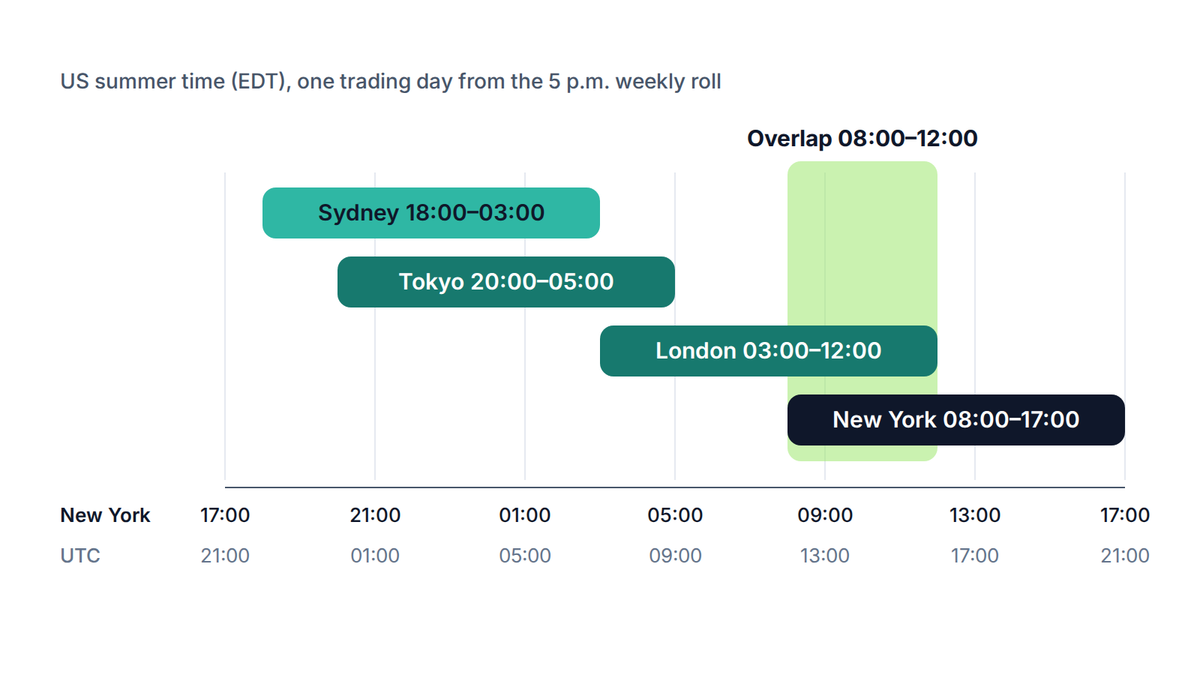
Each center keeps its business day on its own clock. When that clock changes, the session moves against UTC. New York time (also called Eastern Time) stays 8:00 a.m. to 5:00 p.m. year-round, so the London open stays at 3:00 a.m. New York time as long as both sides have changed their clocks.
The trouble is that they do not change together. In 2026, the dates fall like this:
| Place | Clocks go forward | Clocks go back |
|---|---|---|
| United States | 8 Mar 2026 | 1 Nov 2026 |
| United Kingdom | 29 Mar 2026 | 25 Oct 2026 |
| Sydney, Australia | 4 Oct 2026 | 5 Apr 2026 |
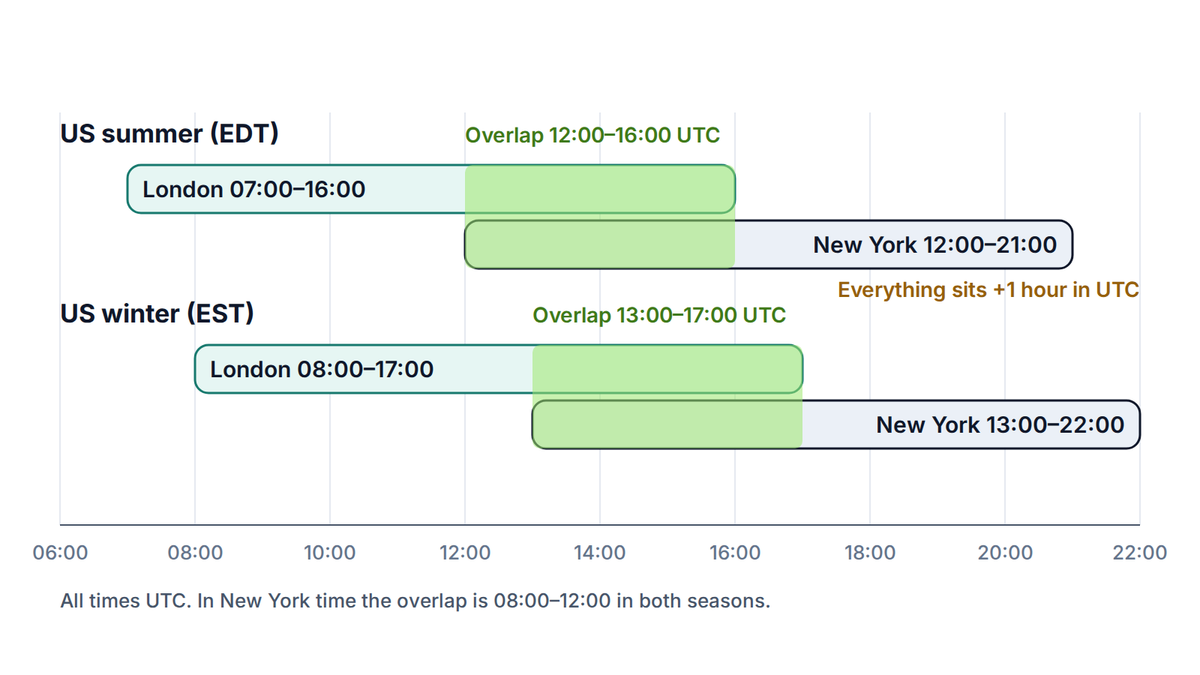
Between 25 Oct and 1 Nov 2026, London is back on winter time while New York is still on summer time. London then opens at 08:00 UTC, which is 4:00 a.m. New York time instead of 3:00 a.m. It also closes at 17:00 UTC, or 1:00 p.m. New York time. The same gap appears between 8 Mar and 29 Mar.
In those weeks the London and New York overlap runs 8:00 a.m. to 1:00 p.m. New York time (12:00 to 17:00 UTC). That is five hours instead of the usual four. The exact hour matters less than knowing the gap exists, so check the date before you assume a table is right.
A simple rule
Keep your session map in New York time, because the New York session and the 5 p.m. daily roll never move on that clock. Convert to your own time zone once for summer and once for winter, and re-check the few weeks a year when the UK, the US and Australia disagree.
London opens at 8:00 a.m. local time. That is 07:00 UTC in British summer time and 08:00 UTC in winter, which is 3:00 a.m. New York time for most of the year. It is the biggest forex trading center, and the United Kingdom has led the global rankings in the Bank for International Settlements (BIS) survey of currency trading for years.
The first hours of London often matter because Asia has spent the night building a narrow range, and Europe's banks arrive with fresh orders. Breaks of that range are common, though not reliable. A break in the first hour can reverse by lunchtime.
Typical London-hours activity centers on the euro, the pound and the Swiss franc, but because so much trading happens, nearly every pair has its tightest spreads then.
The New York session runs 8:00 a.m. to 5:00 p.m. New York time. Most major US data lands at 8:30 a.m. New York time, which is 12:30 UTC in summer and 13:30 UTC in winter. The Forex Factory guide shows how to read those times off a calendar.
From 8:00 a.m. to 12:00 p.m. New York time, London and New York are both open. This overlap is typically the most liquid stretch of the day, so spreads are tight and moves can be large. The US dollar pairs, such as EUR/USD, GBP/USD and USD/CAD, see the most flow.
After London closes at 12:00 p.m. New York time, volume tends to thin out. The New York afternoon is usually slower, and spreads creep wider towards the 5 p.m. roll.
| Window (New York time) | UTC in US summer | What you tend to see |
|---|---|---|
| 17:00 to 20:00 | 21:00 to 00:00 | Weekly open, thin trading, wide spreads |
| 20:00 to 03:00 | 00:00 to 07:00 | Asia: narrow ranges in most pairs |
| 03:00 to 08:00 | 07:00 to 12:00 | London: volume and spread improve |
| 08:00 to 12:00 | 12:00 to 16:00 | Overlap: the busiest, tightest window |
| 12:00 to 17:00 | 16:00 to 21:00 | New York afternoon: fading, spreads widen |
The Asian session covers Sydney and Tokyo. Tokyo runs 9:00 a.m. to 6:00 p.m. local time, which is 00:00 to 09:00 UTC all year, or 20:00 to 05:00 New York time in US summer and 19:00 to 04:00 in winter. Sydney opens first, and its hours move with Australia's clocks.
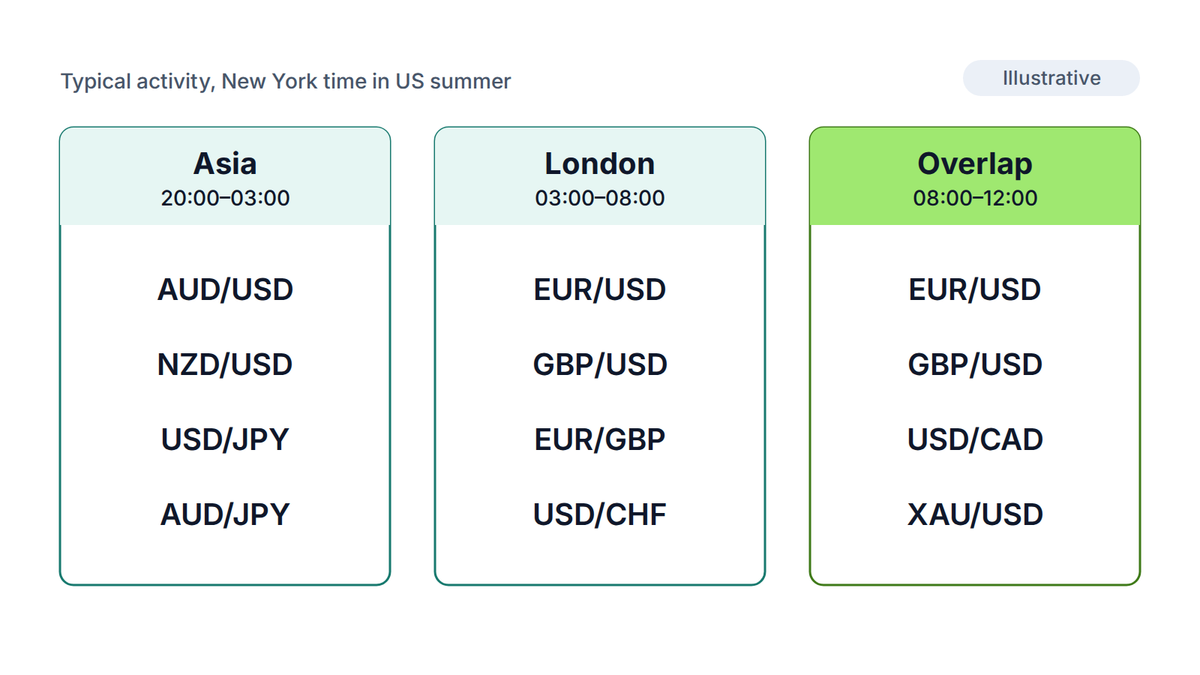
People often ask for the best forex pairs to trade during the Asian session. There is no best, but the most active pairs are the ones whose home currency is awake: the Australian dollar, the New Zealand dollar and the Japanese yen.
Major pairs such as EUR/USD still trade in Asia, but they tend to be calmer and carry wider spreads. Quiet ranges can suit some styles and punish others. Choose by the question you are asking, not by the clock alone.
A session label only tells you who is at their desk. Three other things decide whether an hour is worth trading.
A US jobs report at 8:30 a.m. New York time can move the dollar in seconds, whatever the session. Look at the week's calendar before you plan, as covered in the lesson on trading around the economic calendar. Gold behaves the same way, as the piece on what gold usually does before NFP shows.
The same trade can cost twice as much in a quiet hour. The figures below are illustrative, using one standard lot of EUR/USD (100,000 units), where one pip (the fourth decimal place in most pairs) is worth about $10. Use the pip calculator for your own pair.
| Window | Example spread | Cost on one standard lot |
|---|---|---|
| Overlap | 1.2 pips | $12 |
| Quiet hours | 2.5 pips | $25 |
Right after the weekly open and around the 5 p.m. roll, few banks quote tightly. Prices can jump past a stop loss and fill further away. If your plan depends on tight fills, avoid those minutes.
A session is not a signal
Knowing that the overlap is busy does not tell you which way price will go. Session times describe when activity is likely, so they help with timing and costs. They are not a reason to buy or sell.
Forex trades 24 hours a day from Sunday 5 p.m. to Friday 5 p.m. New York time, so it is closed on weekends. Activity is uneven within the day, and some brokers pause trading briefly around the 5 p.m. roll.
London opens at 8:00 a.m. local time: 07:00 UTC in summer and 08:00 UTC in winter. That is 3:00 a.m. New York time, except in the weeks when the UK and US clocks are out of step, when it is 4:00 a.m.
There is no best pair. The most active ones are AUD/USD, NZD/USD, USD/JPY and the yen crosses, because those currencies' home markets are open. Check the spread before you trade, since it is often wider than in London.
Convert the weekly open and close, Sunday and Friday at 5 p.m. New York time, to your own clock for both summer and winter. Then add the session windows from the table. Remember that your own clocks, and New York's, may change on different dates.
Much less. If you hold trades for days or weeks, the hour you enter matters mainly for cost and slippage. Session timing matters most to short-term traders, who are more exposed to spreads and to quiet, choppy periods.
The PipsMorrow Team
A team of writers covering XAU/USD gold trading education. We focus on explaining the mechanics and risk management in a structured way, with no trade signals and no promotion of any specific broker.
Last updated
Gold market open time in New York time and UTC: when XAU/USD opens on Sunday, the daily break, the weekly close and the busiest hours of the week.
10 min read
Read more →Set up the Forex Factory calendar for gold: your local time zone, the filters that matter, and why a green USD number often means gold falls.
11 min read
Read more →What is CPI in forex? Learn what the number measures, why the surprise moves the dollar and gold, when it lands in UTC, and how to size a trade around it.
9 min read
Read more →Build on this article with the full gold trading curriculum, ordered from the basics to advanced topics, free.

