
Fundamentals
FOMC and Gold: Why the Rate Decision Is Rarely the News
FOMC and gold explained: why the rate decision is rarely the news, when it lands in New York time and UTC, and how to size a gold trade around it.
12 min read
Read more →
Gold before NFP: the range squeeze, wider spreads and stop runs traders describe, what the research supports, and how to manage risk into the release.
Ask what gold does before NFP and you'll hear confident answers: it drifts up, it drifts down, it always fakes one way first. None of those has solid evidence behind it. What does repeat is how the market behaves, not which way it goes.
This article looks at gold before NFP honestly. It covers the three tendencies traders describe most, what published research supports, and where the evidence stops. It then turns that into a risk plan, with calculator numbers, for the hours around the release.
The employment report itself is covered in the lesson on Employment Data and NFP. Here the focus is narrower: gold, the build-up, and your position.
Non-Farm Payrolls (NFP) is the headline number in the US Employment Situation report from the Bureau of Labor Statistics (BLS). It usually comes out on the first Friday of the month at 8:30 a.m. New York time (ET). The unemployment rate, wages and revisions arrive in the same release.
The US shifts its clocks for daylight saving time, so the release moves against UTC. It lands at 12:30 UTC while the US is on daylight saving time, and 13:30 UTC when it isn't. In 2026, US daylight saving began on 8 Mar and ends on 1 Nov.
| Period | New York time (ET) | UTC |
|---|---|---|
| US daylight saving (EDT), 8 Mar to 1 Nov 2026 | 8:30 a.m. | 12:30 |
| US standard time (EST), rest of the year | 8:30 a.m. | 13:30 |
| Next release: September 2026 data, Fri 2 Oct 2026 | 8:30 a.m. EDT | 12:30 |
What that means on your clock depends on where you live. The 2 Oct release lands at 13:30 in London, 20:30 in Singapore and 22:30 in Sydney. A December release lands at 13:30 in London, 21:30 in Singapore and 00:30 on Saturday in Sydney.
The first Friday is a habit, not a law. The BLS schedule sometimes moves a release, and in late 2025 a US government shutdown pushed the September 2025 report from 3 Oct to 20 Nov. Check the date each month rather than assuming it.
Search for gold and NFP and three descriptions come up again and again. Each has a plausible mechanism. That makes them worth understanding, even though none is a trading rule.
In the hours before the release, gold often seems to trade in a narrower range than usual. The story is that large participants reduce risk and wait, so fewer orders push price around. Traders then draw the pre-release high and low and watch for a break.
The spread, the gap between the buy and sell price, often widens in the minutes around the release. Liquidity providers pull or widen their quotes when they expect a jump. This one is less a pattern than a mechanical feature of how quotes work around big news.
Traders also describe a quick spike through the pre-release range, then a reversal. Stops cluster just beyond obvious highs and lows, so a burst of orders can trigger them in a thin market. After the release, the headline and the wage figure can also point in different directions.
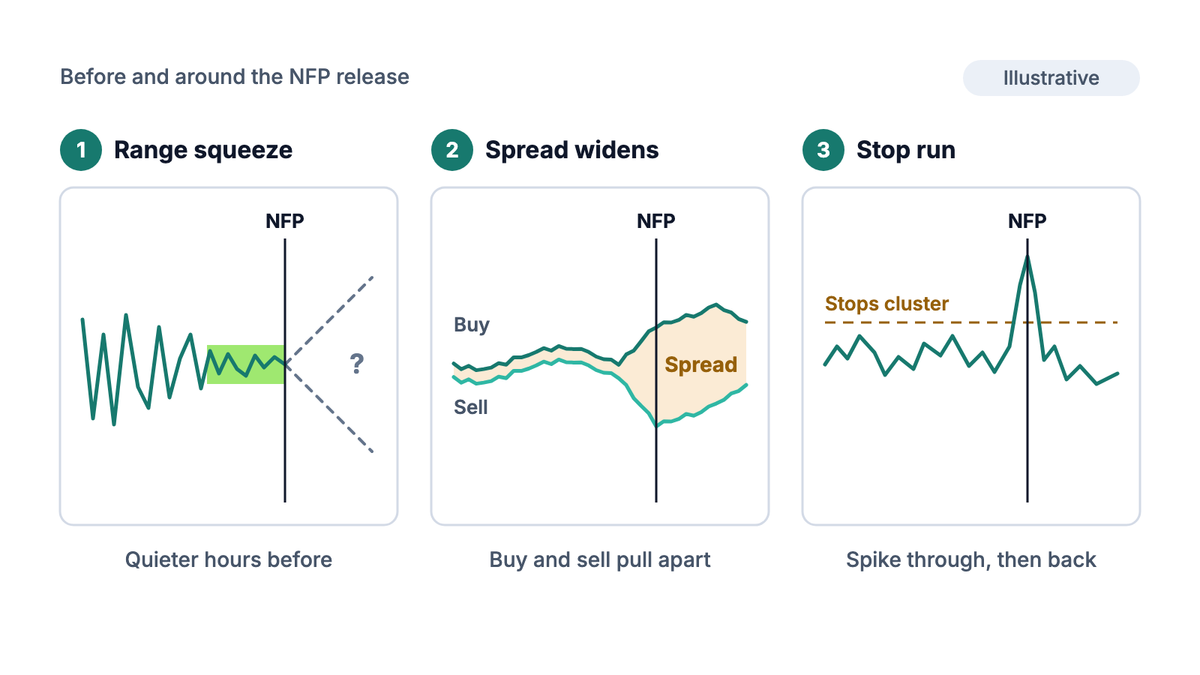
Notice what's missing from the list: a direction. The tendencies worth taking seriously are about liquidity and cost, not about whether gold goes up or down.
Some parts of the NFP story are well supported. Others rest on blog posts and memory. It helps to keep them apart.
A 2012 study in the Journal of Banking and Finance by Elder, Miao and Ramchander studied intraday gold, silver and copper futures from 2002 to 2008. The authors found metal futures responded swiftly and significantly to US news surprises. Non-farm payrolls and durable goods orders had the largest impact among the 8:30 a.m. releases.
They also found that news of an unexpectedly stronger economy tended to push gold down. Earlier work by Christie-David, Chaudhry and Koch appeared in the Journal of Economics and Business in 2000. It also found gold responding to US releases such as the unemployment rate and CPI.
The range squeeze has a cousin in the research. A 2003 study by Antulio Bomfim found unusually low stock market volatility before FOMC announcements, which he called a calm before the storm. That was measured on US stocks around Fed decisions, not on gold around NFP. It supports the mechanism, not the gold-specific claim.
We could not find peer-reviewed evidence of a consistent upward or downward drift in gold in the hours before NFP. Claims of that kind usually come from vendors or forum posts, without data you can check.
| Claim | Status | Basis |
|---|---|---|
| Gold reacts sharply to the NFP surprise | Supported | Intraday studies of gold futures |
| Stronger-than-expected US data tends to weigh on gold | Supported as a tendency | Elder, Miao and Ramchander, 2002 to 2008 data |
| Volatility is lower just before scheduled announcements | Plausible | Found for US stocks before FOMC, not tested here for gold before NFP |
| Spreads widen around the release | Mechanical | How quotes behave when a jump is expected |
| Gold drifts in a set direction before NFP | Not supported | No verifiable evidence found |
Why a small sample misleads
NFP happens about 12 times a year. Ten years gives you roughly 120 releases, spread across very different rate cycles. A pattern that shows up in 70 of them can still be luck, and it can vanish when the Fed's stance changes.
The fair summary: gold's reaction to NFP is real and well studied, but a tradeable pre-NFP direction is not.
Suppose the range squeeze shows up on a given Friday. Trading it still runs into three problems.
Gold trades as XAU/USD, usually as a CFD (a contract for difference that tracks the price without delivering metal). One standard lot is 100 troy ounces, with 1 troy ounce equal to 31.1035 g. On this site's convention, one pip is $0.01, so one pip on one lot is $1.00.
Take a $2,400 account risking 1%, or $24. A trader who uses a $4.00 stop, 400 pips, gets 0.06 lot from the lot size calculator. That stop might suit the quiet range an hour or two before the release.
Now suppose the release gaps price, and the stop fills $20.00 from entry. That is 2,000 pips on 0.06 lot. The pip calculator puts the loss at $120, or 5% of the account. The lot size didn't change; the fill did.
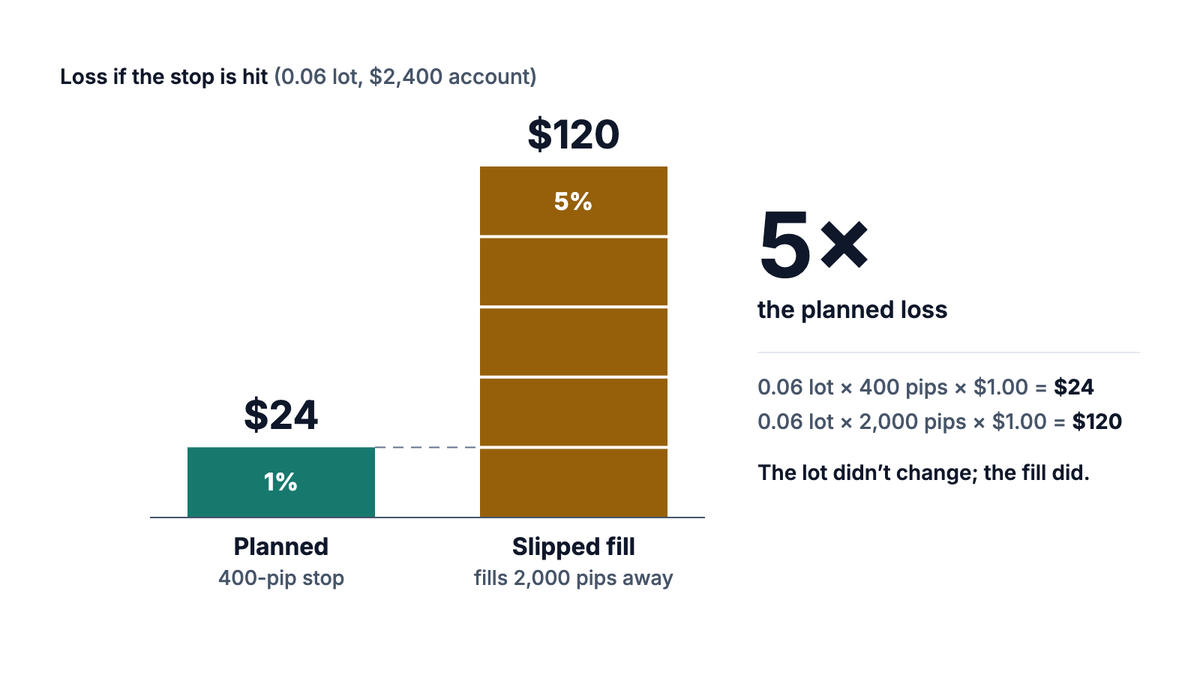
That's the core problem with trading the build-up. Whatever edge the quiet hours offer, the release itself can take back several times over.
If you want to know whether the squeeze shows up on your broker's gold feed, check it rather than trusting anyone's claim. The lesson on backtesting without fooling yourself covers the traps. A simple version looks like this:
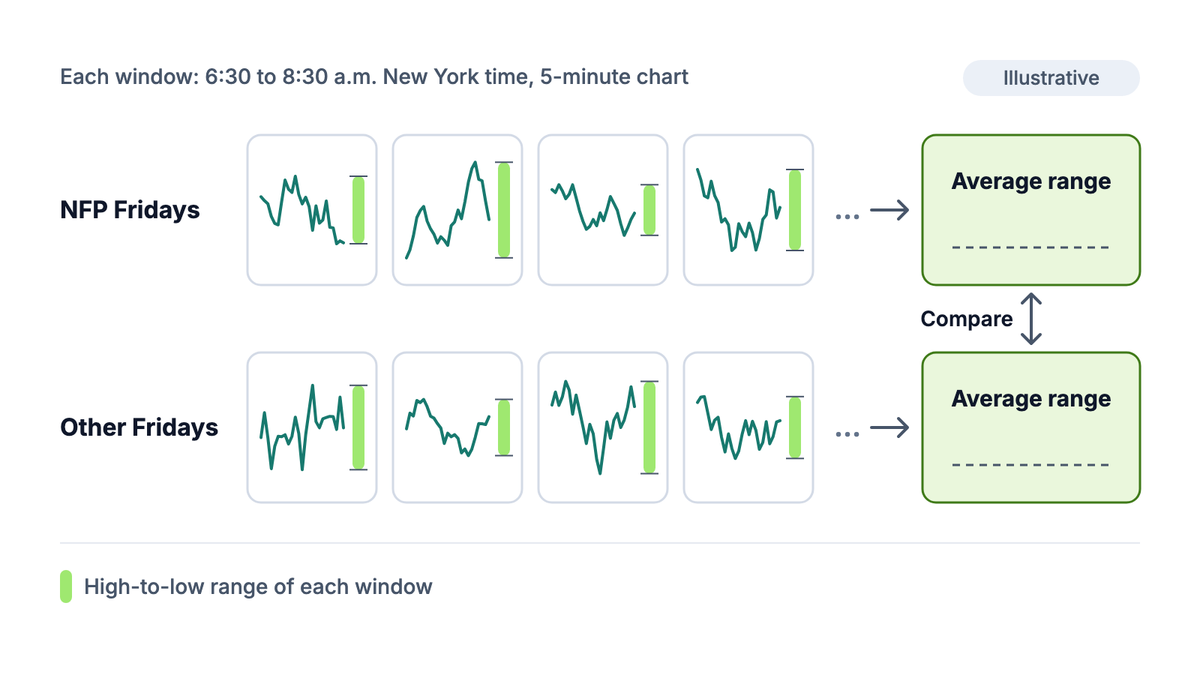
Keep the conclusion modest. A narrower range on NFP Fridays tells you something about liquidity. It doesn't tell you which way gold will break, and it doesn't make the release safer to hold through. A pattern you've measured yourself is worth more than one you've read about, and it's still not a forecast.
The lesson on Economic Events That Move Gold explains how gold tends to read strong or weak payrolls. For the build-up itself, your choices come down to four.
| Choice | What it looks like | Main risk left |
|---|---|---|
| Flat | No gold position from before the release until spreads settle | Missing a move, which costs nothing |
| Reduced size | Existing trade cut to a size that fits a wide stop | A smaller but still real slipped fill |
| Hold with a news stop | Stop placed beyond the likely spike, lot recalculated | Slippage beyond even the wide stop |
| Pending orders at the range edges | Buy stop above, sell stop below | Both filled in a whipsaw, at poor prices |
If you hold, size for the stop you'd really need. On the same $2,400 account at 1%, a stop of 2,400 pips ($24.00) gives 0.01 lot, the smallest size most platforms allow. At 0.5% risk the calculator shows even 0.01 lot is too large for that stop.
Try it now
Enter your balance, your risk and the stop you'd need to survive the first minutes after NFP. If the result is below 0.01 lot, the position doesn't fit your account at that risk.
Risk warning
Leverage, controlling a large position with a small deposit, magnifies NFP moves in both directions. A slipped stop can also push your margin, the deposit set aside to hold the trade, toward a stop out. Trading CFDs can lose you more than you planned.
Set the plan before release day. The routine in Trading Around the Economic Calendar applies directly: decide flat, reduced or held before the release, and don't make that call in the last five minutes.
There is no reliable direction. Research supports a fast reaction to the NFP surprise, but we found no verifiable evidence of a consistent drift before the release. Any claim that gold usually rises or falls beforehand deserves skepticism.
NFP is released at 8:30 a.m. New York time (ET). That is 12:30 UTC while the US is on daylight saving time, roughly March to early November, and 13:30 UTC the rest of the year. Convert from UTC to your own time zone, and watch for your own clock changes too.
Liquidity providers expect a jump, so they widen or pull quotes to protect themselves. Fewer prices stand in the market, and the gap between buy and sell grows until the release has been absorbed.
That depends on your plan, but closing or reducing is a common and reasonable choice. If you hold, recalculate the lot size for a stop wide enough to survive the first spike, and accept that it can still slip.
The PipsMorrow Team
A team of writers covering XAU/USD gold trading education. We focus on explaining the mechanics and risk management in a structured way, with no trade signals and no promotion of any specific broker.
Last updated
FOMC and gold explained: why the rate decision is rarely the news, when it lands in New York time and UTC, and how to size a gold trade around it.
12 min read
Read more →Set up the Forex Factory calendar for gold: your local time zone, the filters that matter, and why a green USD number often means gold falls.
11 min read
Read more →Gold contract specifications, line by line: contract size, digits, spread, swap, margin and hours, with each one turned into dollars per trade.
9 min read
Read more →Build on this article with the full gold trading curriculum, ordered from the basics to advanced topics, free.

