
News
Gold Before NFP: Patterns Traders Cite and What Holds Up
Gold before NFP: the range squeeze, wider spreads and stop runs traders describe, what the research supports, and how to manage risk into the release.
10 min read
Read more →
FOMC and gold explained: why the rate decision is rarely the news, when it lands in New York time and UTC, and how to size a gold trade around it.
Most traders think gold jumps on FOMC day because the Fed changes interest rates. Usually it doesn't. The rate decision is almost always known in advance, so the move comes from everything around it: the wording, the projections and the press conference.
That's the real link between FOMC and gold. Gold reacts to the gap between what markets expected and what the Federal Reserve signals, and that gap can open twice in thirty minutes. Depending on where you live, that gap opens in your afternoon, your evening or the middle of your night.
This article explains the mechanism and gives the exact times in New York time and UTC, with examples from a few cities. It also shows, with calculator numbers, what a rate decision can do to a normal-sized position. It goes deeper on the gold side of topics the course covers in Economic Events That Move Gold.
The Federal Open Market Committee (FOMC) is the Fed body that sets US policy rates. It holds eight scheduled meetings a year, each running over two days. The decision comes on the afternoon of day two.
According to the Federal Reserve's published calendar, the policy statement is released at 2:00 p.m. US Eastern time. The Chair's press conference starts at 2:30 p.m. New York moves its clocks for daylight saving time, so the UTC time of the release shifts by an hour during the year.
| Release | New York time (ET) | UTC, US summer (EDT) | UTC, US winter (EST) |
|---|---|---|---|
| Statement and decision | 2:00 p.m. | 18:00 | 19:00 |
| Projections and dot plot (4 meetings a year) | 2:00 p.m. | 18:00 | 19:00 |
| Press conference | 2:30 p.m. | 18:30 | 19:30 |
| Minutes of the meeting | 2:00 p.m., three weeks later | 18:00 | 19:00 |
In 2026, US daylight saving time began on 8 Mar and ends on 1 Nov. So the 28 Oct 2026 decision lands at 18:00 UTC. The 9 Dec 2026 decision lands at 19:00 UTC, because the US will be back on standard time.
Whether that counts as a late night depends entirely on where you live. In London it is an early-evening event. In Singapore it arrives in the small hours, and in Sydney it lands in the early morning of the next day.
| 2026 decision, 2:00 p.m. ET | London | Singapore | Sydney |
|---|---|---|---|
| 17 Jun (US summer) | 19:00 | 02:00 the next day | 04:00 the next day |
| 28 Oct (US summer, UK winter) | 18:00 | 02:00 the next day | 05:00 the next day |
| 9 Dec (US winter) | 19:00 | 03:00 the next day | 06:00 the next day |
Notice the 28 Oct row. The UK has already moved its clocks back, but the US has not, so for one week the gap between London and New York is an hour shorter than usual. Clock changes in your own country can shift the release too.
The Fed's calendar marks four 2026 meetings with a Summary of Economic Projections: March, June, September and December. Those are the meetings with the dot plot, a chart of where each official expects rates to go. They tend to carry more information, so they deserve more caution.
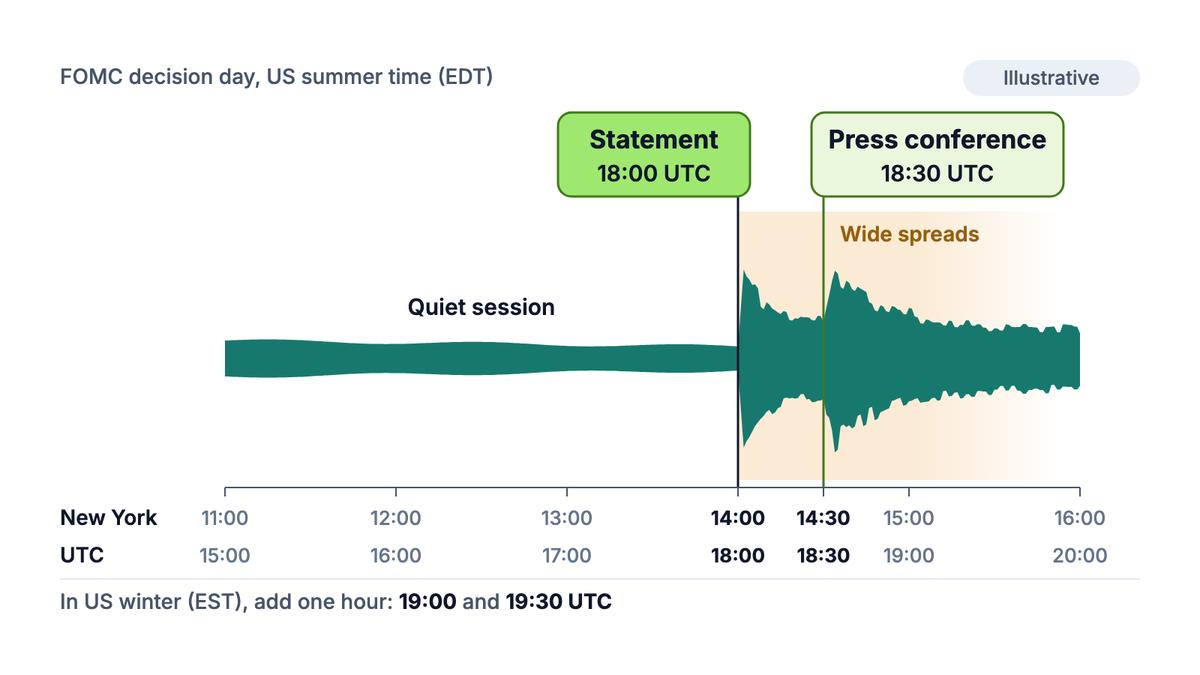
The point to keep: put every FOMC date in your calendar in your own local time, and check which side of each clock change it falls on.
Gold pays no interest. Holding it means giving up the yield you could earn on cash or a Treasury bond instead. When expected rates rise, that sacrifice grows, and gold has to compete harder for money.
The rate that matters most is the real yield, the bond yield after expected inflation. The lesson on what moves the gold price covers this chain in full. The short version runs in three links:
That double channel is why gold often reacts more sharply than a currency pair on the same day. A hawkish surprise, one that points to higher rates for longer, tends to lift real yields and the dollar together. A dovish surprise tends to do the reverse.
Tendency, not a law
These are the textbook directions, and they often fail in the hour after the release. Positioning, geopolitical news or a big move in the days before can all override them. Treat them as the reason gold is sensitive, not as a forecast.
So the takeaway is simple. Gold is sensitive to FOMC because the Fed sets the price of the alternative to holding gold.
By decision day, interest-rate futures already show what the market expects. Tools that read those futures, such as CME's FedWatch, turn them into probabilities for each rate outcome. When one outcome sits near certainty, the decision itself carries almost no new information.
The lesson on how central banks communicate walks through each document in detail. For gold, three sources of surprise matter most:
The statement is short, and most of it repeats the last one. Traders compare it line by line. A single changed phrase about inflation or the labor market can shift the expected rate path, and gold with it.
At four meetings a year, officials publish where they expect rates to be. What moves markets is the change in the median dot since the last projections. A median that shifts toward fewer cuts is hawkish, even if today's decision matched expectations.
The Chair answers questions live for about an hour. Unscripted answers about what would make the Fed cut or pause are where the lasting direction often gets set. This is also why gold can reverse its entire first move.
| What happened | Surprise for markets | Textbook gold reaction |
|---|---|---|
| Expected hold, statement unchanged | Little | Small, often noisy |
| Expected cut, but fewer cuts in the dots | Hawkish | Pressure on gold |
| Expected hold, statement drops a hawkish phrase | Dovish | Support for gold |
| Unexpected hike or cut | Large | Sharp, fast repricing |
| Hawkish statement, then a dovish press conference | Mixed | Move, then reversal |
Research on stock markets adds one more piece. A 2003 study by Antulio Bomfim in the Journal of Banking and Finance found unusually low volatility before FOMC announcements, then a rise afterward. Traders call it the calm before the storm. It was measured on US stocks, not gold, so treat it as a related finding rather than proof for XAU/USD.
The lesson for your trading is that a correct guess about the decision tells you almost nothing about how gold will move.
Many FOMC decisions produce two separate reactions. The first comes at 2:00 p.m. New York time, when algorithms read the statement and the dots. The second comes during the press conference, when people react to tone and answers.
Those two reactions don't have to agree. If the statement reads hawkish and the Chair then sounds relaxed about inflation, gold can drop and then recover all of it. A trader who entered on the first move pays twice: once in the spread, and again when the reversal hits the stop.
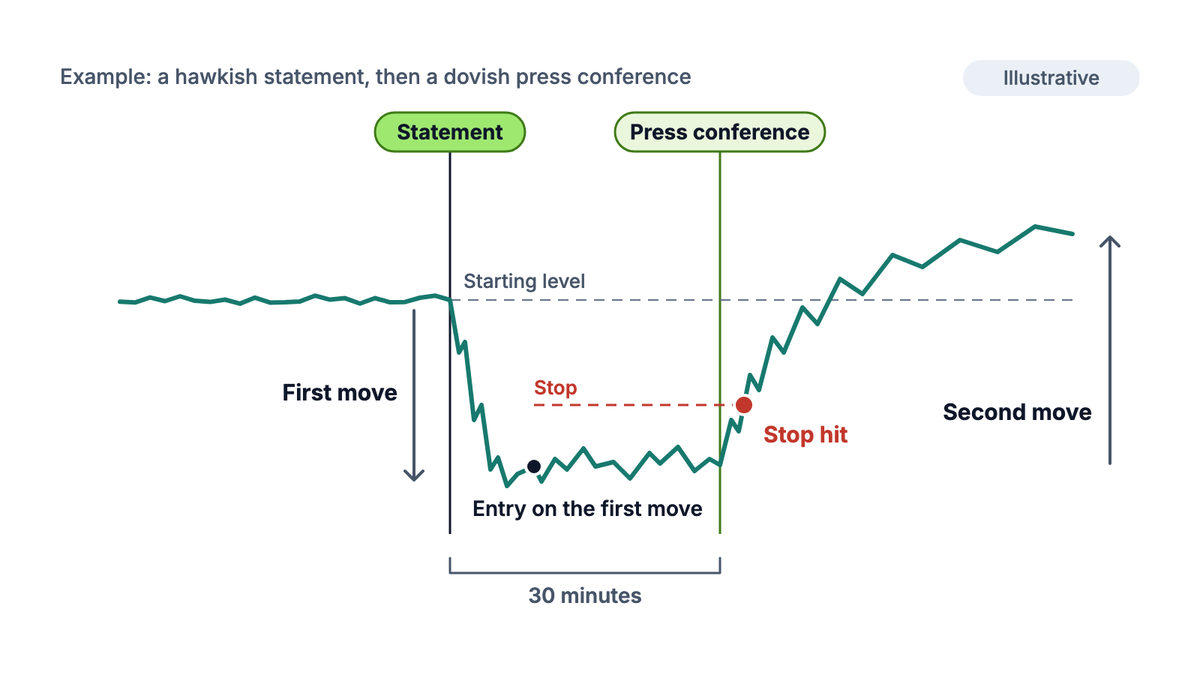
There is also a slower third phase. Over the next day or two, the market digests the projections and any follow-up comments from officials. The first spike, whatever the hour where you live, is only part of the story.
If you remember one thing from this section, remember this: the first move after an FOMC statement is not the verdict, and waiting for the press conference to finish costs you very little.
Gold trades as XAU/USD, usually as a CFD (a contract for difference that tracks the price without delivering metal). One standard lot is 100 troy ounces (31.1035 g each). On this site's convention, one pip (the smallest price step) is $0.01, so one pip on one lot is worth $1.00.
That makes the arithmetic easy and the risk easy to underestimate. On 0.10 lot, a $30 move is 3,000 pips. The profit/loss calculator puts that at $300, which is 12.5% of a $2,400 account. The move can happen in minutes.
Three things change at the release, and all of them work against you:
Say you hold 0.06 lot with a $4.00 stop, 400 pips from entry. The lot size calculator confirms that on a $2,400 account, 0.06 lot with a 400-pip stop risks $24, or 1%.
Now suppose the statement gaps price past your stop, and the fill lands $20.00 from entry instead. That is 2,000 pips on 0.06 lot, a loss of $120. Your planned 1% loss became 5%, without any change in your lot size.
| Scenario | Stop distance | Lot size | Loss if hit |
|---|---|---|---|
| Planned trade, normal fill | 400 pips ($4.00) | 0.06 | $24 (1%) |
| Same trade, fill slips to $20.00 | 2,000 pips ($20.00) | 0.06 | $120 (5%) |
| Sized for a wide news stop | 2,400 pips ($24.00) | 0.01 | $24 (1%) |
The last row is the honest alternative. A stop wide enough to survive FOMC volatility forces a much smaller position. On a $2,400 account, 0.01 lot is the minimum, and even that risks the full 1% at a $24 stop.
Try it now
Enter your balance, your risk percentage and the stop you would need on FOMC day. If the answer is below 0.01 lot, the trade doesn't fit your account.
Risk warning
Leverage, borrowing exposure so a small deposit controls a large position, magnifies FOMC moves in both directions. With high leverage, a slipped stop can take your margin level (your equity as a share of the margin in use) close to a stop out. Trading CFDs can lose you more than you planned, and sometimes your entire deposit.
The rule that follows: size FOMC exposure for the stop you'll actually get, not the stop you typed in.
The lesson on trading around the economic calendar sets out the general routine. Here is how it applies to gold on a rate-decision day, wherever your clock happens to sit.
If the release lands while you sleep, closing or reducing gold positions beforehand is a common choice. That isn't timidity. It is a choice not to hold risk you can't watch through the widest-spread hours of the month.
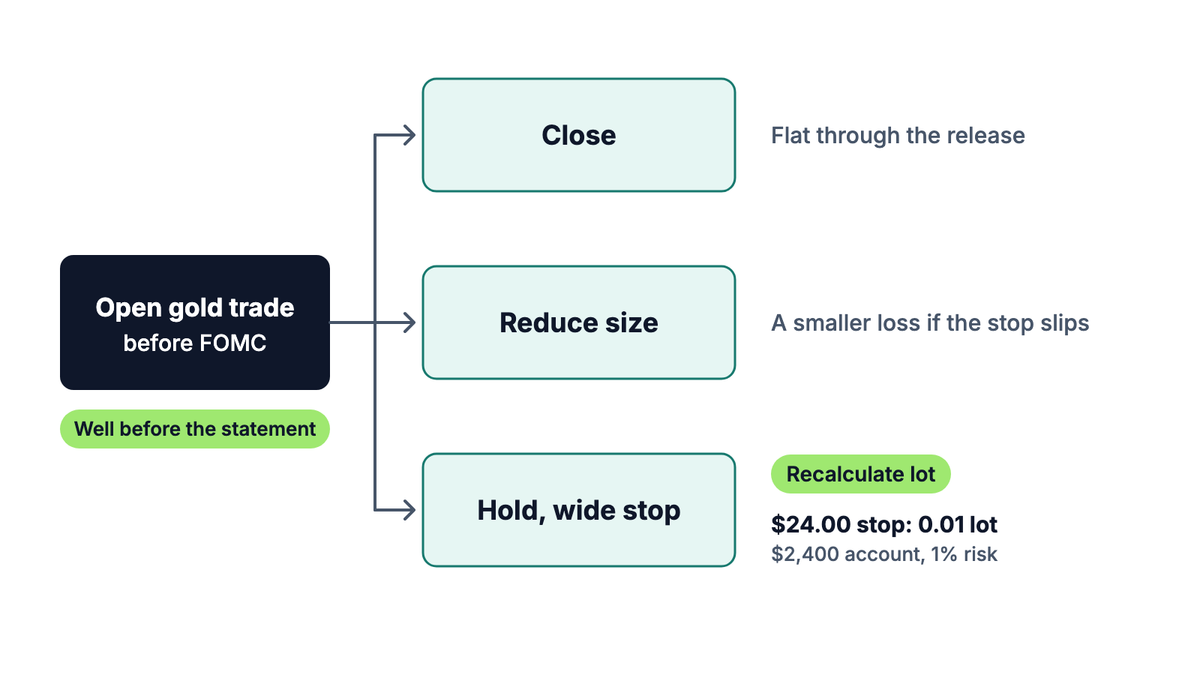
For a full view of the week around a Fed meeting, you can set up a calendar filter as described in using Forex Factory to track gold-moving news. The aim is the same: every decision about FOMC day is made before the statement comes out.
The statement is released at 2:00 p.m. New York time (ET). That is 18:00 UTC while the US is on daylight saving time, and 19:00 UTC when it isn't. The press conference starts 30 minutes later, and you convert both from UTC to your own time zone.
Not reliably in the hours after the decision. A cut that markets fully expected is already in the price, so gold can fall if the guidance points to fewer cuts ahead. What matters is the change in the expected rate path compared with what was priced.
The statement and the press conference are separate pieces of information. Algorithms react to the statement's wording first, and the Chair's answers can then shift the reading of the rate path. When the two point in different directions, the first move often unwinds.
Most beginners are better served by being flat or at reduced size. Spreads widen and stops can slip well past their level, so risk becomes hard to control. Watching a few FOMC releases on a demo account teaches far more at no cost.
The PipsMorrow Team
A team of writers covering XAU/USD gold trading education. We focus on explaining the mechanics and risk management in a structured way, with no trade signals and no promotion of any specific broker.
Last updated
Gold before NFP: the range squeeze, wider spreads and stop runs traders describe, what the research supports, and how to manage risk into the release.
10 min read
Read more →Institutional gold demand explained with World Gold Council data: why central banks and funds buy, how much, and what it can and can't tell you on XAU/USD.
8 min read
Read more →The yen carry trade explained: why traders borrow cheap yen to hold higher-yielding assets, how the numbers work, and what happens when it unwinds.
11 min read
Read more →Build on this article with the full gold trading curriculum, ordered from the basics to advanced topics, free.

