
Fundamentals
Carry Trade Explained: How It Earns and Why It Unwinds
The carry trade explained: how holding a high-rate currency against a low-rate one earns a daily swap, and why the trade unwinds all at once.
12 min read
Read more →
The yen carry trade explained: why traders borrow cheap yen to hold higher-yielding assets, how the numbers work, and what happens when it unwinds.
The yen carry trade is the most famous version of a simple idea: borrow in a currency that costs almost nothing, and hold something that pays more. For decades the Japanese yen was the cheap side of that bargain, and the trade grew large enough to shake stock markets.
This guide explains why the yen became the funding currency, works through the numbers on a small account, and shows what a yen carry trade unwind looks like. It also covers the Japan reverse carry trade and the habits that keep this risk in proportion.
A carry trade needs a funding currency with a low interest rate. Japan has offered that for longer than almost any major economy. Its central bank, the Bank of Japan (BoJ), held rates near zero from the late 1990s, and in 2016 it moved the rate below zero.
On 19 Mar 2024, the BoJ ended negative rates and set its short-term rate at 0 to 0.1%. That was its first rate rise in 17 years. On 31 Jul 2024, it raised the rate to around 0.25%. The path since then has been a slow climb, so check the BoJ's own site for the current level before you rely on any figure.
Low rates alone don't explain the yen's role. Two other features matter:
When the gap with US rates is wide, a trader who sells yen and buys dollars collects the difference. The lesson on carry and rate differentials covers the mechanics in course form, and the article on how the carry trade works in general covers swap and the broker's markup.
The example below uses round, illustrative rates: 4.5% on the US dollar and 0.5% on the yen. They are not today's rates and not a forecast. The gap is 4 percentage points.
One lot (the standard trade size) of USD/JPY is $100,000, so 0.10 lot is a $10,000 position. At 150.00 yen per dollar, that equals 1,500,000 yen. At 1:500 leverage (borrowed exposure that lets a small deposit control a larger position), the position needs $20 of margin, the deposit your broker sets aside to keep it open. The margin calculator gives the same figure.
In textbook form, you borrow 1,500,000 yen, swap it for $10,000 and hold the dollars. The yen loan costs 0.5%, or 7,500 yen, which is $50 at 150.00. The dollars earn 4.5%, or $450. The difference is $400 a year, about $1.10 a night.
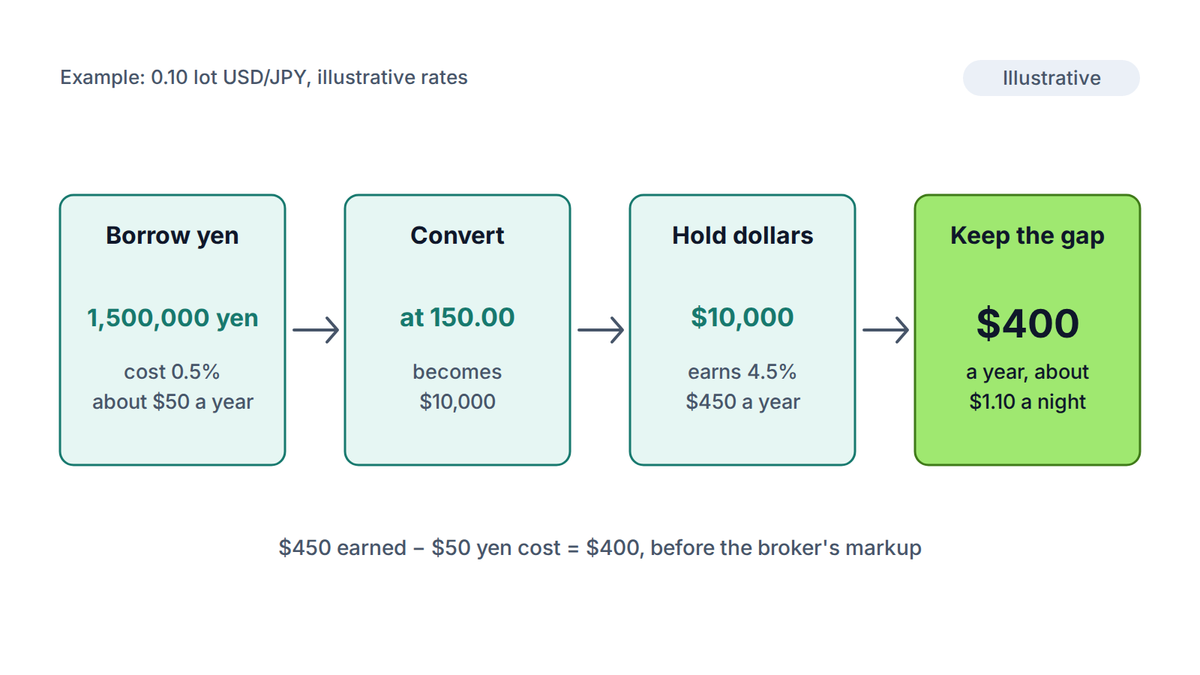
Retail traders don't borrow yen directly. They buy USD/JPY and receive or pay swap (the interest adjustment applied to positions held overnight). The result is the same idea, with the broker's markup taken out of it.
You borrowed yen, so you owe yen. If the yen rises against the dollar, the loan costs more dollars to repay. That exchange-rate move can be far larger than the interest you earn.
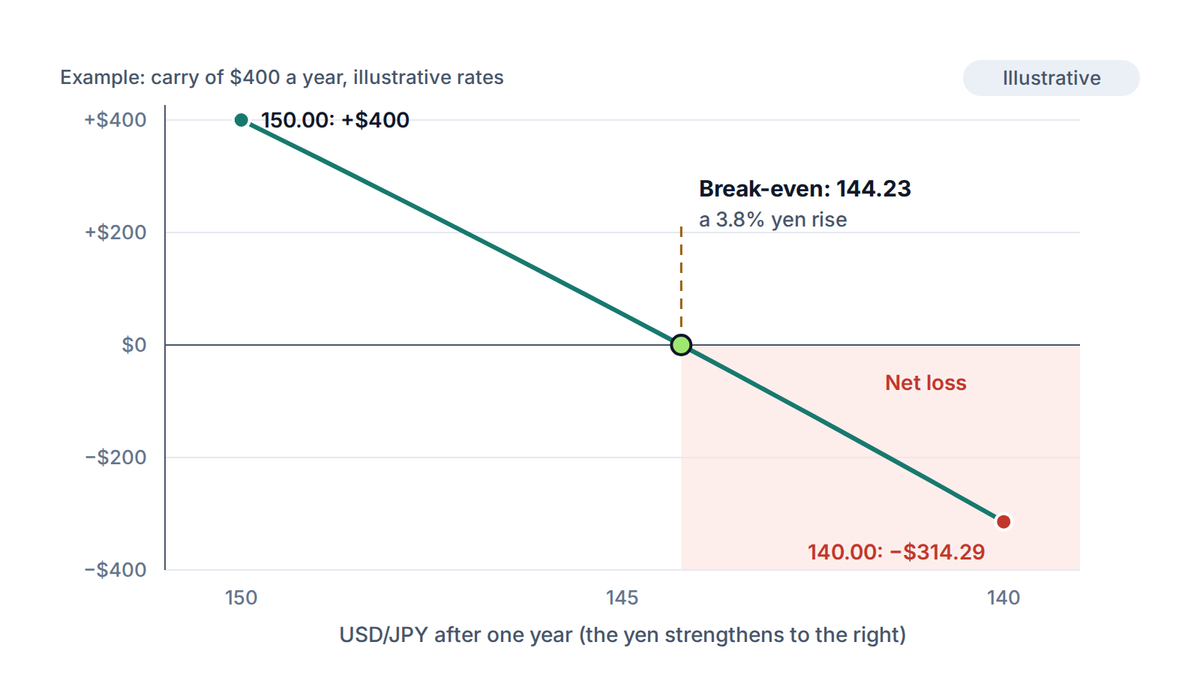
The profit/loss calculator shows the scale. On 0.10 lot, a drop in USD/JPY from 150.00 to 145.00 costs $344.83. A year of carry is $400, so you need only a 3.8% yen rise, to 144.23, to give all of it back.
| USD/JPY after one year | Price result on 0.10 lot | Plus a year of carry ($400) | Net result |
|---|---|---|---|
| 150.00 (unchanged) | $0.00 | $400.00 | +$400.00 |
| 147.00 | −$204.08 | $400.00 | +$195.92 |
| 145.00 | −$344.83 | $400.00 | +$55.17 |
| 144.23 | −$400.55 | $400.00 | about $0 |
| 140.00 | −$714.29 | $400.00 | −$314.29 |
Position size sets how much this matters. At 1.00 lot, a fall from 150.00 to 145.00 costs $3,448.28, more than the whole $2,400 example account. The same size earns $4,000 of carry a year on $200 of margin, which is why the trade looks so attractive until it moves.
Retail positions are tiny next to the real scale of the trade. Large investors borrow yen and use it for far more than USD/JPY. They buy foreign stocks and bonds and higher-yielding currencies, and they do it with leverage.
That spreads the trade across markets. While it runs, yen selling can push the yen lower and prop up the assets it buys. When it reverses, investors must buy yen back and sell those assets, so the pain shows up in places that look unrelated to Japan.
The Bank for International Settlements (BIS) estimated carry trades funded in yen at roughly 40 trillion yen, about $250 billion, going into the August 2024 episode. Estimates like this are rough, because most of the trade sits in derivatives and off-balance-sheet positions that nobody counts in full.
The BoJ raised its rate to around 0.25% on 31 Jul 2024. On 2 Aug 2024, a weak US jobs report showed 114,000 new jobs and unemployment at 4.3%. Both pointed to a narrower gap between US and Japanese rates.
The Federal Reserve's daily noon rates show USD/JPY at 161.73 on 10 Jul 2024 and 143.95 on 5 Aug 2024, a fall of about 11%. On 0.10 lot, that slide cost $1,235.15, about half of a $2,400 account.
On 5 Aug 2024, Japan's Nikkei 225 index fell 12.4% in one session. The VIX volatility index closed that day at 38.57, up from 16.36 on 31 Jul. Markets steadied within days, and the BIS described the episode as volatility amplified by deleveraging. The carry trade article walks through the same event step by step.
It was not the first time. In early October 1998, the yen rose sharply against the dollar within days, in a period when many leveraged funds were cutting positions. Researchers link that move to the unwinding of yen-funded trades. Exact levels differ between sources, so treat the episode as a pattern and not as a data set.
A yen carry trade unwind starts when the reason to hold the trade weakens. There are two main routes, and they can happen at once.
The effect on the carry is easy to size with the example. Start with a 4-point gap and $400 a year on 0.10 lot. If the BoJ adds 0.5 points, the gap is 3.5 and the carry is $350. If the Fed then cuts 1 point, the gap is 2.5 and the carry is $250.
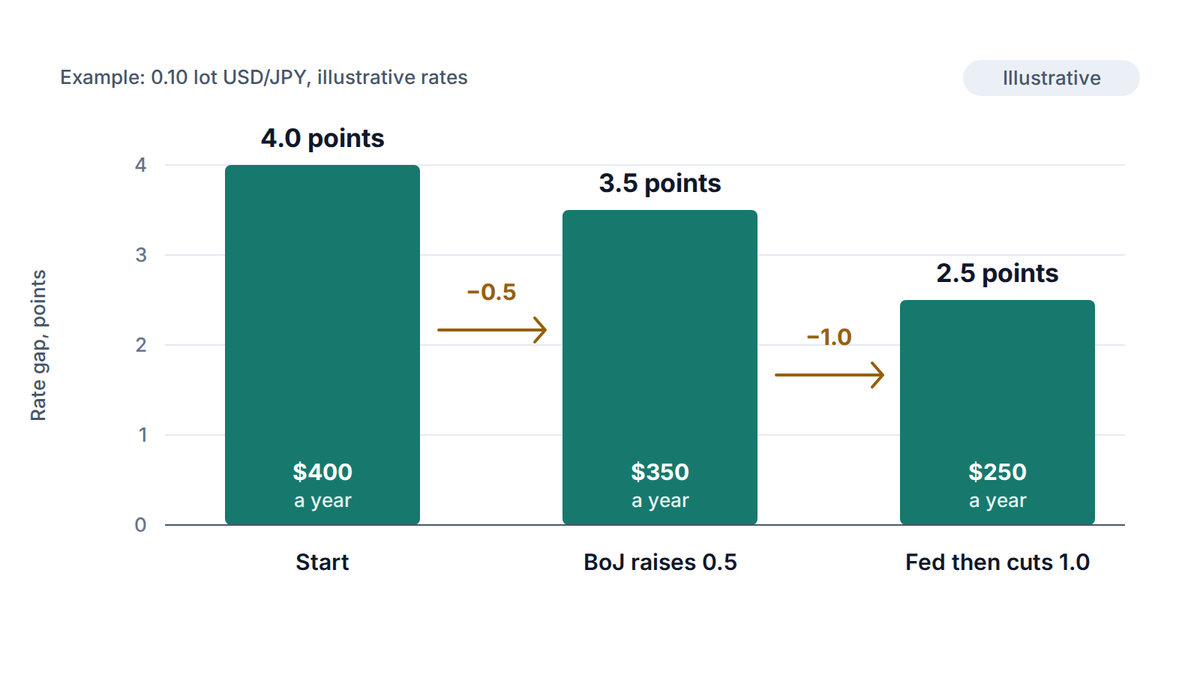
The carry shrinks slowly, but the exchange rate does not. Traders who see the gap narrowing start to leave early, because the yen move can be worth years of income. That early exit is the first push in the loop the carry trade article describes: the yen rises, leveraged positions lose, margin calls follow, and forced buying of yen pushes it higher.
The unwind also hits assets that were bought with yen. In August 2024, the Nikkei's 12.4% drop came in the same session as the yen's rise. The lesson on risk-on and risk-off explains why the yen often strengthens when investors turn cautious.
Reading the warning signs
None of these predicts an unwind, and every one of them has flashed without one. They are worth tracking because each can shift the rate gap or the mood of the market:
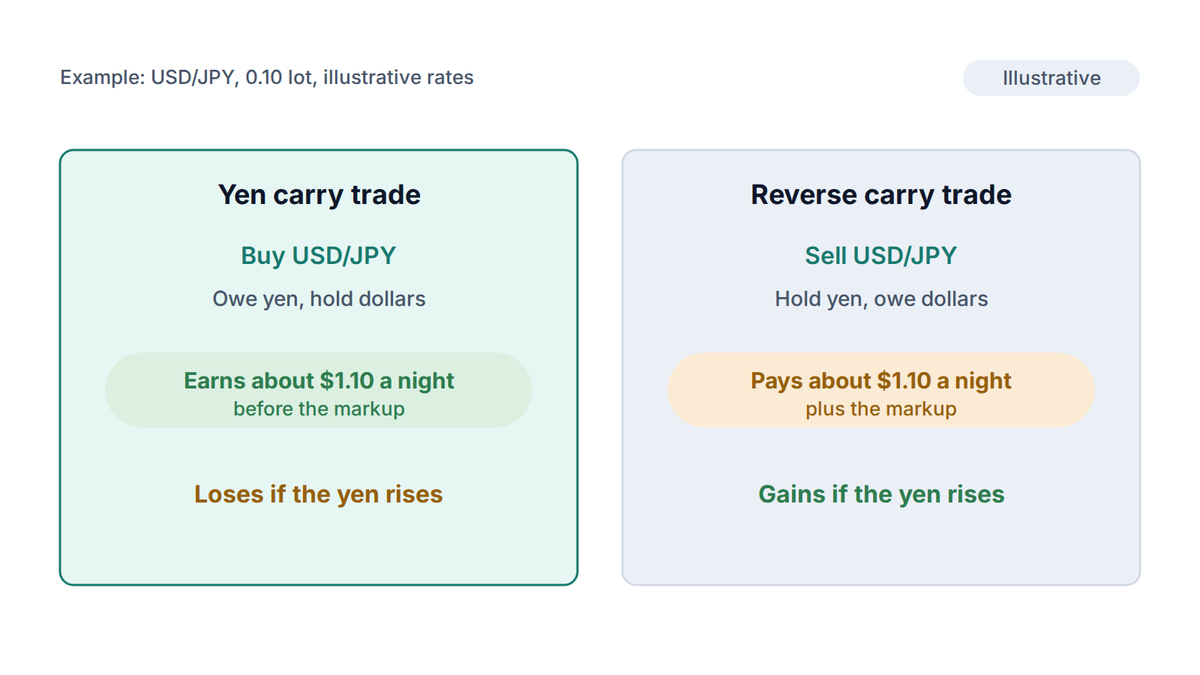
People use the term Japan reverse carry trade in two ways. Some mean the unwind itself, because closing yen-funded trades means buying the yen back. Others mean a deliberate position that does the opposite of the carry trade.
In that second sense, you sell USD/JPY: you hold the low-rate yen and owe the higher-rate dollar. You pay swap every night in the hope that the yen rises by more than the cost. On 0.10 lot in the example, that is about $1.10 a night before the markup, or $32.88 over 30 nights.
Selling USD/JPY pays off when the yen jumps, as in August 2024, and it loses in the long calm stretches when the carry trade grows. The cost is certain and the gain is not, so timing matters much more than it does for a classic carry position. The general article covers the reverse carry trade in more detail.
Most retail traders will never run a true yen carry trade, but they still feel it. It moves USD/JPY, stock indices and other yen pairs, often on days with no obvious news. A few habits keep that in proportion:
Try it now
Enter USD/JPY, a lot size and a price move to see the profit or loss, then compare it with the carry you expect to earn.
Risk warning
Leverage magnifies currency moves in both directions, and a yen carry trade unwind can move USD/JPY by several percent in days. Trading CFDs (contracts for difference, which track a price without delivering the asset) can lose you more than you planned, including your whole deposit.
You borrow or sell yen, which has a very low interest rate, and use it to buy a currency or asset that pays more. You earn the difference in rates for as long as the position stays open. The risk is that the yen rises and the exchange-rate loss outweighs the interest.
They are crowded, leveraged and on the same side. When the yen starts to rise, losses trigger margin calls and stop outs, and closing those positions means buying yen. That buying pushes the yen higher and forces the next round of closing.
No one can say for certain. The BoJ has raised rates since 2024, which narrows the gap, but the trade depends on rate gaps and market mood, and both change. Watch the gap between Japanese and US rates and the BoJ's guidance rather than any headline.
You can buy USD/JPY or another yen cross and collect swap if your broker's swap is positive. After the markup it is smaller than the textbook gap, and at 0.10 lot it is about a dollar a night. The price risk is far larger than the income.
The PipsMorrow Team
A team of writers covering XAU/USD gold trading education. We focus on explaining the mechanics and risk management in a structured way, with no trade signals and no promotion of any specific broker.
Last updated
The carry trade explained: how holding a high-rate currency against a low-rate one earns a daily swap, and why the trade unwinds all at once.
12 min read
Read more →Institutional gold demand explained with World Gold Council data: why central banks and funds buy, how much, and what it can and can't tell you on XAU/USD.
8 min read
Read more →Gold and financial sanctions after 2022: the Russian reserve freeze, the LBMA refinery ban, why central banks turned to gold, and what it means for XAU/USD.
8 min read
Read more →Build on this article with the full gold trading curriculum, ordered from the basics to advanced topics, free.

