Gold and Financial Sanctions: What 2022 Changed for Gold
Gold and financial sanctions after 2022: the Russian reserve freeze, the LBMA refinery ban, why central banks turned to gold, and what it means for XAU/USD.
By the PipsMorrow TeamUpdated 8 min read
In March 2022 Russia's finance minister said sanctions had frozen about $300 billion of the $640 billion the country held in gold and foreign currency reserves. Those were assets Russia still owned but could no longer use. Much of what stayed within reach was gold stored in Russia.
Every reserve manager in the world noticed. The link between gold and financial sanctions has shaped the market ever since. It changed who buys gold, where they keep it and what drives the price. This article walks through what happened, what the evidence shows, and what it means when you look at an XAU/USD chart.
Key takeaways
The 2022 freeze of about $300 billion in Russian reserves showed that assets held abroad can be switched off.
Sanctions then reached gold itself: the LBMA suspended six Russian refiners on 7 Mar 2022, and G7 and EU import bans followed.
The ECB links sanctions to large jumps in gold's share of reserves, though most central banks say sanctions haven't changed their decisions.
Since early 2022, gold has broken from its old inverse link with real yields, largely because of central bank buying.
Sanctions headlines often land on weekends: size for a Monday gap, and stand aside if even the minimum lot breaks your risk rule.
The 2022 timeline: how sanctions reached gold
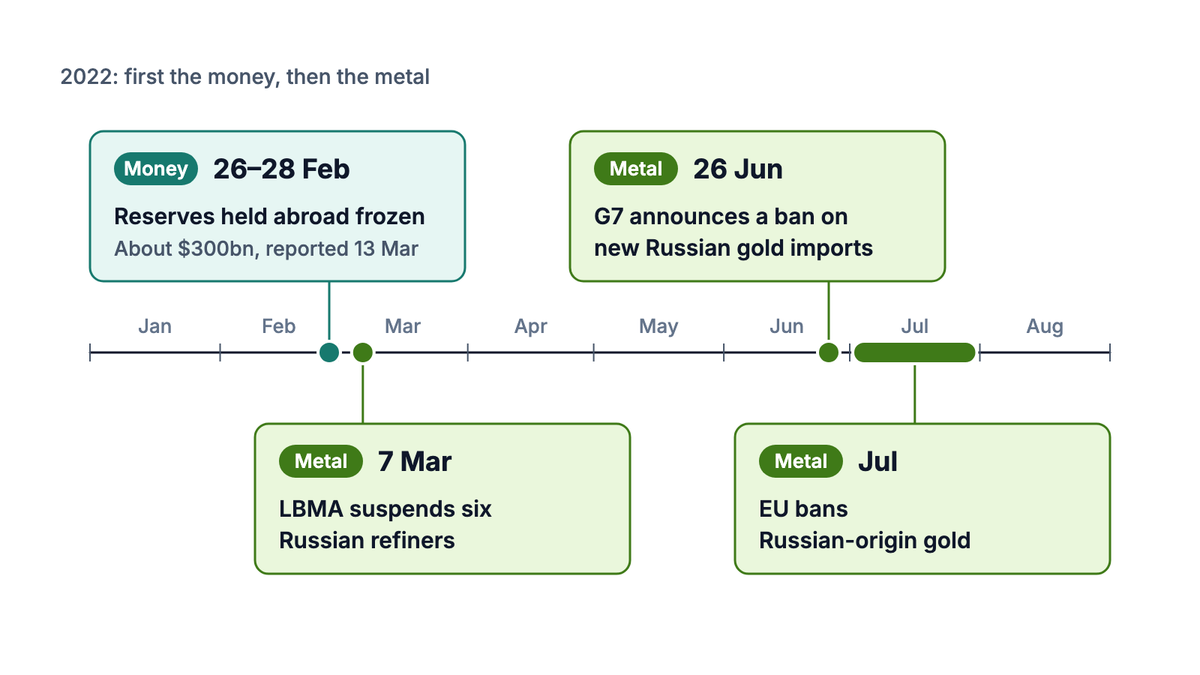
The measures came in two waves. First, Western governments cut off Russia's central bank from its reserves held abroad. Then they cut Russian gold off from the main Western markets.
Two of these landed on a weekend: 26 Feb 2022 was a Saturday and 26 Jun 2022 a Sunday
Date
Measure
Source
26 Feb 2022
Western leaders commit to restrictive measures on the Central Bank of Russia
Joint leaders' statement
28 Feb 2022
US persons barred from transactions with the Central Bank of Russia
US Treasury, OFAC Directive 4
7 Mar 2022
Six Russian refiners suspended from the London Good Delivery List
LBMA
13 Mar 2022
About $300 billion of $640 billion in reserves reported frozen
Russian Finance Ministry
26 Jun 2022
G7 announces a ban on imports of new Russian gold
G7 summit, US and UK governments
Jul 2022
EU bans buying, importing or transferring Russian-origin gold
EU seventh sanctions package
Aug 2022
Switzerland bans imports of Russian gold
LBMA summary of sanctions
The LBMA (London Bullion Market Association) runs the Good Delivery List, the standard that decides which refiners' bars trade in London. Its suspension notice said bars made before 7 Mar 2022 remain Good Delivery. Bars made afterwards by the six refiners do not.
Sources: US Treasury, LBMA, G7 and EU announcements.
The point: sanctions hit both Russia's financial reserves and its ability to sell newly produced gold in London, New York and Zurich.
Why sanctions pushed central banks toward gold
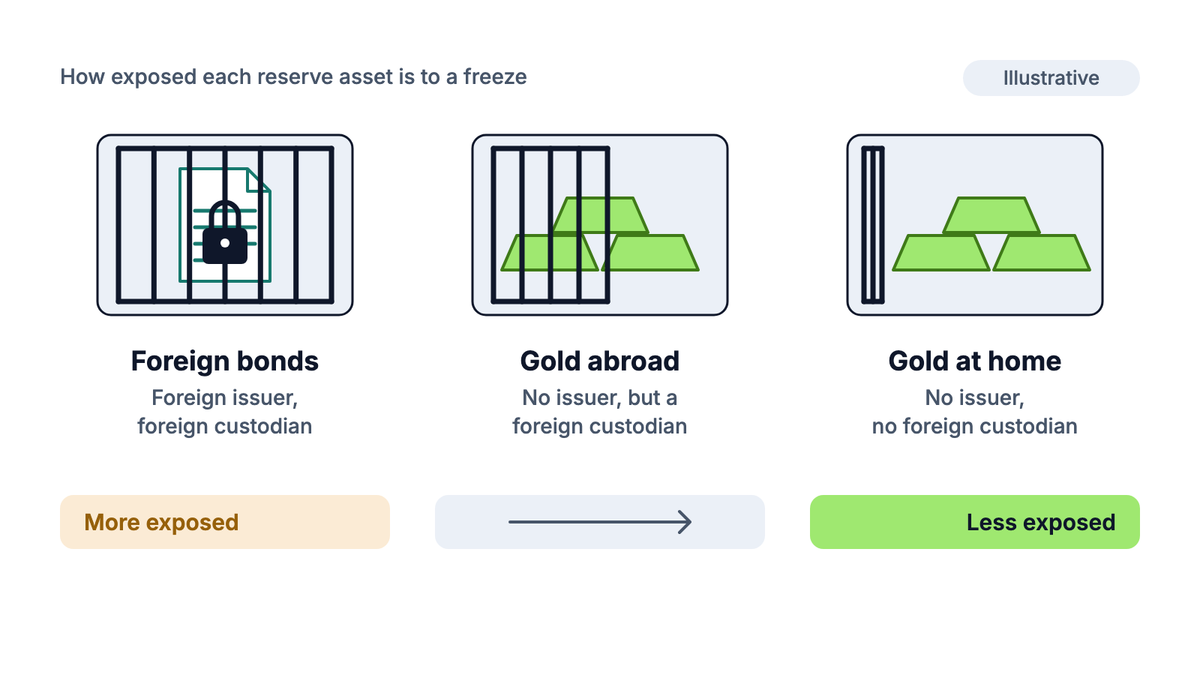
Most reserves are held as foreign bonds and deposits, recorded in another country's financial system. That system can freeze them. Gold stored in your own vault has no issuer and no foreign custodian, so there is nothing for another government to switch off.
The European Central Bank studied this in a 2025 report. It looked at the ten largest annual jumps in gold's share of a country's reserves since 1999. In five of them, the country faced sanctions that year or the year before. It also found that about one in four emerging-market central banks cited sanctions concerns or changes in the international monetary system as reasons to hold gold.
The picture isn't one-sided. The same ECB report noted that in mid-2024, nearly 90% of surveyed central banks said sanctions had not affected their reserve decisions. The shift is concentrated in countries that are geopolitically distant from the West, and those countries have been active buyers.
Where central banks keep their gold
Storage has become a question in its own right. The World Gold Council's 2026 Central Bank Gold Reserves Survey asked about this. Of the respondents, 57% used the Bank of England as a vault, and 49% stored gold domestically. The share that had increased domestic storage in the past year rose to 9%, from 5% the year before.
Russia is the extreme case. Bank of Finland research put gold at about 21% of Russia's reserves at the end of 2021. By Dec 2025, Bank of Russia data reported by Interfax put it at about 43%. Much of that rise reflects the higher gold price rather than new buying.
Gold abroad can be frozen too
Gold is only beyond reach if it sits beyond reach. About 31 tonnes of Venezuelan central bank gold sits at the Bank of England. It has been caught since 2018 and 2019 in a legal dispute over who controls Venezuela's central bank. Euronews reported in Aug 2026 that it was still awaiting a ruling.
Illustrative. Where an asset is held matters as much as what it is.
What changed in the physical gold market
Russia is one of the world's largest gold producers, at an estimated 325 tonnes in 2022 according to Metals Focus figures cited by Reuters. The bans didn't make that gold disappear. They changed where it went.
A Reuters review of customs data found that Russia exported 116.3 tonnes of gold between 24 Feb 2022 and 3 Mar 2023. The UAE took 75.7 tonnes, up from 1.3 tonnes in all of 2021. China and Turkey took about 20 tonnes each. Reuters noted that the data did not suggest any breach of US sanctions by those countries.
The result is a market with two tracks. Pre-2022 Russian bars still trade in London, while newer Russian metal moves through other hubs. For a CFD (contract for difference) trader, this matters mainly as background. XAU/USD tracks the global spot price, the price for immediate delivery, which reflects overall global demand, including metal that trades outside London.
What gold and financial sanctions did to the price
For years, the most reliable model of gold was simple. When real yields (bond yields after inflation) rose, gold tended to fall, because gold pays no interest. The what moves gold lesson explains that link.
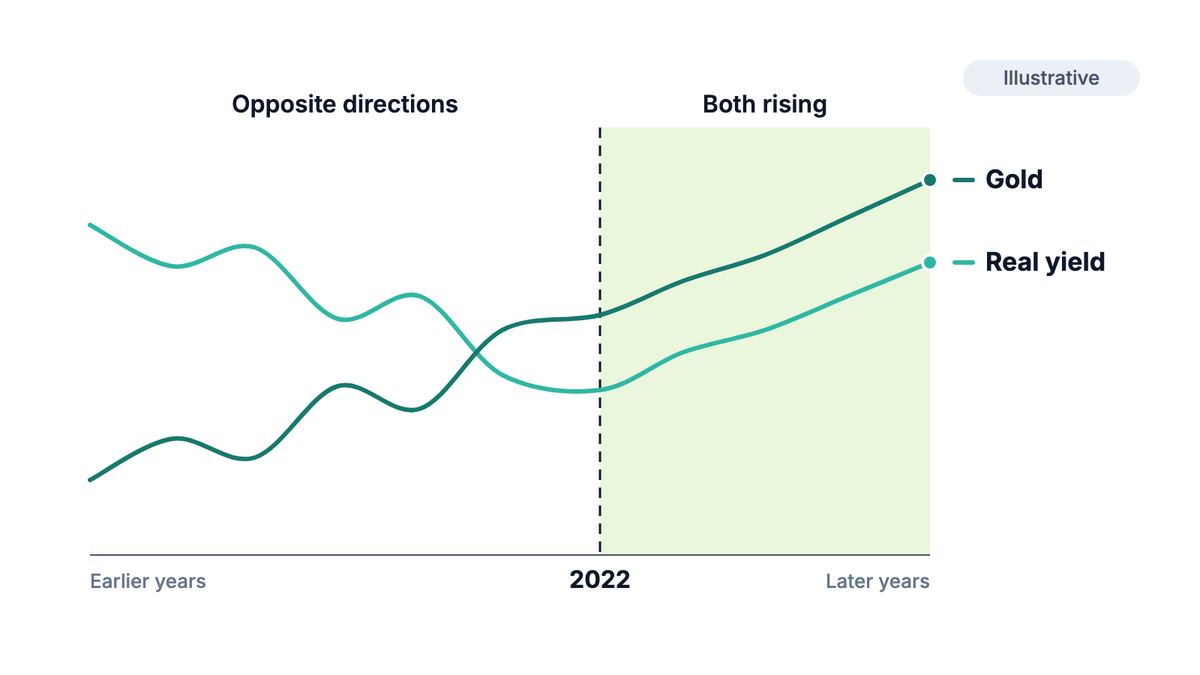
After 2022 the model broke. According to the World Gold Council, real yields on 10-year US inflation-protected bonds rose about 2.5 percentage points in 2022 and the dollar gained over 8%. Gold still finished the year up 0.4%, which the WGC credited largely to exceptional central bank buying. The ECB likewise found that the negative correlation between gold and real US yields broke down after early 2022.
Illustrative shape, not data. The old inverse link between gold and real yields weakened after early 2022.
For a chart reader, this is the lasting change. A rise in real yields no longer guarantees gold weakness, because a large buyer group now cares more about sanctions risk than about yield. Read the interest rates lesson with that caveat in mind.
It also cuts the other way. A sanctioned holder can become a seller when it needs cash. The WGC named Russia the largest central bank seller in Q2 2026, at 22 tonnes.
Reading sanctions headlines on an XAU/USD chart
Sanctions news does not reliably push gold higher. Gold briefly traded above $2,000 in early March 2022, then gave back much of the move as the Fed began raising rates on 16 Mar. The structural effect played out over years, not days, as the article on institutional gold demand shows.
The practical risk is timing. Sanctions are often announced on weekends, when the market is closed. At most brokers XAU/USD reopens on Sunday evening New York time, around 6 p.m. ET (22:00 or 23:00 UTC, depending on US daylight saving), and price can open far from Friday's close. That's a gap, and a stop loss inside a gap fills at the next available price, not at your level. The slippage lesson explains why. The economic events lesson covers the scheduled releases that can collide with such news.
Sizing for a headline-driven market
Use the site's shared example of a $2,400 account risking 1%, or $24. On gold a pip is $0.01, and one pip on one lot (100 troy ounces, a troy ounce being 31.1035 g) is worth $1.00. With a $12 stop (1,200 pips), the lot size calculator gives 0.02 lot, risking exactly $24.
Now suppose headlines make you want a $40 stop. Even the minimum 0.01 lot then risks $40, about 1.7% of the account. When the smallest possible position breaks your risk rule, the honest answer is to stand aside. The where a stop belongs lesson covers what to do when the stop is too wide.
Try it now
Enter your balance, risk percentage and stop distance before a weekend with sanctions talk in the news. If the calculator says the minimum lot is too big, that's your answer.
Check the calendar and the news on Friday. Know whether major policy meetings fall over the weekend.
Cut size or close before the weekend if a gap would exceed your planned loss.
Separate the headline from the trend. The risk-on and risk-off lesson shows how haven flows fade once the news is absorbed.
Frequently asked questions
Why did sanctions on Russia increase demand for gold?
Freezing about $300 billion of Russian reserves showed that assets held in foreign financial systems can be blocked. Gold held domestically has no issuer or foreign custodian, so some central banks, especially those distant from the West, bought more of it.
Can gold reserves be frozen by sanctions?
Yes, if the gold is stored in a foreign vault. About 31 tonnes of Venezuela's gold at the Bank of England has been tied up in a legal dispute for years. Gold held at home can't be frozen, but sanctions can still stop it being sold in major markets.
What is the LBMA Good Delivery List, and why did Russia lose access?
It's the list of refiners whose bars are accepted in the London market. On 7 Mar 2022 the LBMA suspended six Russian refiners in light of UK, EU and US sanctions. Their bars made before that date remain acceptable.
Did sanctions make the gold price rise?
Not directly or immediately. Gold spiked in early March 2022 and then fell back as the Fed raised rates. The larger effect came through years of heavy central bank buying, which helped gold resist rising real yields.
◆
The PipsMorrow Team
A team of writers covering XAU/USD gold trading education. We focus on explaining the mechanics and risk management in a structured way, with no trade signals and no promotion of any specific broker.
Institutional gold demand explained with World Gold Council data: why central banks and funds buy, how much, and what it can and can't tell you on XAU/USD.