
Getting started
Forex Session Times: When Each Market Opens and Moves
Forex session times for Sydney, Tokyo, London and New York in New York time and UTC, with the daylight-saving shifts and the hours that actually move.
10 min read
Read more →
Gold market open time in New York time and UTC: when XAU/USD opens on Sunday, the daily break, the weekly close and the busiest hours of the week.
Gold market open time is the first thing to settle before you place a trade, because gold does not run on a stock exchange timetable. Spot gold (XAU/USD, the price of one troy ounce of gold in US dollars) trades almost around the clock on weekdays, with one short pause each day and a break over the weekend.
This guide gives the weekly open, the daily break and the weekly close in New York time and UTC (Coordinated Universal Time, the world's reference clock). It then shows the hours when gold is busiest and what that does to your costs. If you want the wider picture first, read the lesson on sessions, liquidity and the clock.
Gold has no single official opening bell. Spot gold is traded over the counter, which means banks, brokers and dealers quote it directly to each other and to clients. The nearest thing to a shared timetable comes from the futures market. CME Group, which runs the main gold futures contract, lists electronic trading from Sunday 6:00 p.m. to Friday 5:00 p.m. New York time, with a 60-minute break each day starting at 5:00 p.m. (checked on cmegroup.com, 25 Oct 2026).
Brokers that offer XAU/USD as a CFD (contract for difference, a product that tracks the price without you owning any gold) normally follow a similar rhythm. Some open on Sunday at 5:00 p.m. New York time, in line with forex, and some at 6:00 p.m. So the honest answer to the question is: roughly Sunday evening in New York, but your broker has the final say.
| Event | New York time | UTC in US summer (EDT) | UTC in US winter (EST) |
|---|---|---|---|
| Weekly open (futures reference) | Sunday 6:00 p.m. | Sunday 22:00 | Sunday 23:00 |
| Daily break starts | 5:00 p.m. (Monday to Thursday) | 21:00 | 22:00 |
| Daily break ends | 6:00 p.m. | 22:00 | 23:00 |
| Weekly close | Friday 5:00 p.m. | Friday 21:00 | Friday 22:00 |
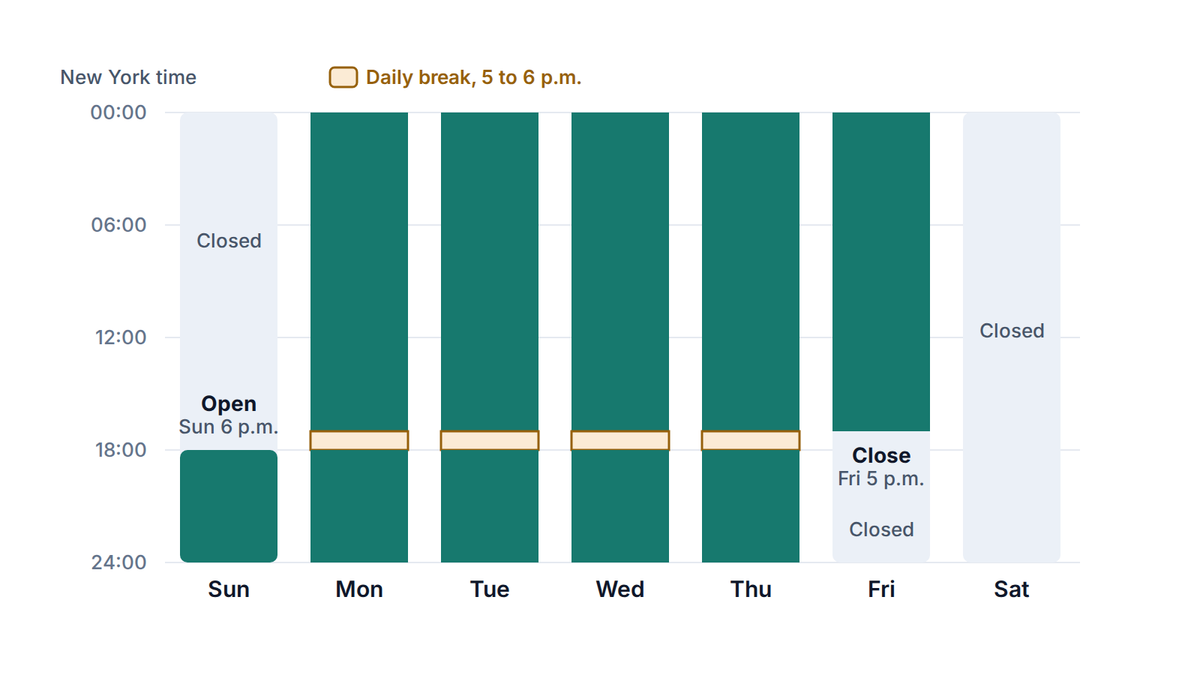
Each weekday, gold pauses for about an hour starting at 5:00 p.m. New York time (21:00 UTC in US summer, 22:00 UTC in winter). This is when exchanges and brokers close one trading day and start the next. Quotes can freeze or thin out, and some platforms reject new orders.
That daily rollover is also when swap (the overnight interest charge or credit on a position you hold past the cutoff) is applied. A position held through 5:00 p.m. New York time pays or earns swap, and many brokers charge triple on Wednesday for the weekend. The article on reading a broker's gold contract specifications shows where to find those numbers.
The weekend is a bigger issue. Between Friday 5:00 p.m. and Sunday evening, news keeps arriving but gold cannot trade. A Saturday headline can leave price opening above or below Friday's close. That jump is called a gap, and a stop loss does not protect you from it. It fills at the first available price, which can be worse than your level.
Check your platform clock
Your trading platform shows the broker's server time, which is often neither UTC nor your local time. Many servers sit a few hours ahead of New York so that the daily candle ends at the New York close. Find your platform's offset once and write it down.
A quick way to answer is to start from the day of the week, in New York time.
Remember that the date changes at different hours in different places. If you live in Asia or Australia, Sunday evening in New York is already Monday morning for you. The market has not opened early. Your calendar is simply ahead.
Holidays are the other reason a market may not behave as usual. Around US holidays such as Thanksgiving and Christmas Day, exchange hours are shortened and brokers often follow with an early close or a late open. CME publishes its holiday schedule about two weeks ahead on cmegroup.com, and most brokers post theirs on their site. Check both before you hold a position through a holiday.
Thin holiday trading usually means wider spreads and more erratic prices, so even when the market is technically open, it may not be a good time to trade.
Open does not mean busy. Gold follows the same handoff as forex: Asia first, then London, then New York. The forex session times guide covers the clock changes in detail. Here is how it looks for gold in US summer time.
| Window | New York time | UTC (US summer) | What you tend to see |
|---|---|---|---|
| Weekly open and Asia | 6:00 p.m. to 3:00 a.m. | 22:00 to 07:00 | Thinner trading, narrower ranges, wider spreads at the very start |
| London morning | 3:00 a.m. to 8:00 a.m. | 07:00 to 12:00 | Volume rises as European desks arrive |
| London and New York overlap | 8:00 a.m. to 12:00 p.m. | 12:00 to 16:00 | The busiest hours, with the most data releases |
| New York afternoon | 12:00 p.m. to 5:00 p.m. | 16:00 to 21:00 | Activity fades into the daily break |
Gold is special because it answers to the dollar and to US interest rates, and the US data comes out in the New York morning. That is why the overlap matters so much. Most major US releases land at 8:30 a.m. New York time (12:30 UTC in summer, 13:30 UTC in winter), and the piece on what gold usually does before NFP shows how sharply price can react.
London adds a second anchor. The LBMA Gold Price, a benchmark used by banks, miners and dealers, is set in two auctions run by ICE Benchmark Administration at 10:30 and 15:00 London time (checked 25 Oct 2026). That is 5:30 a.m. and 10:00 a.m. New York time when London and New York clocks are in step. These auctions do not move price by themselves, but they mark moments of heavy dealing.
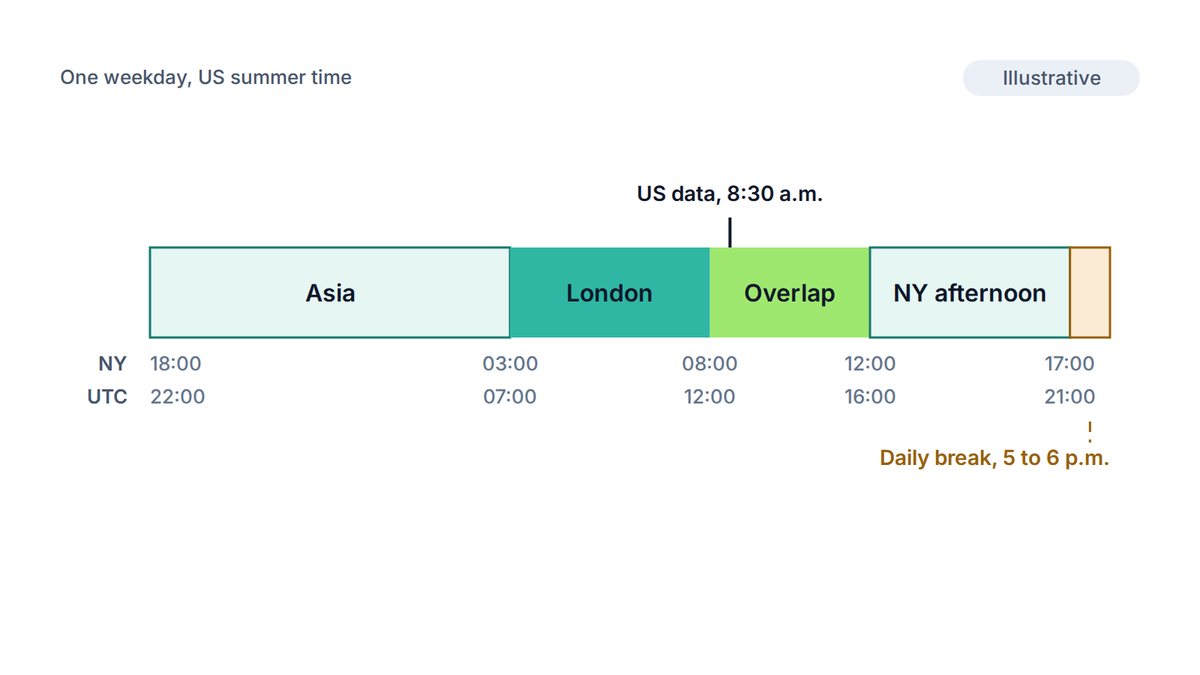
The spread is the cost you pay to get into a trade, and it changes through the day. At the busiest hours it is usually at its tightest. Just after the weekly open, around the daily break and during rollover, dealers quote less aggressively and the spread widens.
Here is the effect on a small position. Take the site's usual example: a $2,400 account risking 1% per trade, which is $24. You buy 0.1 lot of gold, where one lot is 100 troy ounces (a troy ounce is the standard unit for precious metals, about 31.1 grams), so 0.1 lot is 10 ounces. Assume the price is about $4,000 an ounce for illustration. A spread of $0.30 costs you $3 the moment you open the position. A spread of $0.80 costs $8. Each figure comes from the site's P/L calculator.
| Spread on gold | Cost on 0.1 lot | Share of the $24 you plan to risk |
|---|---|---|
| $0.30 (busy hours) | $3.00 | 12.5% |
| $0.80 (quiet hours) | $8.00 | 33.3% |
The same trade, with the same stop loss, starts a third of the way to its risk limit in the quiet hour. That does not make quiet hours off limits. It means you should know what you are paying before you click. The pip calculator turns any spread into dollars, and the lesson on what a trade really costs covers spread, swap and commission together.
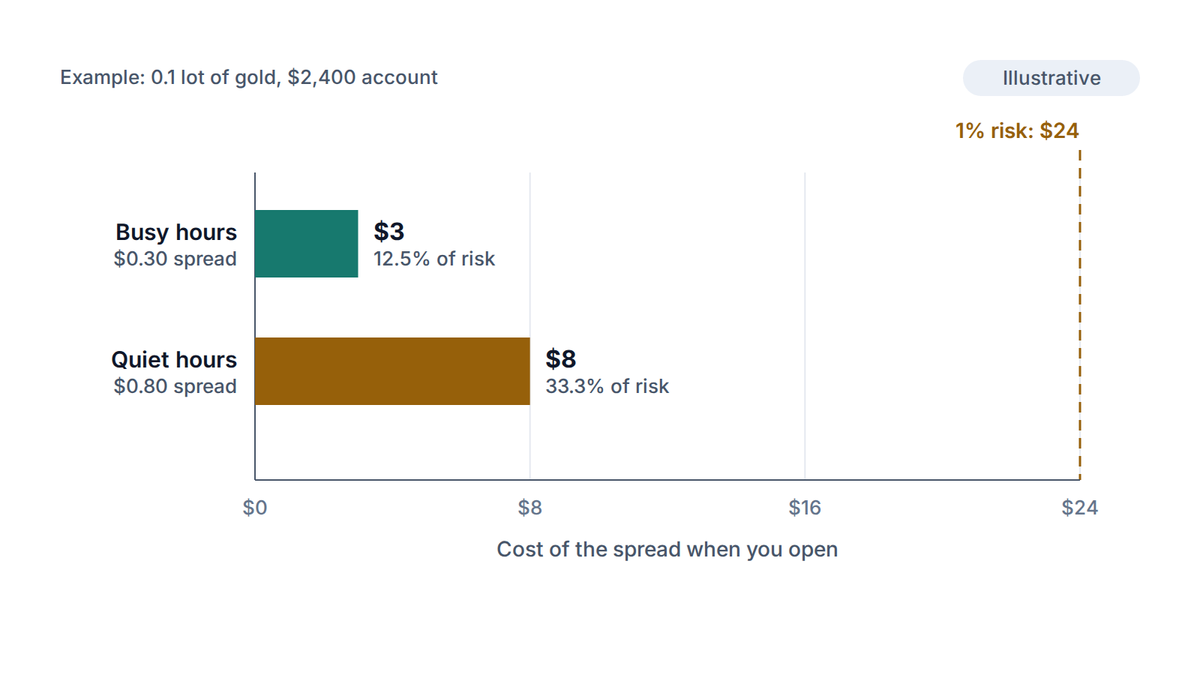
You do not need to be at the screen for every hour. Use the schedule to decide when to look and when to leave gold alone.
A schedule is not a signal
Knowing when gold is busy says nothing about which way it will move. Trading hours help with timing and cost. They are not a reason to buy or sell.
Trading gold on margin carries a high risk of losing money quickly, so size every position from a stop loss and a fixed risk percentage rather than from the clock.
On the reference schedule, gold opens on Sunday at 6:00 p.m. New York time, which is 22:00 UTC in US summer and 23:00 UTC in winter. Some brokers open an hour earlier. Check the trading hours page or the market watch window on your own platform.
Convert Sunday 6:00 p.m. New York time to your own clock. If you are east of New York, it may already be Monday for you. Do the conversion once for US summer time and once for winter, because the US changes its clocks on different dates from many other countries.
Gold is open Monday to Thursday except for the break at 5:00 p.m. to 6:00 p.m. New York time. It opens Sunday evening and closes Friday at 5:00 p.m. Holidays can shorten these hours, so check your broker's holiday notice.
Almost. Gold trades around the clock from Sunday evening to Friday afternoon in New York time, but with a daily pause of about an hour and a closure over the weekend.
There is no best time for every plan. The London and New York overlap, 8:00 a.m. to 12:00 p.m. New York time, usually has the most activity and the tightest spreads, but it also has the biggest data-driven swings. Choose hours that match your plan and your risk.
The PipsMorrow Team
A team of writers covering XAU/USD gold trading education. We focus on explaining the mechanics and risk management in a structured way, with no trade signals and no promotion of any specific broker.
Last updated
Forex session times for Sydney, Tokyo, London and New York in New York time and UTC, with the daylight-saving shifts and the hours that actually move.
10 min read
Read more →How to add XAUUSD to MT5 through Market Watch, read its specification, and decode suffixes like XAUUSD.m so you pick the right gold symbol.
7 min read
Read more →XAUUSD pip value explained: what one pip on gold is worth at 0.01, 0.10 and 1.00 lots, and why brokers disagree on what a gold pip even is.
9 min read
Read more →Build on this article with the full gold trading curriculum, ordered from the basics to advanced topics, free.

