
Brokers
What Is a Margin Call? Triggers and Stop Out Explained
What is a margin call? It is your broker's warning that equity is close to the margin held. See the numbers, the stop out that follows and how to avoid both.
10 min read
Read more →
Leverage in forex lets a small deposit control a larger position. See how margin differs from leverage, what the numbers look like and how much is too much.
Leverage in forex is the reason a $2,400 account can open a position worth $110,000. It is also the reason the same account can lose a fifth of its balance on one afternoon. Both facts come from the same mechanism, and most beginners only hear the first one.
This guide explains how leverage works, how it differs from margin, and why the ratio your broker advertises is the wrong number to worry about. All the examples use one account: $2,400, trading EUR/USD at 1.1000. Prices are illustrative, and every figure comes from the site's calculators.
Leverage (trading a position larger than the money you put up) works because your broker covers the gap. You deposit a small amount, the broker holds it as security, and you get the price exposure of a much bigger position. The market sees a full-size trade. Your account sees a deposit.
Leverage is written as a ratio. At 1:100, each $1 of your money supports $100 of position. At 1:500, it supports $500. The higher the second number, the smaller the deposit the broker asks for.
Forex is the market where this is most common, because currency prices move in small steps. A move of one pip (the fourth decimal place of a price like EUR/USD, a step of 0.0001) is tiny. Leverage makes small steps large enough to matter, in both directions. The guide to pips in forex covers the step itself.
Take 1 lot (a standard position of 100,000 units of the base currency) of EUR/USD at 1.1000. The position is worth $110,000. At 1:500 the broker holds $220 of your money and covers the other $109,780. You are not handed that cash. You get its price exposure while the trade is open, and it is gone when you close.
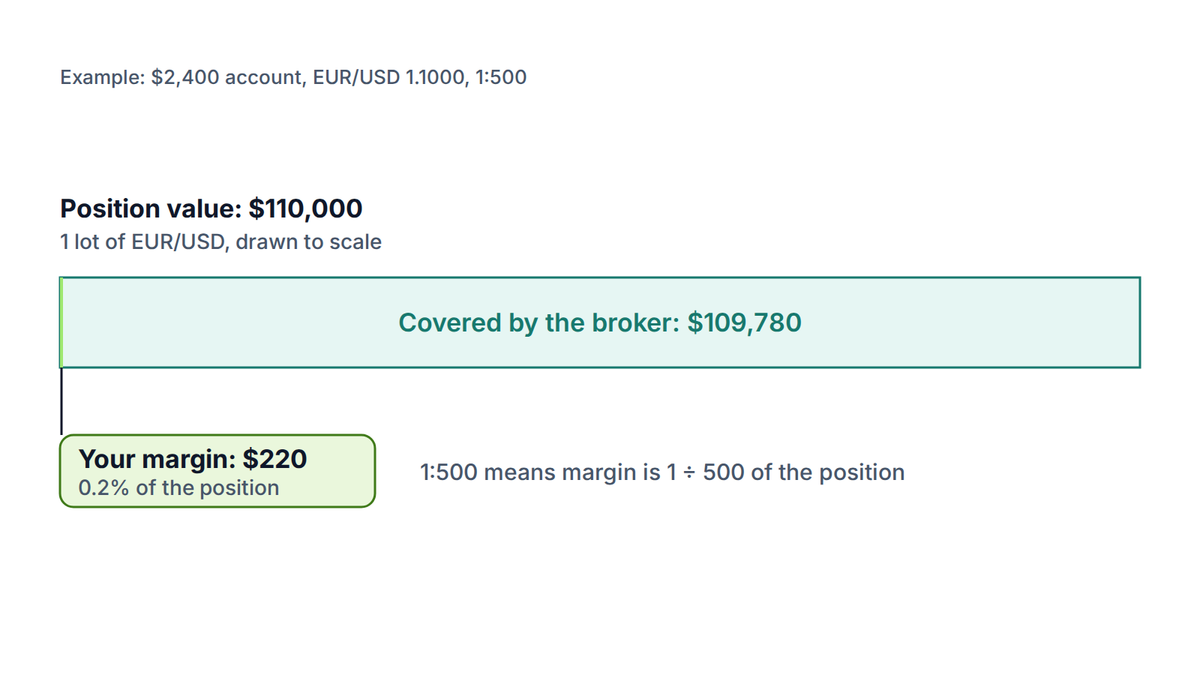
People mix these two up because they are two views of one fact. Margin (the deposit held against an open position) is an amount of money. Leverage is the ratio that sets how large that amount is. Pick the ratio and the margin follows.
What each variable means:
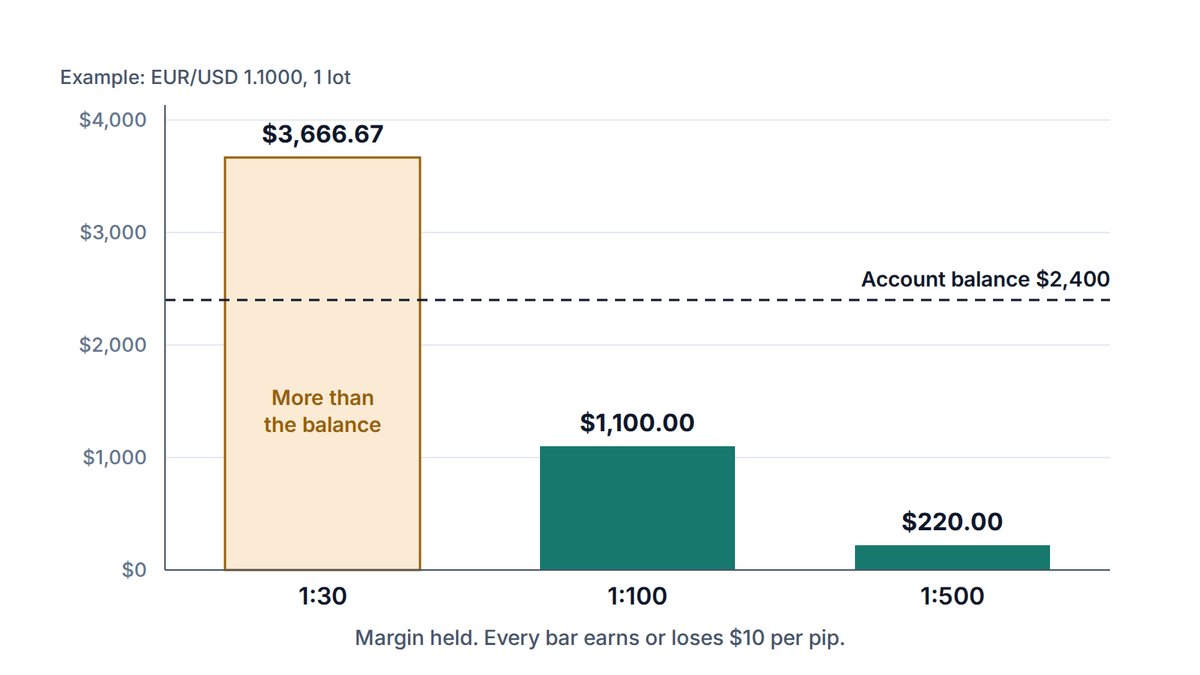
The lesson on leverage and margin goes further into free margin and margin level. Here is what the same 1-lot trade needs at three common ratios, from the site's margin calculator.
| Leverage | Margin held | Share of $2,400 | Free margin left |
|---|---|---|---|
| 1:30 | $3,666.67 | 152.8% | Not allowed: more than the balance |
| 1:100 | $1,100.00 | 45.8% | $1,300.00 |
| 1:500 | $220.00 | 9.2% | $2,180.00 |
At 1:30 the account cannot open this trade at all, because the deposit would exceed the balance. That is leverage working as a brake. At 1:500 the platform will happily open it, and 90% of the balance stays free.
Now the important part. A pip on 1 lot of EUR/USD is worth about $10 under every one of those ratios. The ratio decided how much money was set aside. It did not change what the trade earns or loses.
Follow one trade through. You buy 0.5 lots of EUR/USD at 1.1000 with 1:500 leverage. The position is worth $55,000 and the margin held is $110. A pip is worth $5.
That is the whole mechanism. Leverage turns a small price move into a large percentage move on your account, and it does so symmetrically. If you want to see what happens when the losses grow too large for the margin held, the article on what a margin call is follows that path.
Leverage can be tiered
Some brokers cut the maximum ratio as your position or balance grows, or around major news. Read the account terms for the leverage rules on your instrument, because the ratio is not always fixed.
The ratio on your account is a maximum. What you actually use is effective leverage, which is your total position value divided by your balance. Two traders on the same 1:500 account can sit at 2 times and 90 times.
What each variable means:
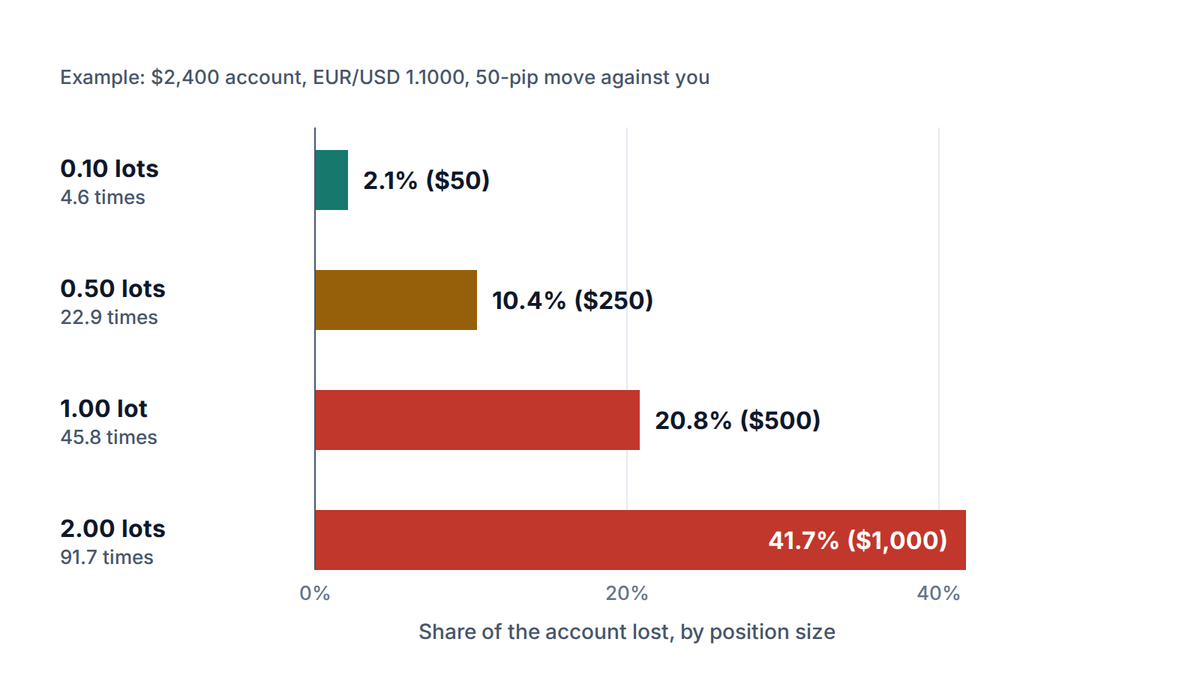
Here is the $2,400 account at five sizes, using the site's leverage calculator and a 50-pip adverse move on EUR/USD (about $10 per pip per lot).
| Position | Position value | Effective leverage | Loss on 50 pips | Share of account |
|---|---|---|---|---|
| 0.10 lots | $11,000 | 4.6 times | $50 | 2.1% |
| 0.50 lots | $55,000 | 22.9 times | $250 | 10.4% |
| 1.00 lot | $110,000 | 45.8 times | $500 | 20.8% |
| 2.00 lots | $220,000 | 91.7 times | $1,000 | 41.7% |
Every row is permitted at 1:500, and the broker would show no warning at open. Yet the last row loses 41.7% of the account on a move that EUR/USD can make in a few days. Effective leverage, not the advertised ratio, tells you how much a move hurts.
There is no official safe number, and anyone quoting one is guessing. What you can do is work back from the loss you accept. Start with a stop loss, size the trade so that stop costs about 1% of the account, and see what effective leverage falls out.
On $2,400, 1% is $24. With a 20-pip stop on EUR/USD, the size is $24 ÷ (20 pips × $10) = 0.12 lots. That position is worth $13,200, so effective leverage is about 5.5 times. At 1:500 it needs only $26.40 of margin, and at 1:30 it needs $440.
Notice what happened. A sensible risk plan landed at roughly 5 times, far below even the 1:30 ceiling. The routine in the guide to sizing a position gets you there, and the lot size article shows how to read the number you enter.
Warning signs of too much
Your margin is a large share of the balance. One ordinary move wipes out a big slice of the account. You cannot place a stop loss without exceeding your risk budget. Or you pick the size because the platform allows it. Any one of these means the position is too big.
Common rules of thumb keep effective leverage in single digits for beginners, and the risk-based sizing above usually does that on its own. Treat any such figure as a guide, since a wide stop on a volatile pair can still push the number higher.
Try it now
Enter the pair, price, lots and your balance. The leverage calculator shows your effective leverage, and the margin calculator shows the margin held and the free margin left.
The ceiling depends on where your broker is regulated and what kind of client you are. In the EU, retail clients are capped at 1:30 on major currency pairs under rules from ESMA, the European markets regulator. In the US, rules from the CFTC allow up to 1:50 on major pairs and 1:20 on others, and the NFA sets the exact deposits.
Many brokers registered in other jurisdictions offer much higher ratios, in the hundreds. Rules and definitions of a major pair change, so check your own broker's regulator and its published terms rather than a figure from an article. If you are choosing a broker, ratio is only one of several things to compare.
| Setting | What it controls | Who sets it |
|---|---|---|
| Maximum leverage | The lowest margin you can be asked for | Regulator and broker |
| Account leverage | The ratio applied to your trades | You, within the maximum |
| Effective leverage | How large your positions are against your balance | You, with every trade |
Yes, in effect. A position worth no more than your balance has effective leverage of 1 time or less, so it behaves as an unleveraged trade even on a high-ratio account. On $2,400, 0.02 lots of EUR/USD is worth $2,200. Some brokers also let you lower your account ratio, and the platform will not stop you from sizing small.
The catch is the minimum trade size. The smallest position the broker allows sets the lowest effective leverage you can reach on a small account. With a 0.01 lot minimum, that is $1,100 on this account, or about 0.5 times.
Your broker holds a small part of your balance as margin and lets you trade a position many times larger. The full position moves your account with every pip. Profits and losses are calculated on the whole position, not on the margin.
Margin is the money held against an open position. Leverage is the ratio between the position and that money. At 1:100, margin is 1% of the position value. Change the ratio and the margin changes, but the profit or loss per pip does not.
It depends on the regulator and the client type. Retail limits are 1:30 on major pairs in the EU and up to 1:50 in the US, while some offshore brokers offer far more. A higher maximum does not make a bigger position wise.
You can keep positions small enough that effective leverage is 1 time or less. On a $2,400 account that means a position worth up to $2,400. The result is smaller gains and losses, and it is the most direct way to limit risk.
The PipsMorrow Team
A team of writers covering XAU/USD gold trading education. We focus on explaining the mechanics and risk management in a structured way, with no trade signals and no promotion of any specific broker.
Last updated
What is a margin call? It is your broker's warning that equity is close to the margin held. See the numbers, the stop out that follows and how to avoid both.
10 min read
Read more →Lot size in forex is the trade size you choose. See what standard, mini and micro lots are, what 1 lot is worth per pip, and how to pick one for your risk.
8 min read
Read more →Pips in forex explained: what a pip is, how to count them on any pair including yen pairs, and how to work out what one pip is worth in dollars.
7 min read
Read more →Build on this article with the full gold trading curriculum, ordered from the basics to advanced topics, free.

