What Is a Margin Call? Triggers and Stop Out Explained
What is a margin call? It is your broker's warning that equity is close to the margin held. See the numbers, the stop out that follows and how to avoid both.
By the PipsMorrow TeamUpdated 10 min read
If you are asking what is a margin call, the short answer is a warning. Your broker tells you that your losing positions have eaten so much of your account that the deposit holding them open is no longer safely covered. Ignore it and the broker may close your trades for you.
This guide works through the mechanics on the site's shared $2,400 gold account. You will see exactly where a margin call fires, where the stop out sits behind it and which habits keep you far from both. The thresholds below are common examples, and your own broker sets its own.
Key takeaways
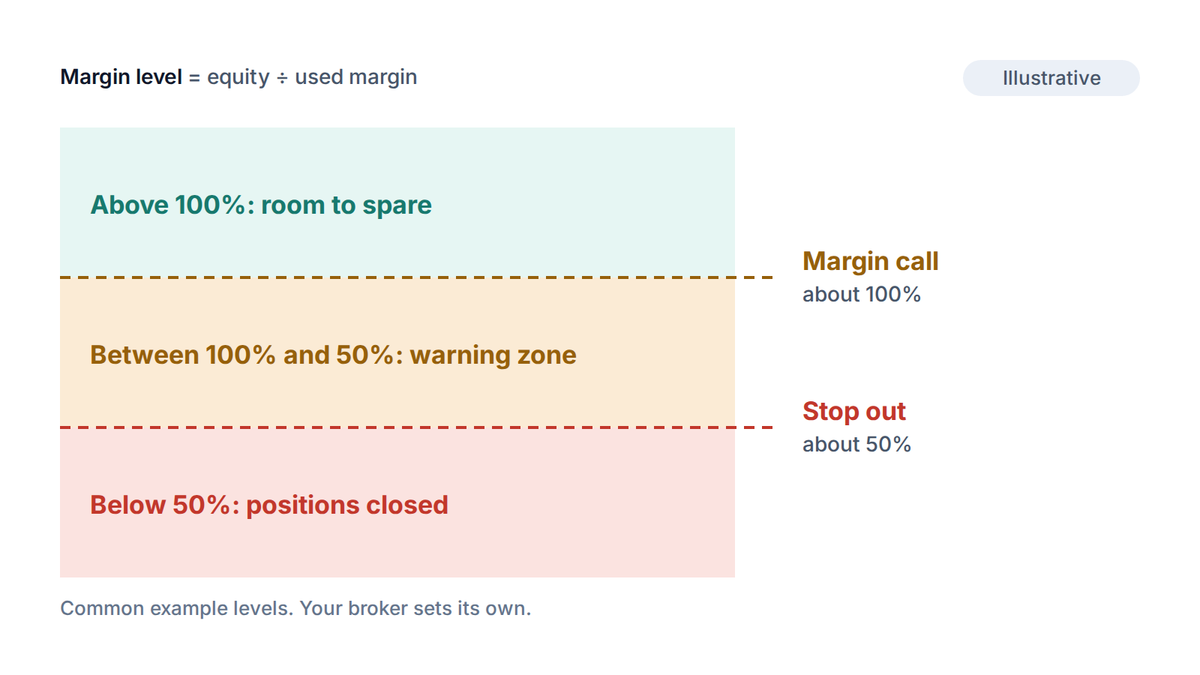
A margin call is a warning that your margin level, equity divided by used margin, has fallen to your broker's set level, often around 100%.
A stop out is the next step: the broker closes positions automatically, often when margin level reaches about 50%, at whatever price is available.
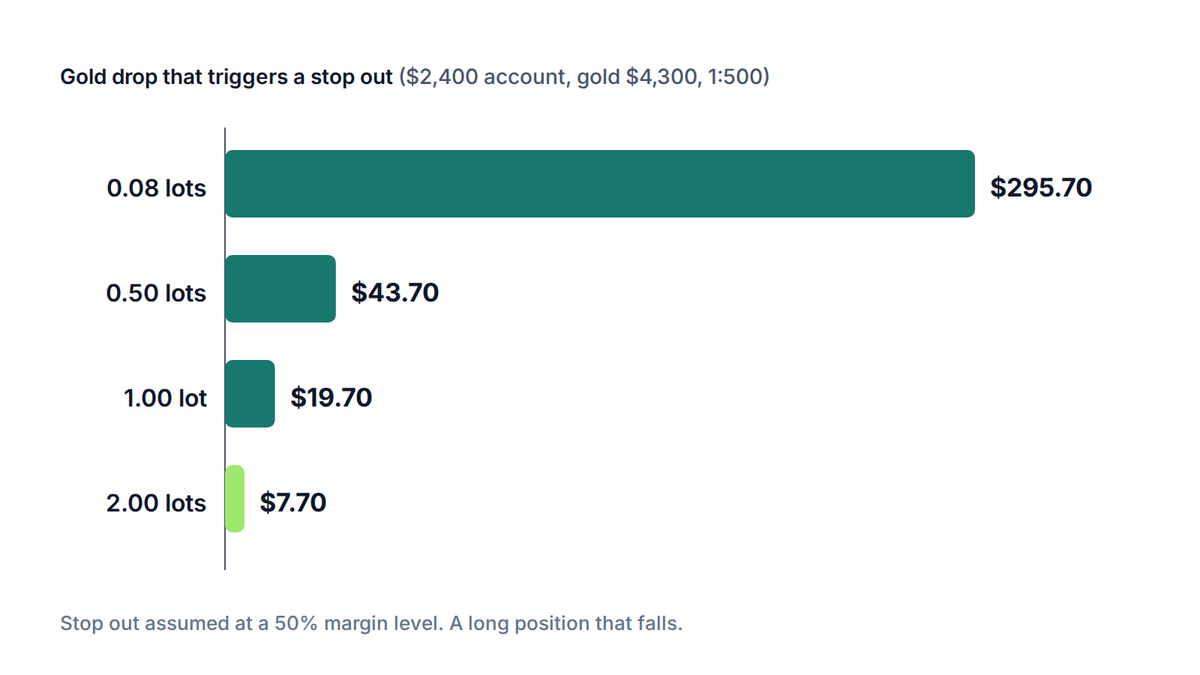
Position size decides how far price can move before either level is reached. On gold at $4,300 with a $2,400 account, 2 lots stop out after a $7.70 drop, while 0.08 lots would need $295.70.
Size from your stop and risk budget, keep used margin small, and watch margin level before news and weekends.
Adding money in a hurry or removing the stop loss is not a fix. Smaller positions are.
What a margin call is in forex and trading
When you open a position with leverage (trading a position larger than your deposit), your broker sets aside part of your balance as margin (the deposit held against the open position). That money is not spent, and it comes back when the trade closes. While the trade is open, though, it cannot cover anything else.
Two more terms matter. Equity is your balance plus or minus the running profit or loss on open trades. Free margin is equity minus the margin currently held, so it is the cushion a losing trade eats into. The lesson on leverage and margin covers these in more depth.
Margin level = (equity ÷ used margin) × 100%
What each variable means:
equity — Balance plus or minus the profit and loss of open positions
used margin — The margin held across everything you have open
Brokers watch this one number. When it falls to the broker's margin call level, you get a warning, usually on the platform and sometimes by email. In forex and in margin call trading generally, a call is not a bill. It is a signal that you are running out of room.
Some brokers also block new positions once the call level is reached. Others only show a warning. Read your broker's terms, because the exact behavior is theirs to define and it differs from firm to firm.
Margin level falls as losses grow. The 100% and 50% levels are common examples that your broker may set differently.
What triggers a margin call
Only one thing moves margin level: equity falling faster than used margin. Used margin barely changes while a trade is open, so in practice a margin call comes from floating losses. A bigger position makes each dollar of price movement cost more, and that is the whole story.
Take the shared example: a $2,400 account, gold at $4,300 per troy ounce (a lot of gold is 100 ounces) and 1:500 leverage. The figures come from the site's margin calculator. Here is what four position sizes look like the moment they are opened.
Gold at $4,300, 1:500 leverage, $2,400 balance, no other positions. Margin level is rounded.
Position
Position value
Margin held
Free margin
Margin level at open
0.08 lots
$34,400
$68.80
$2,331.20
3,488%
0.50 lots
$215,000
$430.00
$1,970.00
558%
1.00 lot
$430,000
$860.00
$1,540.00
279%
2.00 lots
$860,000
$1,720.00
$680.00
140%
Every row is allowed by the platform at 1:500. That is the trap. The platform checks whether you can afford the deposit, not whether the trade is sensible. A 3-lot position would need $2,580 of margin, more than the account holds, so only that one gets refused.
How far price must move
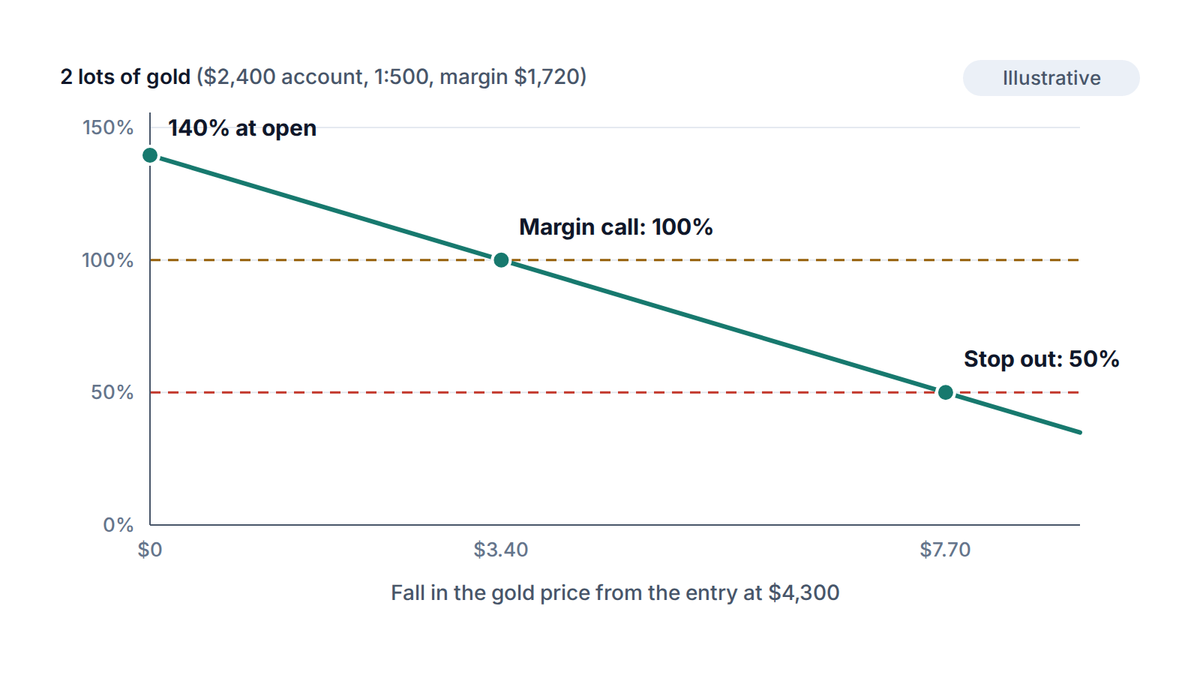
With a margin call at 100%, the call fires when equity equals used margin. For 2 lots, that is $1,720. The account must lose $680 to get there. Two lots hold 200 ounces, so a $3.40 drop does it.
A long gold position that falls. Same account as above, with the two common example levels.
Position
Loss to reach a margin call at 100%
Price drop
Loss to reach a stop out at 50%
Price drop
0.08 lots
$2,331.20
$291.40
$2,365.60
$295.70
0.50 lots
$1,970.00
$39.40
$2,185.00
$43.70
1.00 lot
$1,540.00
$15.40
$1,970.00
$19.70
2.00 lots
$680.00
$3.40
$1,540.00
$7.70
Gold can move several dollars in a normal session, and far more around major data. A $3.40 cushion on 2 lots is thin, but $291.40 on 0.08 lots is a different world. The size of the position decides how much room you have. Leverage only decided whether the platform let you open it.
The price drop that triggers a stop out at 50%. Doubling the position roughly halves the room.
Margin call vs stop out
The two levels are often confused, and the difference matters. A margin call is a warning that leaves the choice to you. A stop out is the broker acting, closing positions on its own without asking you.
Levels vary by broker and account type. Check your own broker's terms.
Margin call
Stop out
What it is
A warning
Forced closing of positions
Common example level
About 100% margin level
About 50% margin level
Who acts
You
The broker's system
Typical effect
Alert, sometimes new positions blocked
Largest losing position closed first, then others if needed
Price you get
Your own choice
Whatever the market offers at that moment
Brokers differ widely on both numbers, and some have only a stop out level with no separate call. Many describe the stop out in their contract terms rather than on the platform, so look for a page on margin or account rules. The guide to reading a broker's gold specs shows the kind of terms to find.
Why the stop out is not a safety net
A stop out feels like a protection, but it fires on the broker's schedule. Prices can jump past the level before the system acts, so the account can fall further than 50%. The closing price is the market price at that moment, not the one you hoped for.
Do not plan around a stop out
If your plan relies on being stopped out, you do not have a plan. A stop loss you place yourself, at a size you chose, always comes first. The stop out is what happens when that discipline has already failed.
Whether a loss can take your balance below zero depends on your broker's rules and your account type. Some brokers offer protection against negative balances and some do not, so check this before you trade a large position.
A walk-through: how an oversized gold trade ends
Say a trader with $2,400 buys 2 lots of gold at $4,300 and sets no stop loss. The margin held is $1,720 and the margin level at open is about 140%. Here is the sequence if gold falls.
2 lots of gold, $2,400 balance, 1:500. Margin level uses used margin of $1,720.
Gold price
Floating loss
Equity
Margin level
What happens
$4,300.00
$0
$2,400
140%
Position open
$4,296.60
$680
$1,720
100%
Margin call
$4,292.30
$1,540
$860
50%
Stop out begins
The whole slide from open to stop out is $7.70. At 200 ounces, that loses $1,540, or 64% of the account. A margin call happens along the way, but a fast market leaves little time to react.
Margin level falls in a straight line as gold drops. The 2-lot position has only $7.70 between opening and a stop out.
Gaps skip the warning
Over a weekend or around a big release, price can jump from one level to another with no trades in between. Suppose gold gaps down $20 against the 1-lot position from the first table. The loss is $2,000 and equity falls to $400.
Margin level is now about 47% against $860 of used margin, below the example stop out level. There was no chance to add funds or close the trade. A margin call that arrives at the same moment as the stop out is a warning in name only.
How to stay well clear of a margin call and stop out
None of this needs a clever trick. Staying away from both levels comes from the same sizing discipline that protects your account anyway.
Size from the stop, not from the margin available. Use the routine in the guide to sizing a gold position. At 1% risk on $2,400, a $3.00 stop gives 0.08 lots, which needs only $68.80 of margin.
Always place a stop loss. It ends the trade at a loss you chose long before margin level matters. At 0.08 lots, a $3.00 stop loses about $24.
Keep used margin small. A common rule of thumb is to hold well under 10% to 20% of equity as margin. Needing most of your balance is a sign the position is too big.
Treat free margin as a warning light, not a target. If a trade would use most of it, skip the trade.
Watch the calendar. Close or shrink positions before major releases and weekends, when gaps are likeliest. The Forex Factory calendar guide shows where to find them.
Count every open position together. Two gold trades are one margin pool, and their losses add up.
Use the margin calculator before you press buy, to see the margin and the free margin left.
Check the lot size. A slip from 0.10 to 1.00 lots is a tenfold change. The article on lot size shows how to read it.
Try it now
Choose Gold (XAU/USD), enter the price, lots, leverage and your balance. The calculator returns the margin held and the free margin left, so you can see how much room a position leaves before you open it.
A call is a signal, not a command. You have three honest choices, and the first is usually the best.
Close or reduce positions. Cutting size raises margin level at once, and you stay in control of which trade goes.
Deposit funds only if the original plan still holds. Money added to rescue a failing trade often just raises the cost of being wrong.
Do nothing and accept the stop out. This hands the decision to the broker's system, at its price.
Do not remove the stop loss
Moving or deleting a stop to avoid a loss is the usual way a margin call becomes a stop out. A stop loss limits the loss in ordinary conditions. It does not remove gap risk, but it removes the option to hope.
Does lower leverage help?
Leverage does not change how much you lose on a move. A 1-lot gold position holds 100 ounces, so it gains or loses $100 for every $1 move, at any leverage. What changes is the margin held, and so how much free margin you have.
Higher leverage lowers the margin held, which raises the margin level at open. That looks safer but is not, because it lets you open a position you should never take. Lower leverage refuses oversized trades on its own, which some traders find a useful brake.
1 lot of gold at $4,300, $2,400 balance. Loss to stop out is equity less half the margin held.
Leverage
Margin on 1 lot of gold
Margin level at open
Loss to stop out at 50%
1:100
$4,300
Not allowed: more than the $2,400 balance
Not applicable
1:200
$2,150
112%
$1,325
1:500
$860
279%
$1,970
The pattern is worth a pause. At 1:200 the account reaches the stop out after a $1,325 loss, and at 1:500 after $1,970. Lower leverage brings the stop out closer for the same position. The fix is a smaller position, not a different ratio.
Frequently asked questions
What does a margin call mean in simple terms?
It means your open losses have used up so much of your account that your broker no longer sees enough cushion behind the margin it holds. It is a warning. If your equity keeps falling, the broker may start closing positions.
What is the margin call level in forex?
There is no universal number. Many brokers use a margin level of around 100% for the call and around 50% for the stop out, but both vary. Find the figures in your broker's account terms before you trade.
Can I lose more than I deposited after a margin call?
It depends on the broker and the account type. Fast markets and gaps can push losses past the stop out level. Some brokers offer negative balance protection and some do not, so confirm this in writing.
How do I avoid a margin call in trading?
Size each trade from your stop and a fixed risk, such as 1% of the account, use a stop loss, keep used margin small and reduce positions before major news. Smaller positions keep margin level far above any broker threshold.
◆
The PipsMorrow Team
A team of writers covering XAU/USD gold trading education. We focus on explaining the mechanics and risk management in a structured way, with no trade signals and no promotion of any specific broker.
Leverage in forex lets a small deposit control a larger position. See how margin differs from leverage, what the numbers look like and how much is too much.
Compounding trading means each period's gain is added to the balance that earns the next. See the math on a $2,400 account, and the risks it leaves out.