
Tools
What Is Drawdown in Trading? How to Measure and Recover
What is drawdown in trading? It is the fall from an account's peak to its next low. Learn to measure it and why a 50% loss needs a 100% gain to recover.
10 min read
Read more →
Trailing drawdown is a loss limit that rises with your best balance. See how end-of-day and intraday trailing differ, with worked numbers on a $50,000 account.
Trailing drawdown is a loss limit that moves up as your account grows and never moves back down. If you are asking what is trailing drawdown, think of a floor that follows your best balance upward, so profit you make today can shrink the room you have tomorrow.
Funded-account programs often use this rule, and it comes in two common versions: end-of-day and intraday. They sound close, yet they can leave you with very different room after the same trades. This guide explains both on one $50,000 example, with every number checked. It is education, not a suggestion to place any trade.
A drawdown (the fall in an account from its peak) limit is the line that says how far you may fall before the account fails. A prop firm evaluation usually has one. Break it, and the account is closed or the evaluation ends.
There are two basic designs. A static limit is fixed at the start: a $50,000 account with a 4% limit fails at $48,000 forever. A trailing limit starts there too, but it chases your profit. Every time you set a new high, the floor moves up by the same amount, and it does not come back down when you lose.
What each variable means:
The phrase trailing max drawdown refers to the same thing. It is the maximum loss the firm lets you have, measured from a moving high instead of from the start. The word trailing is what makes it different from the drawdown you read about in a normal guide to drawdown in trading.
A static limit lets a trader who is up 6% risk a large share of that profit while the firm's own exposure stays the same. A trailing limit protects the firm by locking in part of the gains. For you, the cost is that the cushion built from profit is not really yours to spend.
Rules differ between firms
Firms change their rules often, so this article names none. The numbers below show how each rule type works. Your own program may measure from balance or equity, may reset daily, or may lock the floor at a set level. Treat your rule sheet as the final word.
With an EOD trailing drawdown, the firm looks at your account once a day, at its set cutoff time. The highest closing value so far becomes the new reference, and the floor is that value minus the allowance. Swings during the day do not move the floor.
Say you start with $50,000 and the allowance is $2,000. The floor begins at $48,000. On Day 1 the account rises to $51,500 at its best, then settles to close at $50,800. The EOD reference is the close, so the floor moves to $50,800 − $2,000 = $48,800.
The peak of $51,500 never counted. A rule based on closes only cares about where the day ended, which gives you more breathing room when you trade in and out of profit during the session.
Even so, an EOD rule can still end your account during the day. Most programs also watch for a breach in real time, so if your value touches the current floor, the account can fail before the cutoff. The EOD part only decides when the floor moves up.
People searching for what is intraday trailing drawdown want to know what makes it harsher. The answer is that the floor follows the highest value reached at any moment, so a brief spike counts. That includes open profit (gains on a position that is still running), because equity includes floating results.
Use the same Day 1. The account peaks at $51,500 during the session and closes at $50,800. An intraday rule sets the reference to $51,500 the moment it prints, so the floor is $51,500 − $2,000 = $49,500. It stays there even though you gave back $700 of profit by the close.
| Day 1 item | End-of-day trail | Intraday trail |
|---|---|---|
| Starting balance | $50,000 | $50,000 |
| Best value during the day | $51,500 | $51,500 |
| Closing value | $50,800 | $50,800 |
| Reference used | $50,800 | $51,500 |
| Floor after Day 1 | $48,800 | $49,500 |
| Room above the floor at the close | $2,000 | $1,300 |
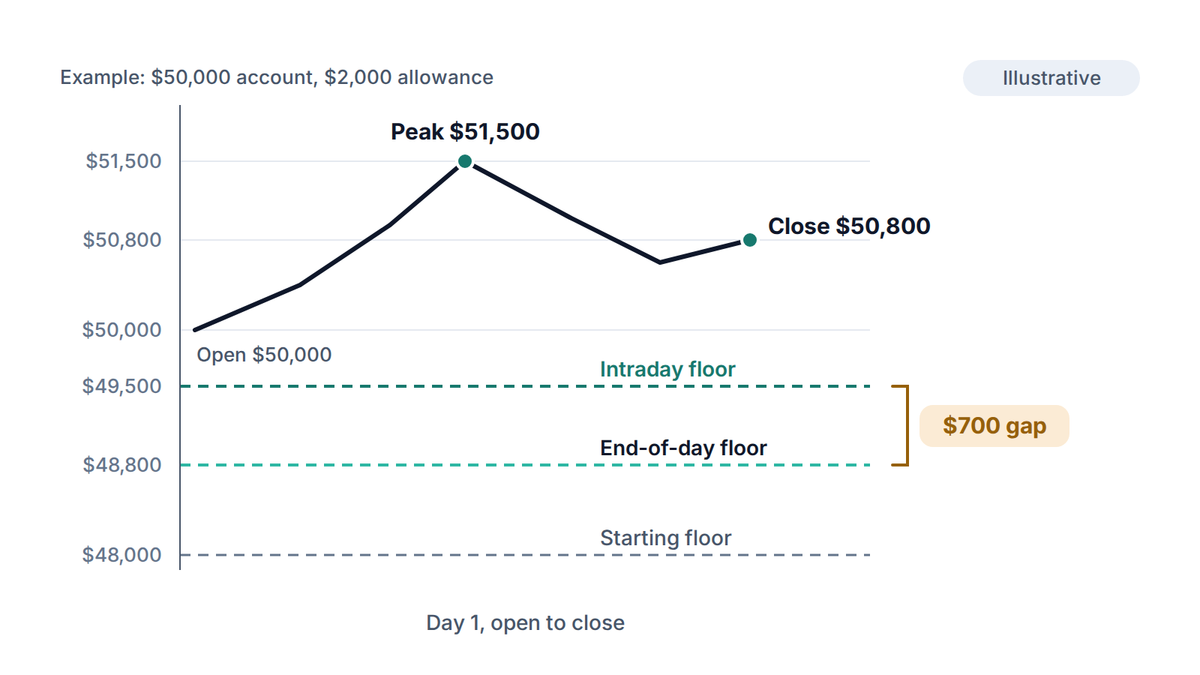
Under an intraday rule, a position that is $1,500 in profit raises your floor by $1,500 even if you have not closed it. If price turns and you exit at break-even, the floor stays where the peak put it. You have the same balance as before and less room.
A trade can fail you without a loss
With an intraday trail, a winning trade that reverses can leave you closer to the floor than you started. Check whether your rule counts open profit, and plan your exits with that in mind.
One day shows a small gap. Two days show how it grows. On Day 2 the account opens at $50,800, peaks at $52,300 and closes at $50,600, a net loss of $200 on the day. Both rules here stop the floor from rising above the $50,000 starting balance, a lock many programs use.
| Moment | Static | End-of-day trail | Intraday trail |
|---|---|---|---|
| Start | $48,000 | $48,000 | $48,000 |
| Day 1 close ($50,800) | $48,000 | $48,800 | $49,500 |
| Day 2 close ($50,600) | $48,000 | $48,800 | $50,000 |
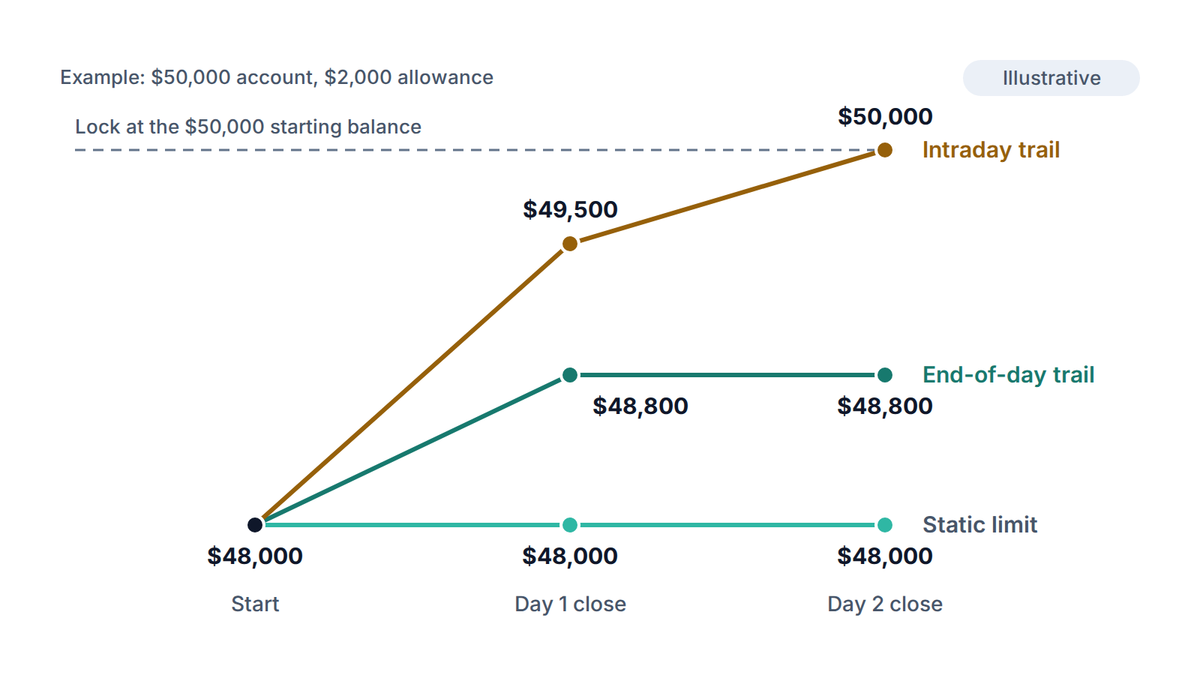
At the Day 2 close your balance is $50,600. That leaves $2,600 of room under the static rule, $1,800 under the EOD trail and just $600 under the intraday trail. The account is up $600 from the start, yet the intraday rule leaves you one normal losing trade away from failing.
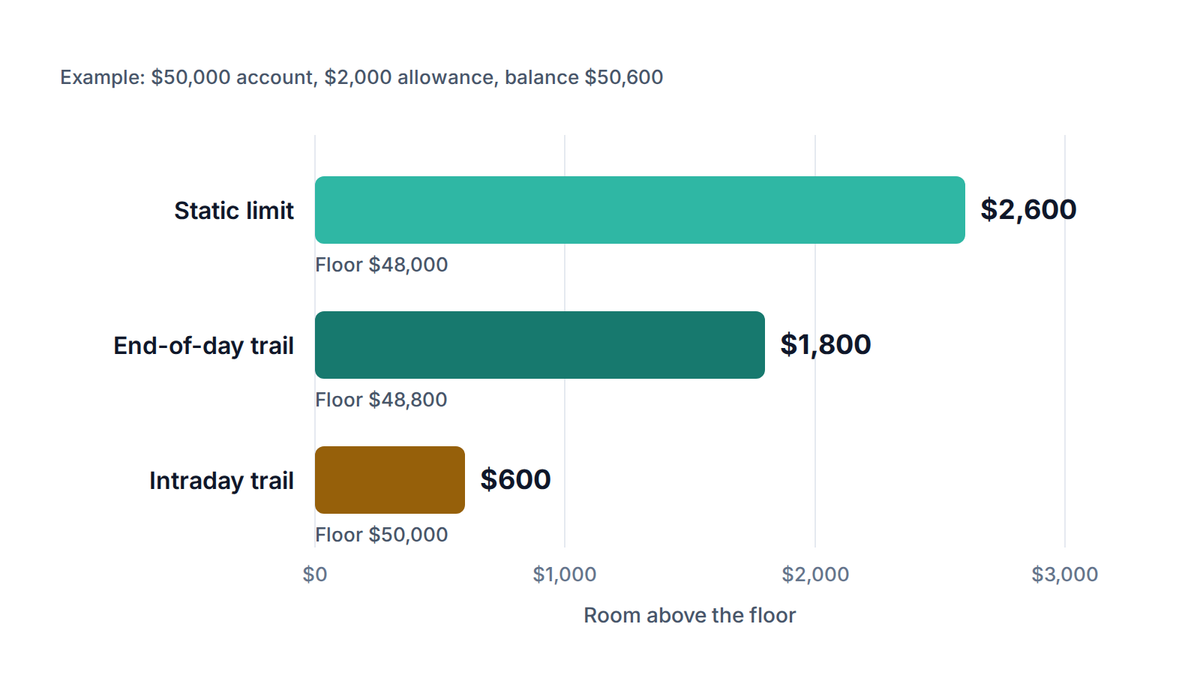
The effect on trade size is direct. At 1% risk per trade, a $50,600 balance puts $506 on the line. Under the intraday trail you have room for one such loss and the second would hit the floor. Under the EOD trail you can take three. The site's prop firm drawdown calculator returns those counts for your own inputs.
A trailing limit changes what risk per trade means. Your real budget is the gap to the floor, not your balance. When the gap is $600, a 1% risk on a $50,600 balance is most of what you have, so sizing from the balance would be a mistake.
Trailing rules also reward patience. Because the floor only rises, a big early win can leave you with less margin for error than a steady start. That is one reason many traders keep early risk small and let the account build a larger gap over time. The lesson on prop firms and evaluation rules covers the other rules you may meet, such as daily loss limits.
Test your rule before you pay for it
Put your program's numbers into a calculator and replay a bad day. If a normal losing streak would break the limit, the rule is telling you to size down before you start.
Try it now
Enter the account size, the allowance, whether the limit is trailing and your highest balance. The calculator returns the floor, the room you have left and how many losing trades at your risk setting still fit.
The calculator asks for closed balances, and open losses usually count at the firm too, so leave yourself margin. For the wider picture of how a falling account behaves, see the lesson on drawdown.
It is a loss limit whose floor rises with your highest tracked balance or equity. The floor equals that high minus a fixed allowance, and it never drops when you lose. Many programs stop it from rising past the starting balance.
It is a trailing limit that updates the moment your account reaches a new high during the day, including open profit. A brief spike can lift the floor, even if you give the gain back before the close.
An EOD trailing drawdown moves the floor only from the closing value each day. An intraday one moves it from any peak. On a $50,000 account with a $2,000 allowance and a $51,500 peak that closes at $50,800, the floors are $48,800 and $49,500.
Often it does. Many programs lock the floor at the starting balance once you have earned the allowance, so on a $50,000 account it stops at $50,000. Others never lock. Your rule sheet decides, so check it before you plan.
The PipsMorrow Team
A team of writers covering XAU/USD gold trading education. We focus on explaining the mechanics and risk management in a structured way, with no trade signals and no promotion of any specific broker.
Last updated
What is drawdown in trading? It is the fall from an account's peak to its next low. Learn to measure it and why a 50% loss needs a 100% gain to recover.
10 min read
Read more →Compounding trading means each period's gain is added to the balance that earns the next. See the math on a $2,400 account, and the risks it leaves out.
9 min read
Read more →How to size a position on gold to the risk you can afford: a five-step routine, worked numbers on a $2,400 account and the traps that turn 1% into 10%.
8 min read
Read more →Build on this article with the full gold trading curriculum, ordered from the basics to advanced topics, free.

