
Technical analysis
ATR Indicator: How to Read It and Size Stops
The ATR indicator measures how far price normally moves. Learn how to read it, how it is calculated and how to size stops, targets and lots with it.
11 min read
Read more →
Buy limit vs buy stop: one waits for a lower price, the other for a breakout. See how each pending order works, with forex and gold examples and sell versions.
The choice of buy limit vs buy stop comes down to one question: do you want to buy cheaper than the market, or only once it has proven it can climb? Both are pending orders (instructions that wait for a price you name), but they sit on opposite sides of the current price and do opposite jobs.
This guide explains what a buy limit order is, how a buy stop differs, and how the sell versions mirror them. It uses EUR/USD and gold, not shares, and finishes with how to size each trade. It teaches mechanics, not trade calls.
A market order buys or sells right now at the price on screen. A pending order does not. You set a price, and the platform opens the position only if the market reaches it. Until then nothing is open, and in most setups no margin (the deposit a position locks up) is held.
Every pending order is a limit order or a stop order, and the direction decides the rest. Whether it sits above or below the current price depends on only two facts: whether you are buying or selling, and whether you want a better price or confirmation.
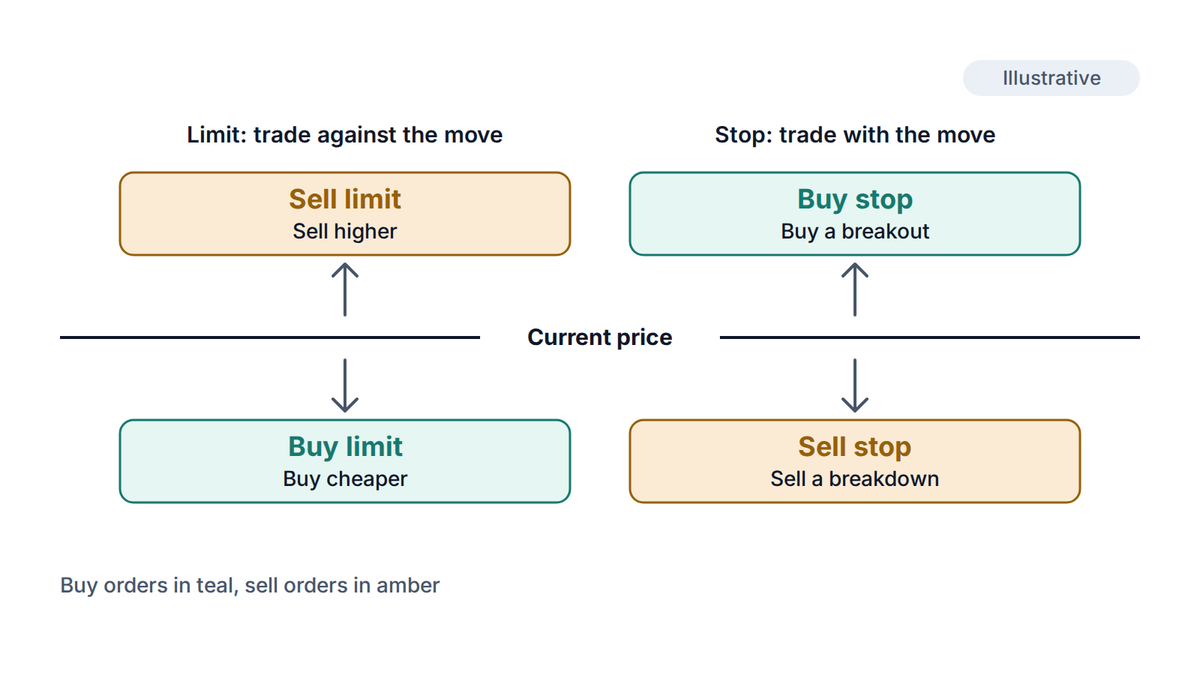
Hold on to this layout and the four names stop being confusing. The lesson on order types and when to use each covers the full set, including market orders.
A buy limit is placed below the current price. It says: buy if the market falls to this level, and never pay more than it. The idea behind a buy limit is that price may dip to support (an area where buyers have stepped in before) and bounce.
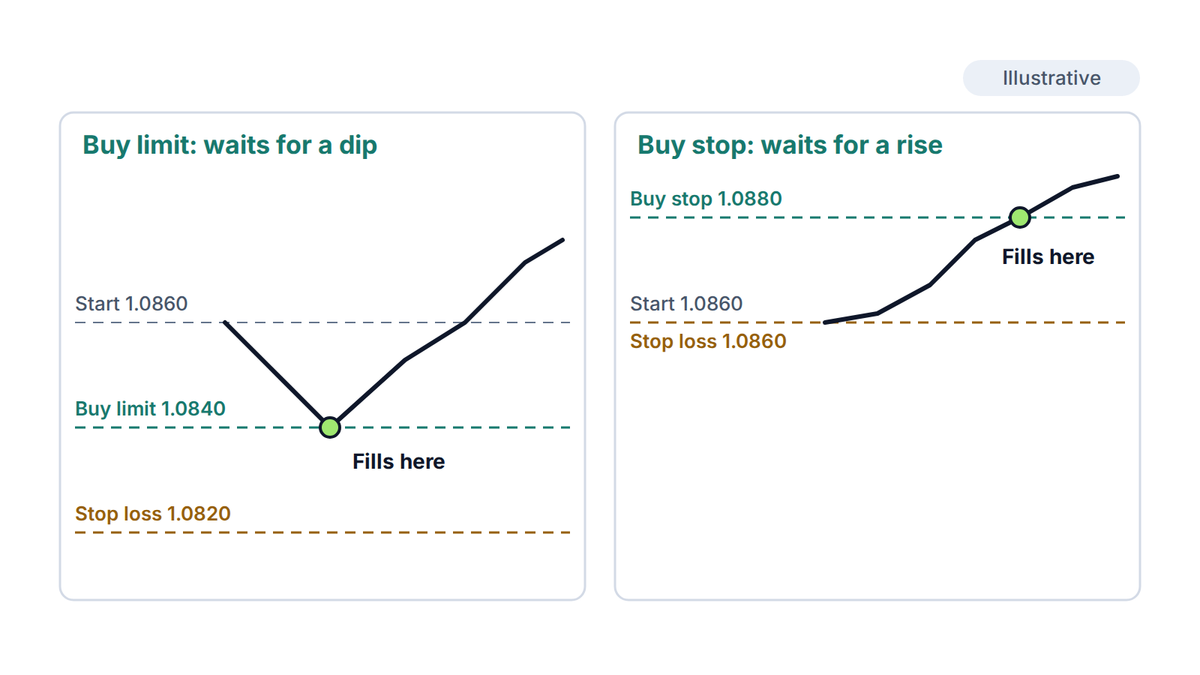
Take EUR/USD trading at 1.0860. You expect a dip toward 1.0840 and want to be long there, with a stop loss (an exit order that caps the loss) at 1.0820. You place a buy limit at 1.0840. If the price never falls that far, nothing happens.
Because a buy limit buys cheaper, the stop loss can usually be placed closer. The same logic works on gold. With gold at an assumed $4,300, a buy limit at $4,280 would sit $20 below the market, with a stop loss at $4,270.
A buy stop is placed above the current price. It says: buy if the market rises to this level. You are not seeking a bargain. You want proof that buyers are in control, such as a close above a resistance level (an area where sellers have capped price before).
With EUR/USD still at 1.0860, a buy stop at 1.0880 waits for a move 20 pips higher. A pip is the usual smallest price step, 0.0001 on this pair. If the market reaches 1.0880, the order becomes a market buy, with a stop loss at 1.0860.
On gold, a buy stop at $4,320 with the market at $4,300 works the same way. It would trigger only if gold trades $20 higher.
Flip everything and you have the sell side. A sell limit sits above the price and sells a rally at a better price. A sell stop sits below the price and sells a breakdown. The words limit and stop keep their meaning.
| Pending order | Placed | Triggers when | Idea behind it |
|---|---|---|---|
| Buy limit | Below price | Price falls to it | Buy a pullback |
| Buy stop | Above price | Price rises to it | Buy a breakout |
| Sell limit | Above price | Price rises to it | Sell a rally |
| Sell stop | Below price | Price falls to it | Sell a breakdown |
One detail trips up new traders. Buy orders trigger on the ask price (what you pay to buy) and sell orders on the bid (what you get when selling). The gap between them is the spread, so a sell stop and a buy stop at similar levels do not trigger at identical moments.
A quick way to check your order
If your platform rejects a pending order, the price is on the wrong side. A buy limit above the market, or a buy stop below it, is the usual cause. Most platforms also require a minimum distance from the current price.
The two types fill differently, and this matters more than the direction. A limit order is a promise about price. A stop order is a promise about getting in.
Once price touches a buy stop, it becomes a market order. If the market is jumping, such as at a data release, the next price may be several pips past your level. That gap is slippage (the difference between the price you expected and the price you got).
Say your 1.0880 buy stop fills at 1.0884, with the stop loss still at 1.0860. The stop distance is now 24 pips, not 20. At 0.12 lots, that is a loss of 0.12 × 24 × $10 = $28.80, or 1.2% of a $2,400 account, instead of the planned $24.
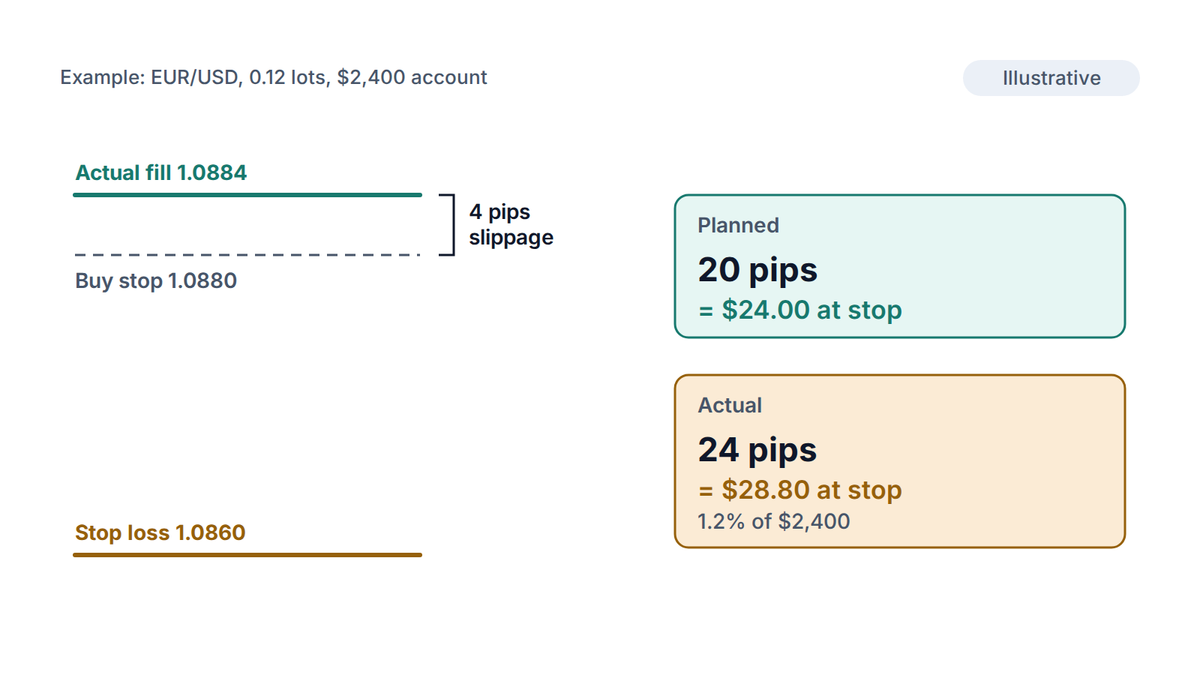
A buy limit avoids this on entry, because it fills at your price or better. Its cost is different: it can sit unfilled while price leaves without you. You trade fill certainty against price certainty. You cannot have both.
The lesson on execution, slippage and requotes goes deeper on why fills differ. The economic calendar guide shows when fast markets are scheduled.
A buy stop limit has two prices. The stop price is the trigger above the market. When it is touched, the platform places a buy limit at a second, lower price, which you also set. MetaTrader 5 offers it. MetaTrader 4 does not.
Say EUR/USD is 1.0860. You set the stop price at 1.0880 and the limit price at 1.0870. Price must first reach 1.0880, which confirms the breakout. Then your order waits to buy at 1.0870 or better, on the retest (a pullback to the broken level).
Don't confuse a buy stop limit with a plain buy stop. The buy stop limit is not a way to guarantee a good fill on a spike. It can simply stay unfilled.
Use the order that matches your reason for the trade. If you think a level will hold, a limit order buys it. If you think a level has to break first, a stop order waits for that. Pick the reason first, then the order type.
| Situation | Order that fits | Main risk |
|---|---|---|
| Price is extended, you expect a dip to support | Buy limit | Never fills, or support fails |
| Price is in a range below resistance | Buy stop above resistance | False breakout, slippage |
| You want the breakout and a better price | Buy stop limit (MT5) | Misses a clean run |
| You cannot watch the chart | Either, with an expiry | Fills during news |
Then size the trade from the price where the order would fill. Use the site's shared example, a $2,400 account risking 1%, which is $24. The numbers below come from the lot size calculator.
| Order | Entry | Stop loss | Stop distance | Lot size | Loss at stop |
|---|---|---|---|---|---|
| Buy limit, EUR/USD | 1.0840 | 1.0820 | 20 pips | 0.12 | $24.00 |
| Buy stop, EUR/USD | 1.0880 | 1.0860 | 20 pips | 0.12 | $24.00 |
| Buy limit, gold | $4,280 | $4,270 | $10.00 | 0.02 | $20.00 |
On gold, the exact size for $24 would be 0.024 lots, which rounds down to 0.02 and risks $20. If you change a pending order's price, change the lot size too. A wider stop needs a smaller size.
Try it now
Enter your balance, risk percentage, instrument and stop distance. The calculator returns the lot size to use for the price where the order would fill.
The article on lot size explains the sizes themselves. For gold, see how to size a position.
A pending order does not know a data release is coming. A buy stop sitting under a jobs report can fill in a spike with heavy slippage. The piece on gold before NFP shows how fast markets move around releases.
A pending order stays alive until it fills, expires or you cancel it. If your view changed, the order did not. Set an expiry (a time at which the platform cancels it) such as the end of the day, or remove it when the idea ends.
A sell limit and a sell stop are easy to swap by accident. Placed in the wrong spot, the platform may reject the order, or you may sell a breakdown when you meant to sell a rally. Check the position against the price ladder before you confirm.
A filled order means price reached your level. It does not mean the idea is right. Plan the stop loss before you place the order, and assume some pending orders will lose.
A buy limit order is a pending order to buy at a set price or lower. It sits below the current price and fills only if the market falls to it. On EUR/USD at 1.0860, a buy limit at 1.0840 waits for a 20-pip drop.
A buy limit is below the current price and buys a dip. A buy stop is above the current price and buys a rise. The limit fills at your price or better. The stop fills at the next available price, which can be worse.
It is a two-price order, offered on MetaTrader 5. When price hits the stop price, the platform places a buy limit at your lower limit price. It avoids chasing a breakout, but can leave you unfilled.
Neither is safe on its own, because both open a position that can lose money. A limit order controls the entry price. A stop order controls whether you enter. Risk is set by your stop loss and lot size.
The PipsMorrow Team
A team of writers covering XAU/USD gold trading education. We focus on explaining the mechanics and risk management in a structured way, with no trade signals and no promotion of any specific broker.
Last updated
The ATR indicator measures how far price normally moves. Learn how to read it, how it is calculated and how to size stops, targets and lots with it.
11 min read
Read more →Revenge trading is trading to win back a loss instead of following a plan. Learn the warning signs of tilt, what it costs and the rules that stop it.
10 min read
Read more →What is a margin call? It is your broker's warning that equity is close to the margin held. See the numbers, the stop out that follows and how to avoid both.
10 min read
Read more →Build on this article with the full gold trading curriculum, ordered from the basics to advanced topics, free.

