
Getting started
Buy Limit vs Buy Stop: Which Pending Order to Use
Buy limit vs buy stop: one waits for a lower price, the other for a breakout. See how each pending order works, with forex and gold examples and sell versions.
10 min read
Read more →
Revenge trading is trading to win back a loss instead of following a plan. Learn the warning signs of tilt, what it costs and the rules that stop it.
Revenge trading is placing a trade to win back a loss rather than because your plan says to. The loss stings, so you open another position fast, usually bigger, hoping the market will pay you back. It is one of the quickest ways a small bad day becomes a damaged account.
This guide explains what revenge trading is, the revenge trading psychology behind it and the warning signs that tilt (an emotional state where anger or frustration drives your decisions) has started. It then shows what a spiral costs on a $2,400 account and gives you rules for how to stop revenge trading. It is education, not a signal to place any trade.
When people ask what is revenge trading, the plain answer is a trade driven by the last loss. The market did not wrong you, but it can feel that way. The urge is to get the money back from the same market, right now, and the plan gets dropped in the rush.
It is not the same as taking a second trade after a loss. A planned second trade follows the same rules as the first. A revenge trade breaks them. It may be larger, sit at a worse price, skip the stop loss or come from a setup you would have passed on an hour earlier.
| Planned trade after a loss | Revenge trade | |
|---|---|---|
| Why it is placed | The setup in your plan appeared | To win back what was lost |
| Size | Same risk per trade as always | Larger, to recover faster |
| Stop loss | Set before entry | Wide, moved or missing |
| Timing | When the setup forms | Within minutes of the loss |
| Feeling | Neutral, a little bored | Angry, tense, in a hurry |
Revenge trading psychology comes down to how people feel about losses. A loss hurts more than an equal gain pleases, and the mind wants to undo it. A closed losing trade feels unfinished until it is repaid, even though the next trade has nothing to do with the last one.
Two things make it worse in trading. Markets are open for long hours, so the next chance is always one click away. And leverage (borrowing that lets you control a large position with a small deposit) makes it easy to size up in a few seconds. Nothing physical slows you down.
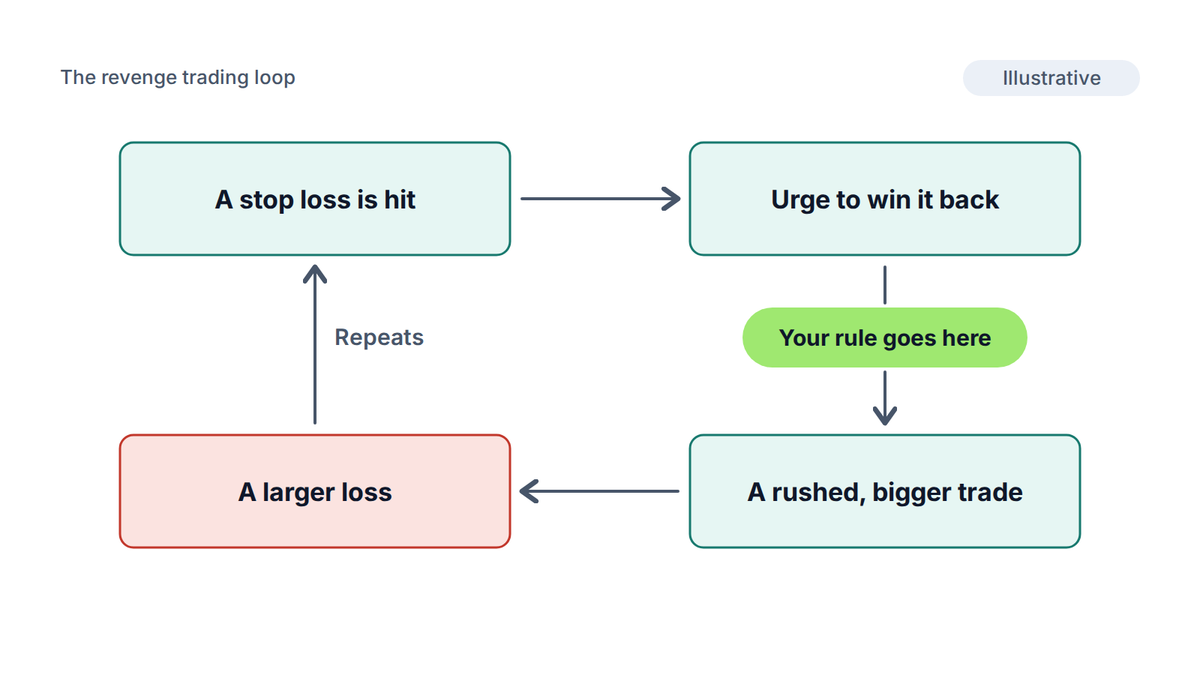
Poker players call this state tilt, and traders borrowed the word. The trouble is that tilt feels like clear thinking from the inside. You believe you are being decisive. So the best warning signs are things you can check in your behavior, not in your mood.
Revenge trading is not only a reaction to a loss. It can follow a winning streak that ends, a missed move you watched without a position, or a stop that was hit just before price went your way. Any of these can start the loop.
A two-question check
Before you place a trade, ask: would I take this exact trade if I had not just lost? And is the size what my rule says? If either answer is no, the trade is probably about the last one.
The damage compounds because each loss comes off a smaller balance and each revenge trade is bigger than the last. Take the site's shared $2,400 account and a plan that risks 1% per trade, which is $24.
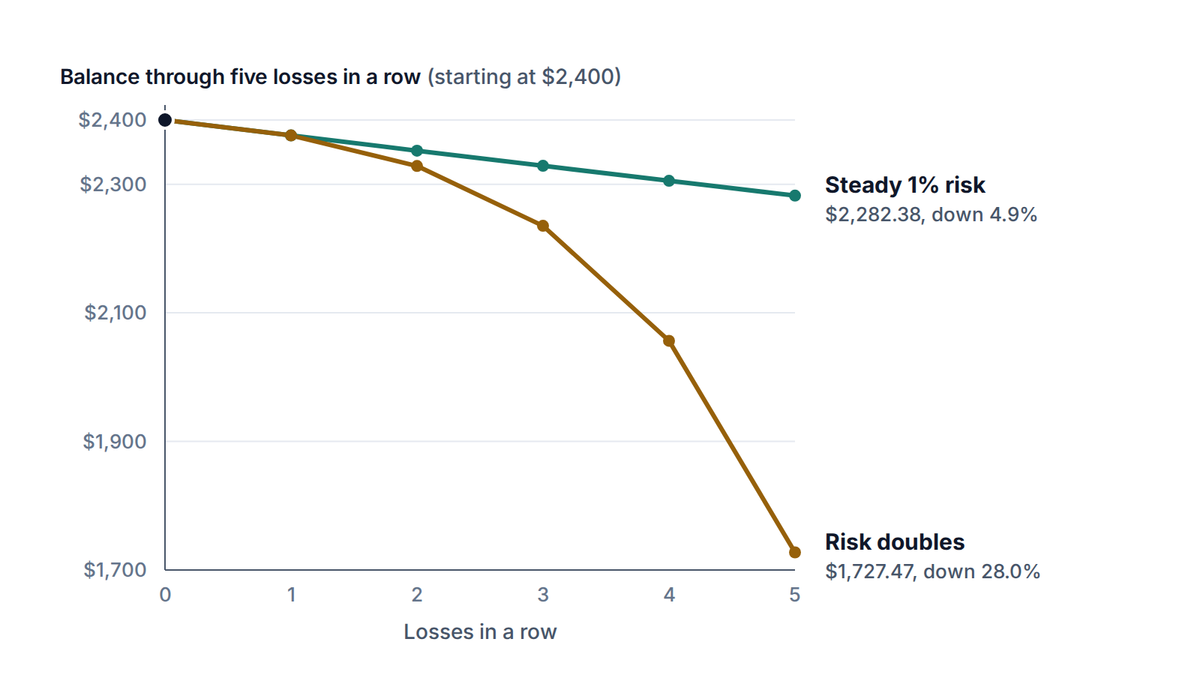
First, the plan holds. Five losses in a row at 1% each leave $2,282.38. That is a drawdown (the fall from a peak to a later low) of 4.9%, and a 5.2% gain restores the balance. It is an unpleasant afternoon, not a crisis.
Now suppose each loss makes you double the next risk: 1%, 2%, 4%, 8% and then 16% of the balance at that moment. All five lose. The figures below come from the drawdown calculator, one trade at a time.
| Trade | Risk | Balance after the loss |
|---|---|---|
| Start | $2,400.00 | |
| 1 | 1% | $2,376.00 |
| 2 | 2% | $2,328.48 |
| 3 | 4% | $2,235.34 |
| 4 | 8% | $2,056.51 |
| 5 | 16% | $1,727.47 |
Same five losses, same market, but the account is down 28.0% instead of 4.9%. To get back to $2,400 from $1,727.47 you need 38.9%, against 5.2% on the steady path. The size, not the number of losses, did most of the harm.
Doubling down is not a recovery plan
Raising size after a loss does not change the odds of the next trade. It only raises how much a bad run takes. The article on what drawdown is shows why the gain needed grows faster than the loss.
Willpower is a poor tool here, because the moment you most need it is the moment it is weakest. The better answer to how to stop revenge trading is to make the decision earlier, when you are calm, and write it down. Then you are only following instructions.
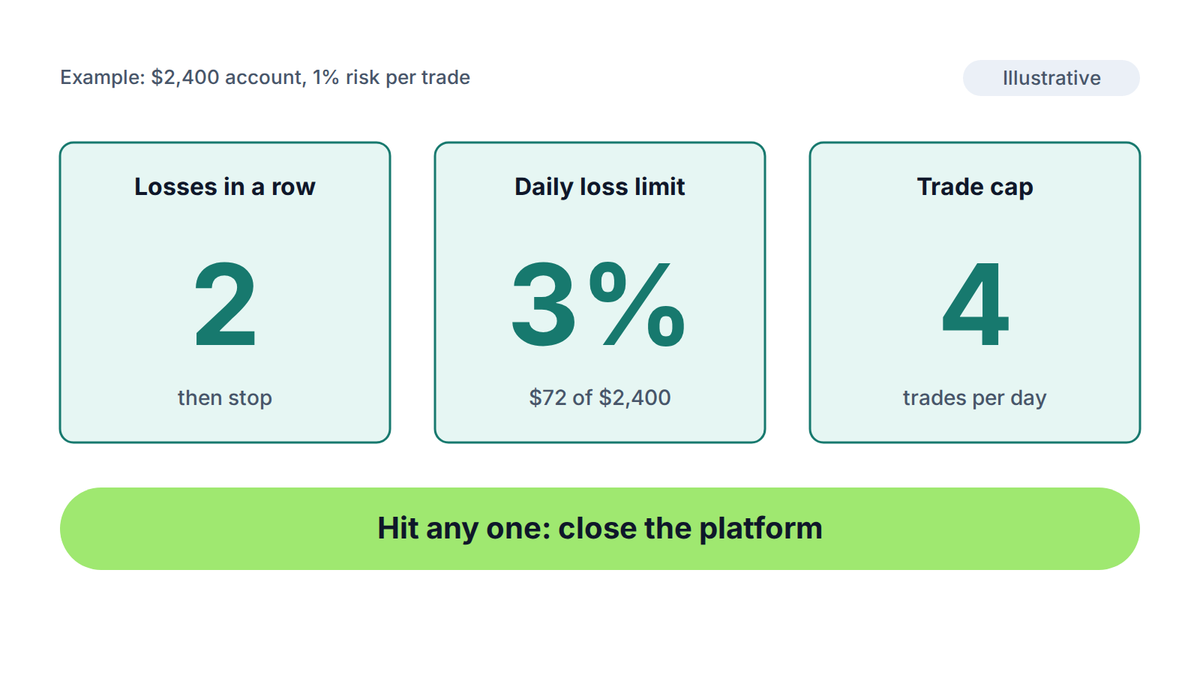
A daily limit works because it turns a feeling into a number. At 3% of $2,400 the most you can lose in a day is $72, so a bad day ends at $2,328. Compare that with the $672.53 lost in the doubling example above.
None of this makes losses disappear. A loss is a cost of trading, and the aim is to keep it a normal-sized one. If a drawdown has already begun, the lesson on tilt, revenge trading and the reset walks through a reset routine in more detail.
Most revenge trades are set up hours earlier by tiredness, stress or a plan that is vague. Prevention is cheaper than the cure, and it mostly means making each day more routine.
Expect to slip sometimes. Everyone who trades long enough takes a revenge trade eventually. What counts is how fast you notice and how small the damage stays. Keep the risk-reward ratio in mind too: a plan with a sensible ratio does not need every loss repaid at once.
Try it now
Before you trade, test what a bad run would do to your own balance. Enter your balance, the number of losses and the loss per trade to see the ending balance and the gain needed to recover.
Revenge trading is trading to recover a loss quickly rather than to follow a plan. It usually means a larger size, a rushed entry and a weak or missing stop loss, placed soon after the previous loss.
Set rules before you trade: a fixed risk per trade, a daily loss limit and a cap on trades per day. When one is hit, close the platform and take a break. Writing down what happened helps you spot the pattern next time.
They are closely linked. Tilt is the emotional state of anger or frustration that clouds judgment. Revenge trading is one common behavior that comes out of it, along with overtrading and moving stops.
There is no fixed answer. Many traders use at least 30 minutes after a hard loss and stop for the day after hitting a daily limit. Pick a rule that you will actually follow and put it in writing.
The PipsMorrow Team
A team of writers covering XAU/USD gold trading education. We focus on explaining the mechanics and risk management in a structured way, with no trade signals and no promotion of any specific broker.
Last updated
Buy limit vs buy stop: one waits for a lower price, the other for a breakout. See how each pending order works, with forex and gold examples and sell versions.
10 min read
Read more →Gold jewelry vs gold bars: how purity, making charges, premiums, buy-back spreads and VAT make the same gram cost more to buy and return less when sold.
12 min read
Read more →The ATR indicator measures how far price normally moves. Learn how to read it, how it is calculated and how to size stops, targets and lots with it.
11 min read
Read more →Build on this article with the full gold trading curriculum, ordered from the basics to advanced topics, free.

