
Gold
Gold Market Open Time: XAU/USD Trading Hours
Gold market open time in New York time and UTC: when XAU/USD opens on Sunday, the daily break, the weekly close and the busiest hours of the week.
10 min read
Read more →
Forex market holidays do not close the market, but they thin it out. See which days to watch, from Christmas to New Year, and what happens to gold spreads.
Forex market holidays are less about a closed sign and more about a quiet room. There is no exchange to shut, so currencies keep trading, but the banks and funds that provide most of the liquidity (how easily you can trade without moving the price) are often away. This guide gives the calendar for the rest of 2026 and early 2027, and shows what thin trading does to gold.
It is written for beginners, so each term is explained as it appears. If you want the weekly hours first, read when the gold market opens, then come back here for the holiday exceptions.
The short answer to what holidays the forex market is closed is: none, officially. Nobody owns forex, so nobody declares a holiday. Spot currency prices come from a network of banks, brokers and liquidity providers, and the network stays connected as long as some of them are quoting.
In practice three things can still stop you from trading. First, your broker can close its platform or stop new positions on certain dates. Second, the weekend still applies: the market pauses from Friday 5 p.m. to Sunday 5 p.m. New York time in the usual forex convention. Third, related markets such as futures and the London gold benchmarks can close, and brokers often follow them.
That is why the useful question is not whether the market is open. It is how many people are trading. A market with few participants behaves differently, even if the clock says it is open. The forex session times guide explains the normal daily pattern, and the lesson on sessions, liquidity and the clock covers why it matters.
Most large forex volume passes through London and New York. When one of those cities is on holiday, half the usual dealers are missing. When both are, as around Christmas Day and New Year's Day, only smaller regional desks quote. With fewer buyers and sellers, a single large order moves price further, and dealers protect themselves by widening spreads.
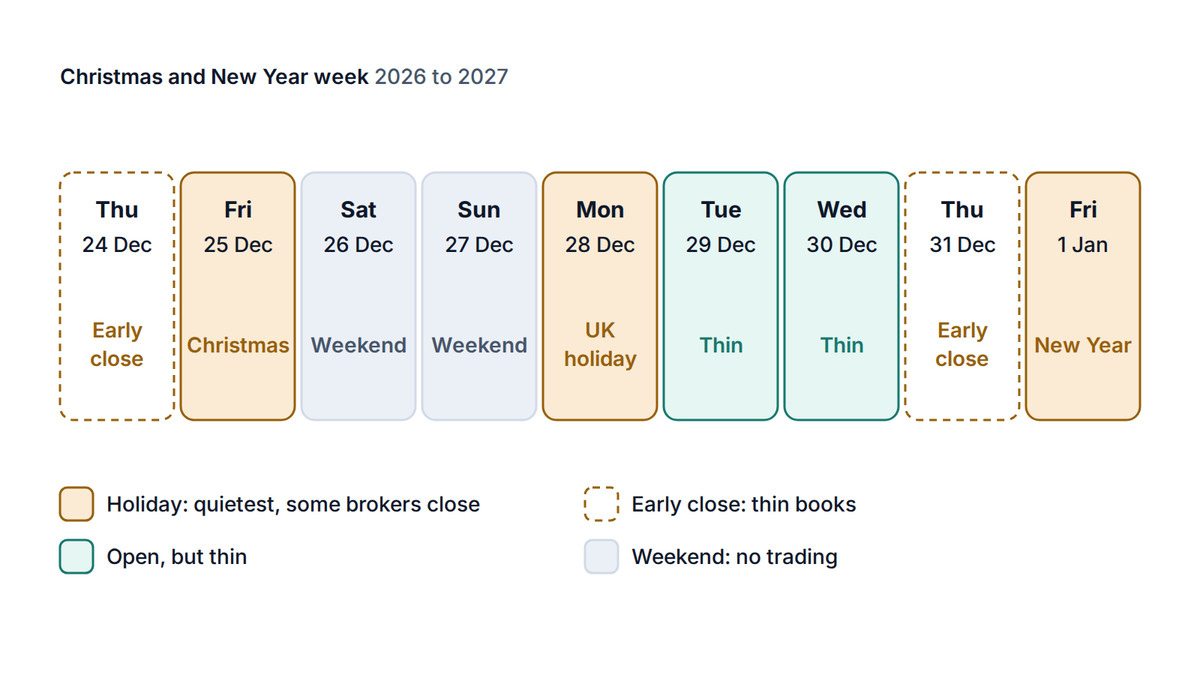
These are the dates where liquidity is most likely to drop for the rest of 2026 and the start of 2027. Weekdays are checked against the calendar. Treat it as a watch list, not a closing schedule: brokers decide their own hours.
| Date | Day | Holiday | What to expect |
|---|---|---|---|
| 26 Nov 2026 | Thursday | US Thanksgiving | US banks and stock exchanges closed. Thin New York session, with shortened futures hours possible the same day and the day after. |
| 24 Dec 2026 | Thursday | Christmas Eve | Many desks leave early. Futures markets run shortened hours and the London gold PM price auction may not run. |
| 25 Dec 2026 | Friday | Christmas Day | Quietest day of the year. Futures closed, no London gold prices published in recent years, and some brokers close. |
| 26 Dec 2026 | Saturday | Boxing Day | Weekend, so no trading. The UK holiday moves to Monday 28 Dec. |
| 28 Dec 2026 | Monday | UK substitute holiday | London is closed, so New York trades alone for the day. Expect thin trading. |
| 31 Dec 2026 | Thursday | New Year's Eve | Early closes and thin books. Some brokers widen spreads early in the day. |
| 1 Jan 2027 | Friday | New Year's Day | Most markets closed. Many brokers pause or run limited hours. |
| 26 Mar 2027 | Friday | Good Friday | Not a US federal holiday, but most stock exchanges and many brokers close or trade lightly. Easter Monday follows on 29 Mar. |
Refresh before you rely on it
Exchanges publish their holiday hours about two weeks ahead, and brokers post theirs on their own sites. Check both in the week before any date in the table. The same dates move by a day or two each year, so do not reuse a calendar from last year.
Gold is more exposed than most currency pairs, because its price formation leans on London and on US futures. Spot gold (XAU/USD, the price of one troy ounce of gold in US dollars; a troy ounce is the standard precious-metals unit, about 31.1 grams) usually keeps a quote at brokers on holidays. The quote is just thinner.
Two anchors disappear. The LBMA Gold Price, a benchmark set in London auctions, was not published on 25 Dec, 26 Dec or 1 Jan in the LBMA's notice for the 2025 to 2026 holiday period. In earlier years the afternoon auction also did not run on 24 and 31 Dec. The 2026 to 2027 notice may differ, so check lbma.org.uk. On the US side, CME Group lists holiday schedules for 24 to 26 Dec 2026 and 31 Dec 2026 to 1 Jan 2027, with hours confirmed about two weeks before.
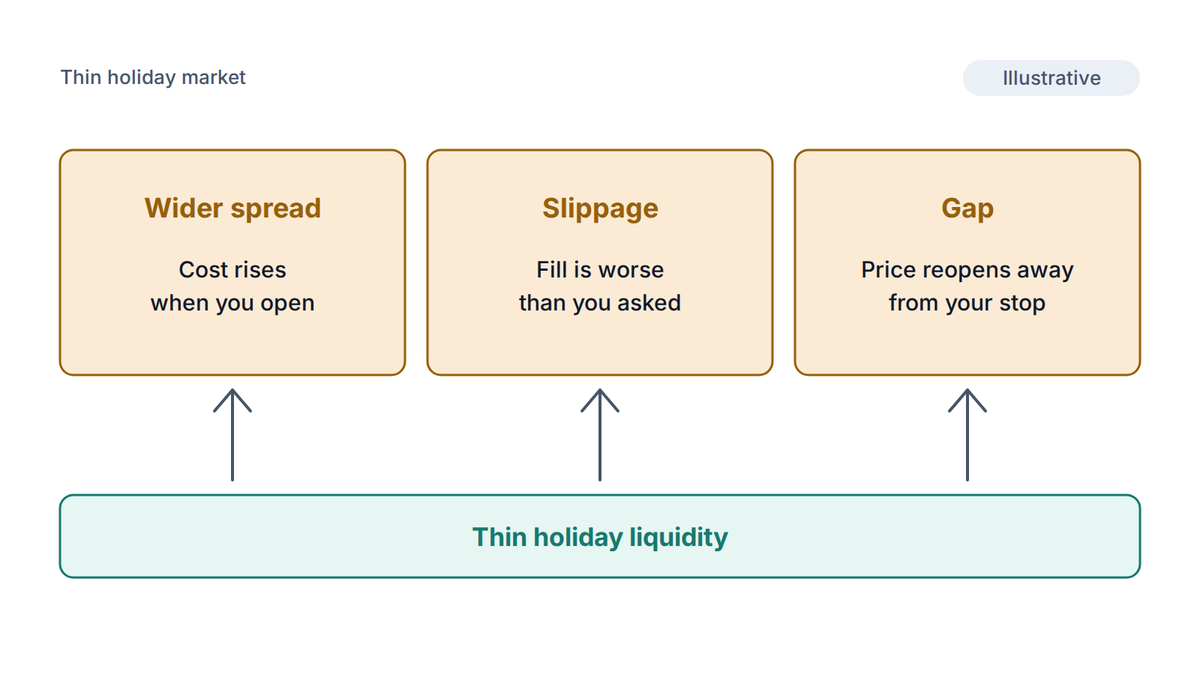
When the benchmarks and futures are quiet, banks have less reason to trade gold and the market-makers behind your broker's quote take more risk with every client order. They price that risk into the spread. The result is a wider spread, and a higher chance that price jumps on little news. The article on what spread is in forex covers how that cost is built, and the lesson on what a trade really costs puts it next to swap and commission.
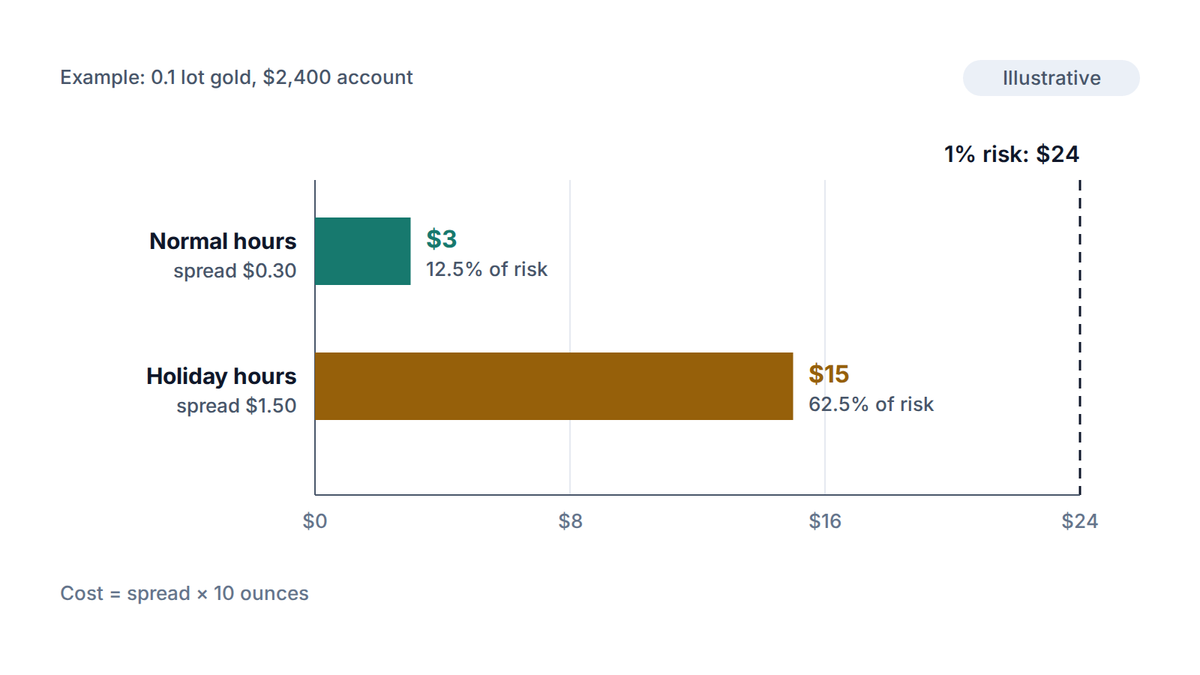
Take the site's usual example: a $2,400 account risking 1% per trade, which is $24. You buy 0.1 lot of gold. One lot is 100 troy ounces, so 0.1 lot is 10 ounces, and each $1 move in gold is worth $10 on that position. Assume a normal spread of $0.30 and a holiday spread of $1.50. Both figures are illustrations, not quotes from any broker.
| Spread on gold | Cost on 0.1 lot (10 ounces) | Share of the $24 you plan to risk |
|---|---|---|
| $0.30 (normal hours) | $3.00 | 12.5% |
| $1.50 (thin holiday trading) | $15.00 | 62.5% |
On a normal day the spread uses an eighth of your planned risk the moment you open the position. On a holiday it uses almost two thirds, before price has moved at all. A small bounce is then enough to hit your stop loss. The pip calculator turns any quoted spread into dollars.
A wider spread is only the first cost. Thin markets also change how your orders behave, and each effect can turn a planned small loss into a larger one.
Holiday weeks also tempt people to trade because the screen is quiet and the day is free. That is a good moment to apply the rules from what a margin call is and keep risk small. Trading gold on margin carries a high risk of losing money quickly.
You do not have to stop trading. You do need a plan written before the holiday, when you are calm. Use this routine each year.
A holiday is not a signal
There is a popular idea that markets always rise at year end. Treat it as a story, not a rule. Nothing in this article tells you which way any market will move.
Officially none, because forex trades over the counter and has no exchange. In practice it is closed at the weekend, and many brokers pause or close on Christmas Day and New Year's Day. Other US and UK holidays leave the market open but thin.
Prices can still move, but participation is at its lowest and futures markets are closed. Some brokers close their platforms or cut their hours, so check your broker's holiday notice before you plan anything.
Fewer banks quote gold, London benchmarks are not published on some dates and futures sessions are shortened. Market-makers take more risk on each order and charge for it with a wider spread.
Yes. After US Thanksgiving on 26 Nov 2026 the main dates are 24, 25, 28 and 31 Dec 2026 and 1 Jan 2027. Good Friday on 26 Mar 2027 follows later.
That is your decision and depends on your plan. If you do, expect wider spreads and smaller reliability from stop losses, so reduce your size and know your broker's hours. Many beginners choose to take the week off.
The PipsMorrow Team
A team of writers covering XAU/USD gold trading education. We focus on explaining the mechanics and risk management in a structured way, with no trade signals and no promotion of any specific broker.
Last updated
Gold market open time in New York time and UTC: when XAU/USD opens on Sunday, the daily break, the weekly close and the busiest hours of the week.
10 min read
Read more →Gold contract specifications, line by line: contract size, digits, spread, swap, margin and hours, with each one turned into dollars per trade.
9 min read
Read more →Forex session times for Sydney, Tokyo, London and New York in New York time and UTC, with the daylight-saving shifts and the hours that actually move.
10 min read
Read more →Build on this article with the full gold trading curriculum, ordered from the basics to advanced topics, free.

