Technical analysis
Liquidity Sweep: How to Spot One and Avoid the Trap
A liquidity sweep is a quick run past an obvious high or low that reverses. Learn what it looks like, and how to tell a sweep from a real breakout.
10 min read
Read more →
What is slippage in trading? See why your fill differs from your price, when it hits gold hardest, and what you can and cannot control, with dollar examples.
What is slippage in trading? It is the gap between the price you expected when you clicked and the price your order was actually filled at. The gap can be a fraction of a pip or several dollars on gold, and it can work against you or for you.
This guide explains why fills differ, which orders are exposed and why gold is exposed more than most markets. It then puts dollar figures on a stop that slips, and separates what you can control from what you cannot.
When you place a market order, you ask for the best price available right now. The price on your screen is the last quote you saw. By the time your order reaches the broker and is matched, that quote may have moved. The difference is slippage.
Say you click buy on gold (XAU/USD, the spot price of one troy ounce of gold in US dollars) with the screen showing $4,300.00. The order fills at $4,300.60. You have slipped $0.60 against you. If it had filled at $4,299.70, the slippage would be in your favor.
What each variable means:
The spread (the gap between the bid and ask price, paid on every trade) is a known cost you can see before you click. Slippage is the surprise on top of it. The guide to what the spread is covers the first cost. Slippage is the one you cannot read off the screen in advance.
Slippage is a gap, not a penalty. If price moves in your direction during the delay, you get a better fill. Many brokers pass positive slippage on to you, and some do not, so check your broker's execution policy. Over many trades the two directions can offset, but the bad fills tend to be larger because they cluster in fast markets.
Two things cause nearly all slippage. Price can move while your order is traveling, and there can be too little volume at the price you wanted.
Your order travels from your device to the broker, and from the broker to a liquidity provider (a bank or dealer that supplies prices). That takes milliseconds when everything is calm. In a fast market, quotes can change many times within those milliseconds.
Each price level has a limited amount available. If your order is larger than what is offered at the quoted price, the rest is filled at the next price up or down. The thinner the market, the faster the next level appears. This is why the same order can fill cleanly at 9:00 a.m. New York time and poorly at 5 p.m., when the daily rollover leaves fewer participants quoting.
A gap happens when the market jumps from one price to another with nothing traded in between. Weekend openings are the usual case. A stop order inside the gap cannot fill at its price, because that price never traded. It fills at the first price available after the jump.
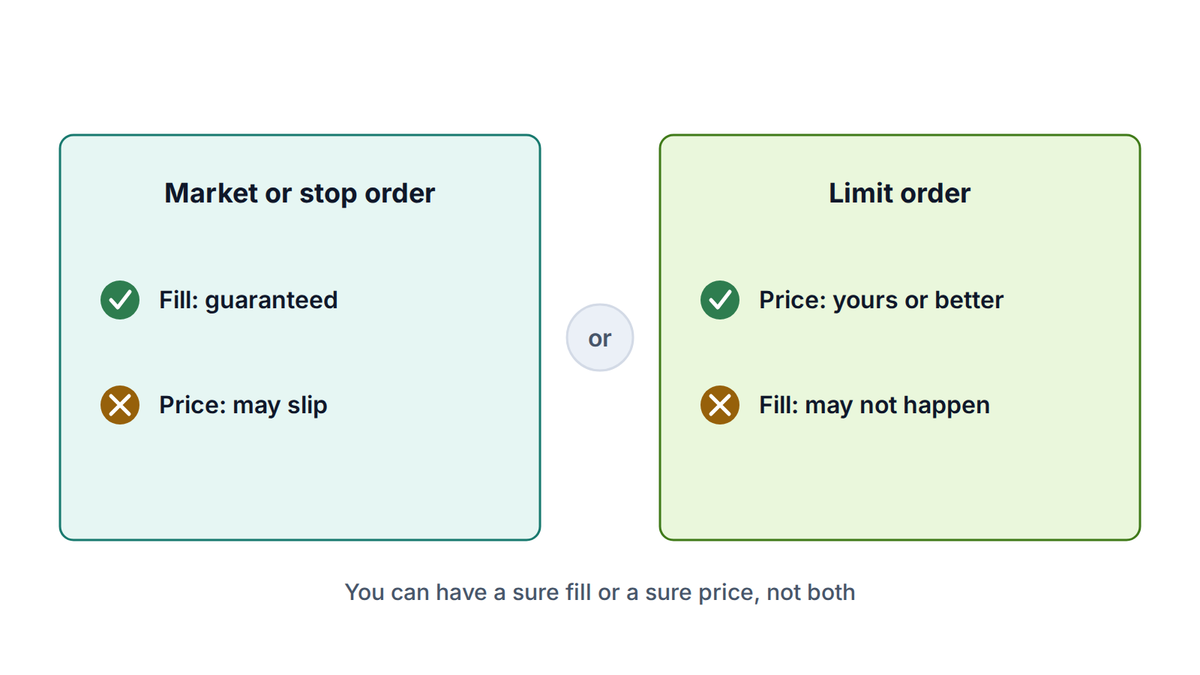
Not every order type is exposed in the same way. What matters is whether the order promises a price or promises a fill. You cannot get both.
| Order | What it promises | Slippage risk | Main downside |
|---|---|---|---|
| Market order | A fill now, at the best available price | Yes, either direction | Price may differ from the screen |
| Stop order (entry) | A market order once price touches your level | Yes, usually worse | Fills past your level in a spike |
| Stop loss | A market order to exit once price touches your level | Yes, usually worse | Loss larger than planned |
| Limit order | Your price or better | No negative slippage | May never fill |
The guide to buy limit and buy stop orders shows how each pending order behaves when price reaches it. A stop loss is the same mechanism pointed the other way, which the guide to stop loss in trading covers. The lesson on execution, slippage and requotes explains what happens inside the broker when an order arrives.
Requotes and rejections
Some brokers do not slip an order. They refuse it instead, either asking you to accept a new price (a requote) or rejecting it. The cause is the same: the price moved. The effect differs, because you know the outcome before you are in the trade.
Gold trades in large size and is usually liquid, but it moves in dollars, not fractions of a cent. A $0.80 slip on gold is 80 pips (on gold a pip is $0.01). The same dollar move relative to price on EUR/USD would be far smaller in pip terms. That makes gold slippage feel large in your account even when it is normal.
Quiet hours matter too. Overnight in the Asian session, gold can have less volume behind each price level, so even an ordinary order can fill a little off the screen. The forex session times guide shows when volume is deepest.
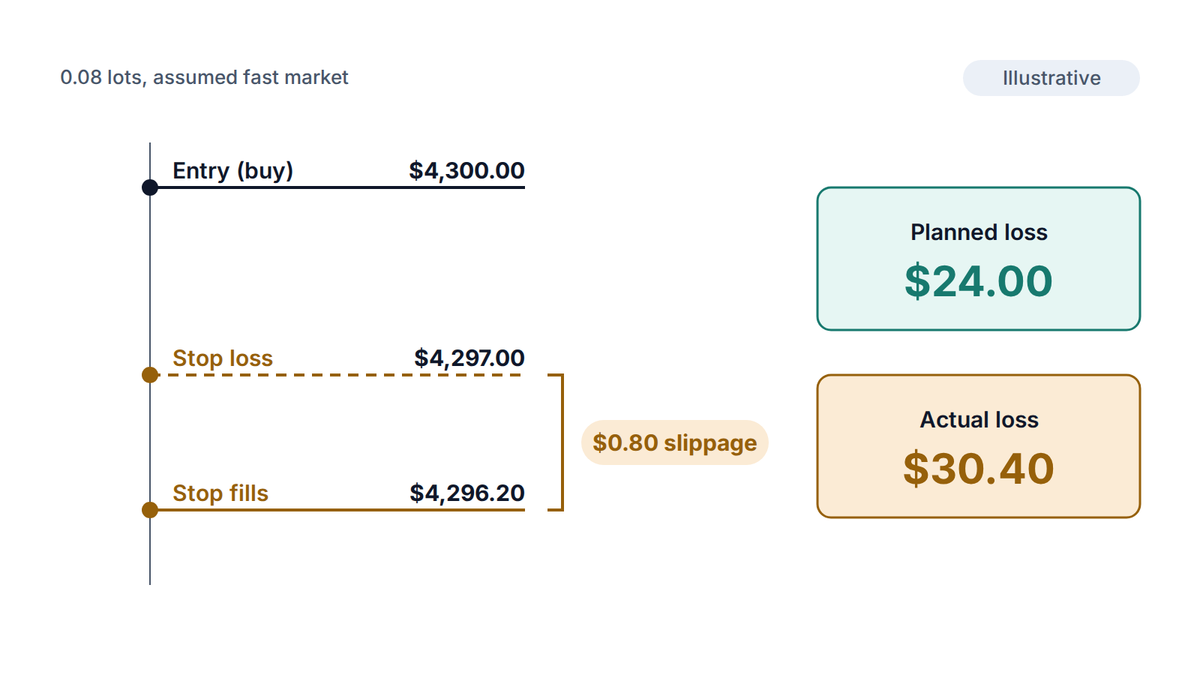
Use the site's shared example: a $2,400 account risking 1% per trade, so $24. You buy gold at $4,300.00 with a stop loss $3.00 below, at $4,297.00. That stop is 300 pips. Dividing $24 by 300 pips at $1.00 per pip per lot gives 0.08 lots, which is 8 troy ounces.
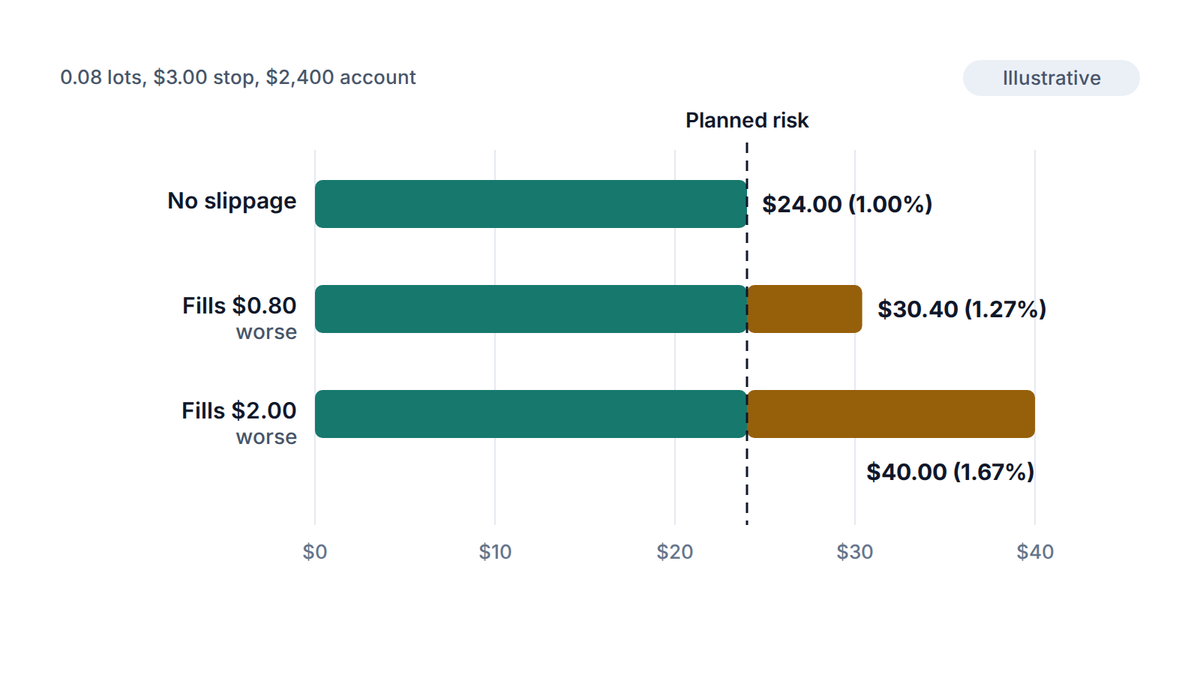
On 0.08 lots, each $1.00 move in gold is worth $8.00. If the stop fills exactly at $4,297.00, you lose 3 × $8 = $24. Now let the market gap through the stop and fill it at $4,296.20, which is $0.80 worse. The loss is 3.80 × $8 = $30.40, which is 1.27% of the account.
| Slippage on the stop | Slippage cost | Total loss | Share of $2,400 |
|---|---|---|---|
| $0.00 (fills at the stop) | $0.00 | $24.00 | 1.00% |
| $0.50 | $4.00 | $28.00 | 1.17% |
| $0.80 | $6.40 | $30.40 | 1.27% |
| $2.00 | $16.00 | $40.00 | 1.67% |
| $5.00 | $40.00 | $64.00 | 2.67% |
Slippage also works on your entry. Buying at $4,300.60 instead of $4,300.00 costs 0.60 × $8 = $4.80 before the trade has moved. The lot size calculator gives you the 0.08 figure, and you can add the likely slip to your stop distance to see the size that keeps your loss near $24.
Try it now
Enter your balance, risk percentage and a stop distance that includes a cushion for slippage. The result is the lot size that keeps even a worse fill closer to your plan.
Slippage is partly your doing and partly the market's. The split matters, because it tells you where to spend effort.
| You cannot control | You can control |
|---|---|
| How fast the market moves | Whether you hold stops through scheduled news |
| How much liquidity sits at each price | The hours you trade and the size you trade |
| Gaps over the weekend | Whether you hold positions over the weekend |
| How your broker routes and fills orders | Which broker you use, and which order type you choose |
A stop loss is not a guarantee
A stop loss is an instruction to exit at the next available price once your level is touched. In normal conditions that is close to your level. In a spike or a gap it can be far from it. Some brokers offer guaranteed stops for a fee, but most standard accounts do not, so read your broker's terms.
Execution is one of the few things in this list that depends on the broker. Look for a published order execution policy that says how slippage and requotes are handled, whether positive slippage is passed on, and what happens to pending orders at a gap. The guide to a regulated forex broker lists what to check. A demo account will not show you real slippage in a fast market, because demo fills are often cleaner than live ones, so judge execution on a small live account.
Slippage is the difference between the price you expected when you placed an order and the price it was filled at. It happens when the market moves, or runs short of volume, between your click and your fill. It can be better or worse than expected.
You cannot remove it, but you can limit it. Use limit orders for entries, stay out of the seconds around scheduled news with stops open, trade liquid hours, keep your size modest and leave room for a worse fill in your stop distance.
No. If price moves your way before your order is filled, you get a better price. This is positive slippage. Whether you keep it depends on your broker's execution policy, so read it before you rely on it.
A limit order fills at your price or better, so it has no negative slippage. The cost is that price may touch your level and move away without filling you, or never reach it at all.
Gold moves in whole dollars during news and at the weekend open, and its price level is high, so a normal slip is many pips. At 0.08 lots a $0.80 slip is $6.40. That is why it pays to size the trade with a worse fill in mind.
The PipsMorrow Team
A team of writers covering XAU/USD gold trading education. We focus on explaining the mechanics and risk management in a structured way, with no trade signals and no promotion of any specific broker.
Last updated
A liquidity sweep is a quick run past an obvious high or low that reverses. Learn what it looks like, and how to tell a sweep from a real breakout.
10 min read
Read more →Buy limit vs buy stop: one waits for a lower price, the other for a breakout. See how each pending order works, with forex and gold examples and sell versions.
10 min read
Read more →The head and shoulders pattern explained: the neckline, the measured target, the inverse version, and why textbook examples look cleaner than live charts.
9 min read
Read more →Build on this article with the full gold trading curriculum, ordered from the basics to advanced topics, free.
