
Brokers
Gold Contract Specifications: 7 Lines That Set Your Costs
Gold contract specifications, line by line: contract size, digits, spread, swap, margin and hours, with each one turned into dollars per trade.
9 min read
Read more →
Before you deposit, confirm the broker is a regulated forex broker. Follow five steps to verify the legal entity, license and register in any country.
A regulated forex broker is a company that a financial authority has licensed and agreed to supervise. That sounds simple, yet most badges on broker websites prove very little until you check them yourself. This guide shows how, in any country.
You will learn to find the exact legal entity behind a brand, confirm its license on the regulator's own register, and read what that license does and does not protect. It takes about ten minutes, and it is worth doing before your first deposit.
A financial regulator is a government body or an authorized agency that sets rules for firms selling financial products. For a forex broker, the rules usually cover capital, how client money is held, how complaints are handled and what the firm must disclose to you.
Regulation does not protect you from your own trading losses. Forex and CFDs are leveraged products (leverage lets you hold a position larger than your deposit), and you can lose money fast whatever the license says. The guide to leverage in forex shows how quickly that can happen.
It cannot promise a good price, fast withdrawals or a fair outcome in every dispute. A license also tells you nothing about how a strategy will perform. For more on how brokers earn their revenue, read the lesson on how brokers make money.
A broker brand often operates through several companies in different countries. Each company has its own license, its own rules and its own clients. The company that holds your money is named in the client agreement you accept at sign-up.
That is why the regulator list on a homepage can mislead. A brand can show a respected regulator while your account is opened under a different company with lighter oversight. The lesson on regulation and where your money sits covers this in more depth.
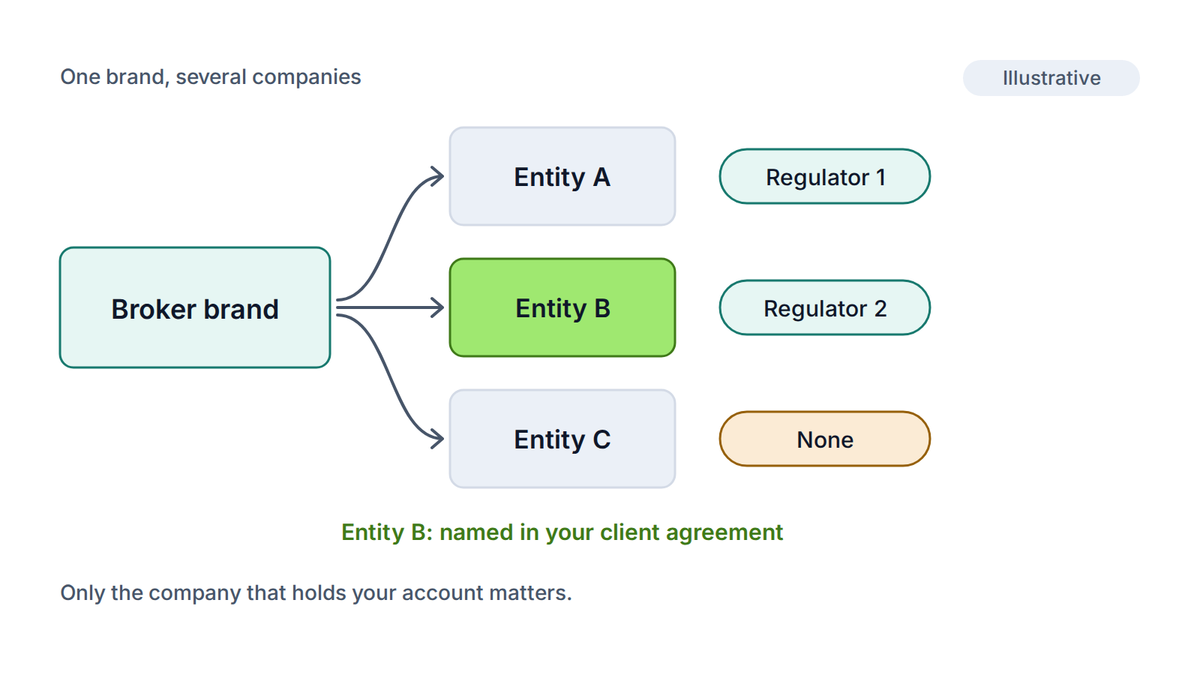
So find the full legal name, the registration or license number and the country. The footer, the terms and conditions and a page called something like Regulation or Legal documents usually list them. If a broker hides these details, treat that as a warning in itself.
Run these steps in order. Stop and look elsewhere if any one fails. Each step should take a minute or two.
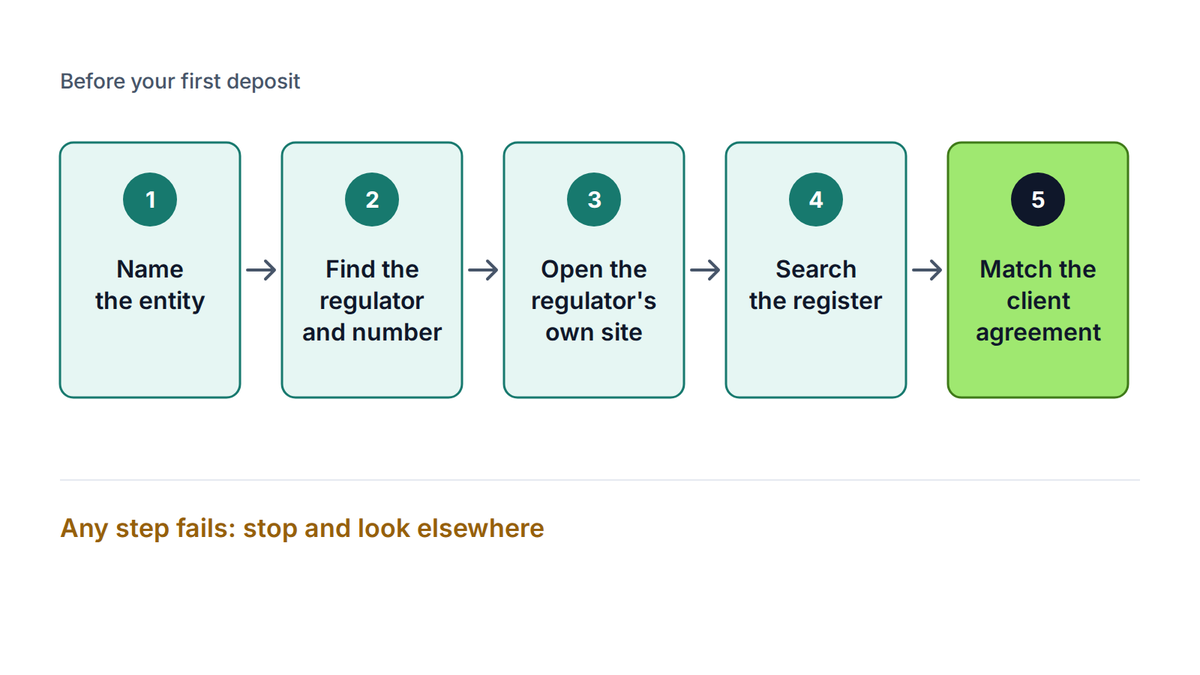
Most major regulators publish a free searchable register. Examples include the UK's Financial Conduct Authority, Australia's ASIC, Cyprus's CySEC and, in the United States, the National Futures Association's BASIC database. Search for your own country's authority and for the authority named by the broker.
Two brokers can both say they are regulated and still offer very different protections. The words on the page matter, so read them closely.
| What you find | What it usually means | What to ask |
|---|---|---|
| Full financial services license | The regulator supervises the firm's conduct, capital and client money | Does it cover retail forex and CFD clients like me? |
| Company registration only | The firm exists legally, but no one supervises its brokerage | Which authority supervises its trading business? |
| License for a different entity | Protections apply to another company, not yours | Which company is named in my agreement? |
| No register entry | The claim cannot be confirmed | Why is the number not on the public register? |
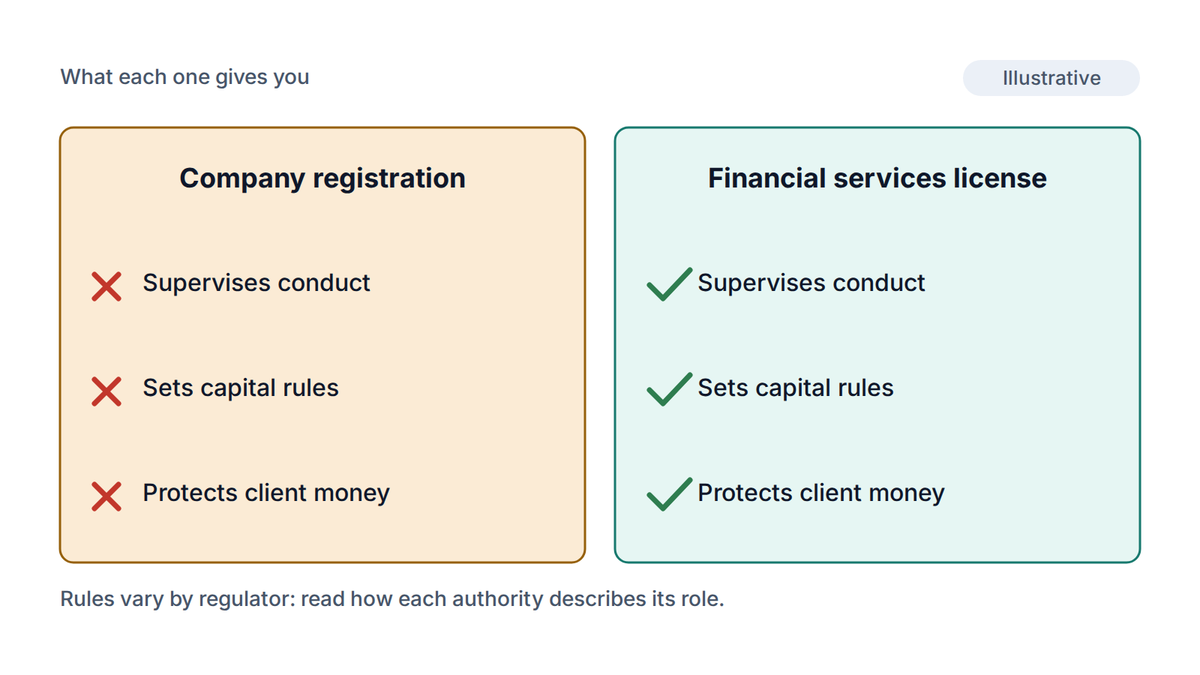
Offshore jurisdictions deserve extra care. Some register companies without supervising forex brokerage. That does not make a broker fraudulent, but it means you have fewer protections and fewer places to complain.
Red flags worth walking away from
Walk away if a broker offers no entity name, asks you to pay through a personal account, pressures you to deposit fast, promises returns or guarantees, or cannot be found on the register it names. Cloned regulator names and fake license numbers are common.
The same method works on any broker. As an example of reading a regulation page, we will use the broker PipsMorrow partners with.
Disclosure
PipsMorrow is an introducing partner of IUX and may earn a commission if you open an account through our links. CFDs are traded on margin and carry a high risk of losing money quickly, so trade only money you can afford to lose.
IUX's regulation page, which we checked on 4 Nov 2026, lists more than one company. IUX Markets Limited is registered in Saint Vincent and the Grenadines. The page itself describes this as a company registration, not a financial services license, and says the local authority does not license or supervise forex and CFD brokerage.
It also lists IUX Markets (MU) Ltd., which holds an Investment Dealer license from the Financial Services Commission of Mauritius, and says the entity is a member of The Financial Commission, an external dispute resolution body. A third entity, IUX Markets AU Pty. Ltd., holds an Australian ASIC license, but the page says it provides no products or services through that website.
Reading this correctly means asking which of these companies would serve you. Each one offers different protections. The page shows why step one, naming the entity, comes before everything else. You would then look up the entity's number on the regulator's own register, following steps three and four.
Check that your country is accepted
IUX says on its regulation page that it does not solicit, market or provide services to people located in Australia, Canada, the United Kingdom, the United States or Malaysia. Brokers accept clients from different countries, so confirm that your country is accepted before you sign up, and read the client agreement for the entity that will serve you.
Many readers search for the best regulated forex broker, but no single answer fits everyone. The right choice depends on your country, the entities that accept you, the account types on offer and what you trade. A ranking cannot know those things, and many rankings are paid placements.
Use the check instead of a ranking. Build a short list of brokers that accept residents of your country, run the five steps on each, and then compare costs. The article on what spread is in forex explains how to measure those costs, and the lesson on how to check a broker before you deposit adds the testing steps.
Passing the check lowers one set of risks. It does not remove the others. Start with a demo account to see the platform and the real spreads, and read the forex demo account checklist before going live.
Then fund only an amount you can afford to lose, and keep your first live trades small. If margin is new to you, read what a margin call is first. A well-regulated broker will still close your trades if your margin runs out.
Keep a record of your checks: the entity name, the register entry, the date you looked and a copy of your client agreement. Licenses change, so look again if the broker moves you to a different entity or country. Our guide on how to start trading gold lists further things to check before opening an account.
It is a broker whose operating company holds a license from a financial authority that supervises its conduct, capital and handling of client money. The license must belong to the exact company that serves you, and you can confirm it on the regulator's public register.
Find the legal entity and license number in the broker's terms, then search that name and number on the regulator's own website. Confirm the status, the permitted activities and the match with your client agreement. A badge on the homepage is not enough.
Trust is the wrong test. Ask what the registration actually covers. Some offshore authorities register companies without supervising forex brokerage, which leaves you with fewer protections and fewer routes for complaints. Read how the authority itself describes its role.
No. Regulation can improve how a broker treats your funds and handles disputes. It cannot make trades profitable or protect you from market losses. CFDs are leveraged and can lose money quickly, so trade only money you can afford to lose.
Each license belongs to a specific company. Ask which one will hold your account, and read that entity's client agreement. The protections of a regulator that supervises a different company in the group do not automatically apply to you.
The PipsMorrow Team
A team of writers covering XAU/USD gold trading education. We focus on explaining the mechanics and risk management in a structured way, with no trade signals and no promotion of any specific broker.
Last updated
Gold contract specifications, line by line: contract size, digits, spread, swap, margin and hours, with each one turned into dollars per trade.
9 min read
Read more →Multi timeframe analysis lets a higher chart set direction and a lower one set timing. Learn a three-step top-down routine you can use on any pair.
10 min read
Read more →A moving average crossover signals a trend change late by design. See what it catches, what it misses, why it lags and how to test your settings.
11 min read
Read more →Build on this article with the full gold trading curriculum, ordered from the basics to advanced topics, free.
