
Getting started
How to Start Trading Gold in 2026: 7 Steps for Beginners
How to start trading gold in 2026 in seven steps: read the specs, check the broker, practice on demo, size your first trade and review it every week.
10 min read
Read more →
A forex demo account is practice with fake money. Learn what it teaches, where it misleads, and the checklist to pass before you trade real money.
A forex demo account lets you place trades with virtual money at live prices. It is the safest place to learn a platform, and it is also the easiest place to build habits that fall apart the first time real dollars are on the line.
This guide covers what a demo teaches, where it misleads you, and a checklist to pass before you switch to a live account. Most demo accounts are free to open, so the cost is not money. It is the time you spend using one properly.
A demo (or practice) account is a trading account funded with virtual money. You see real quotes, place trades, set a stop loss (an order that closes a trade at a loss limit you choose) and watch the balance move. Nothing you do costs a cent.
That makes it ideal for the mechanical skills. You can learn where the buy and sell buttons are, how a pending order differs from a market order, and how to read a lot size field, all without the fear of a typo. The lesson on walking through your first trade is a good companion for this stage.
A demo cannot make you feel anything. Losing virtual $100 is not the same as losing real $100, and most people trade differently once the money is theirs. That is the main reason a good demo record does not predict a good live record.
Demo trading is not a perfect copy of live trading. Five differences matter, and each one can make a demo result look better than live will be.
| Difference | What happens on demo | What can happen live |
|---|---|---|
| Emotion | Little fear or greed | Moving stops, closing early, revenge trades |
| Execution | Orders often fill instantly at the quote | Slippage (a fill at a different price) and requotes |
| Spread | May be tighter or steadier | Widens at rollover and around news |
| Balance | Often $10,000 to $100,000 | Whatever you can afford to fund |
| Consequences | None | Margin calls and real drawdown |
Execution is the quiet one. Some demo servers fill every order at the quote you see, even in fast markets. A live account can fill you worse, which the lesson on execution, slippage and requotes explains. If your strategy only works with perfect fills, demo will not tell you.
A demo profit is not evidence of an edge
A few weeks of demo gains can come from luck, a quiet market or oversized lots. Treat the result as proof that you can follow a process, not as proof that the strategy makes money. The guide to trading expectancy shows how many trades it takes to say more.
The most common demo mistake is leaving the default balance. If the account opens with $10,000 but you plan to fund $2,400, every lot size you practice is about four times too big.
Here is the same 1% rule on both balances, with a 25-pip stop on EUR/USD, where one pip on 1.00 lot is worth $10. On $10,000 the risk is $100, which gives 0.40 lots. On $2,400 the risk is $24, which gives 0.096 lots, rounded down to 0.09 lots and an actual risk of $22.50.
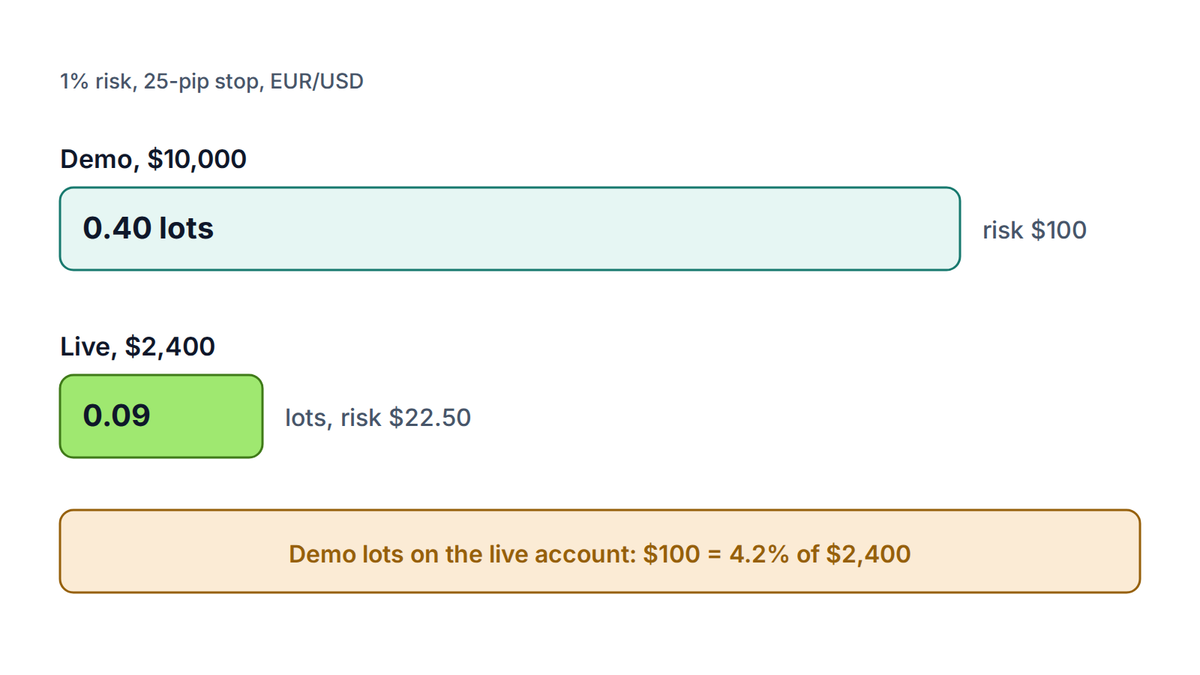
Now see what happens if you carry the demo habit across. Trading 0.40 lots on the $2,400 account with the same 25-pip stop risks 0.40 × 25 × $10 = $100, which is 4.2% of the account. Two losses in a row would take about 8% before you had time to react.
Try it now
Enter your planned live balance, 1% risk and your stop distance to get the lot size you will actually use. Practice with that number on demo.
If your platform lets you pick the starting balance, choose your real figure. If it does not, work out your lot size from your planned balance and ignore the balance on screen. The article on how to size a position gives the full routine, and lot size explains the units.
Work through these six items in order. If one is missing, stay on demo until it is done. None of them guarantees success, but each closes a gap that costs new traders money.
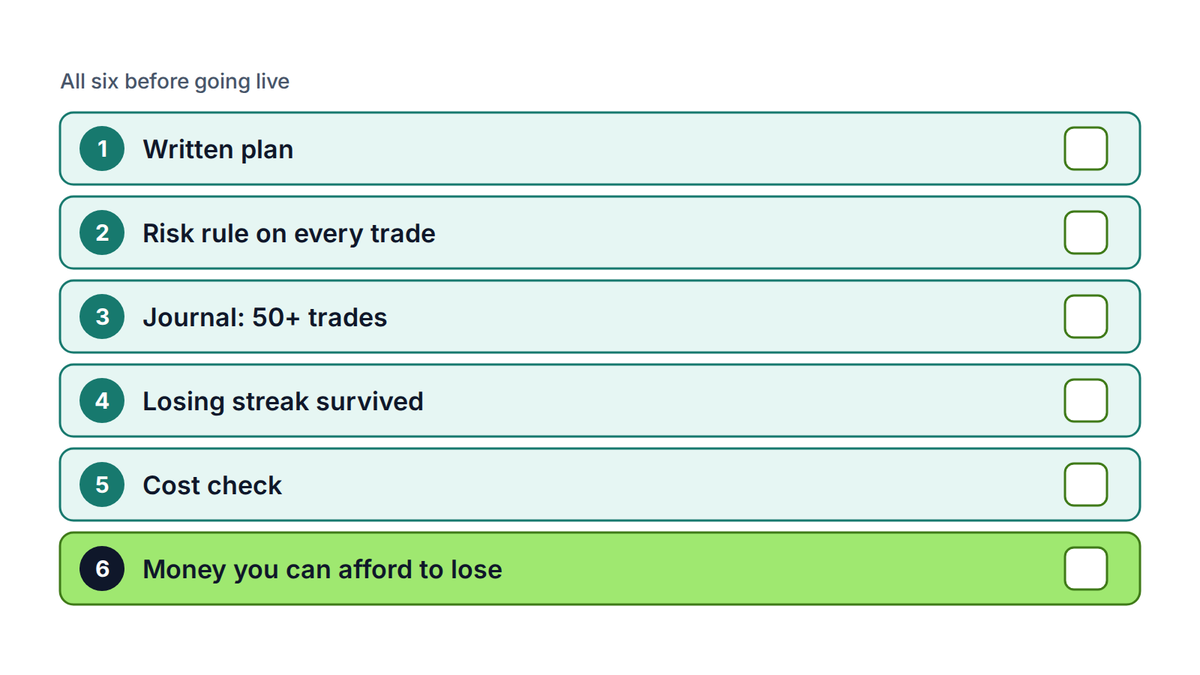
Use the demo to test the checklist, too
Run one full week on demo where you stick to the plan and write the journal after every trade. If that week feels like a chore, expect live trading to feel harder. The lesson forward testing and the limits of demo goes further.
A free forex demo account is offered by almost every broker, usually with a time limit or a sign-up form. Opening one is also a low-risk way to look at a broker before you commit. Judge it on more than the demo itself.
Do not pick a broker because of a bonus or a contest. Promotions carry conditions, often on trading volume, that can push you to trade more than your plan allows.
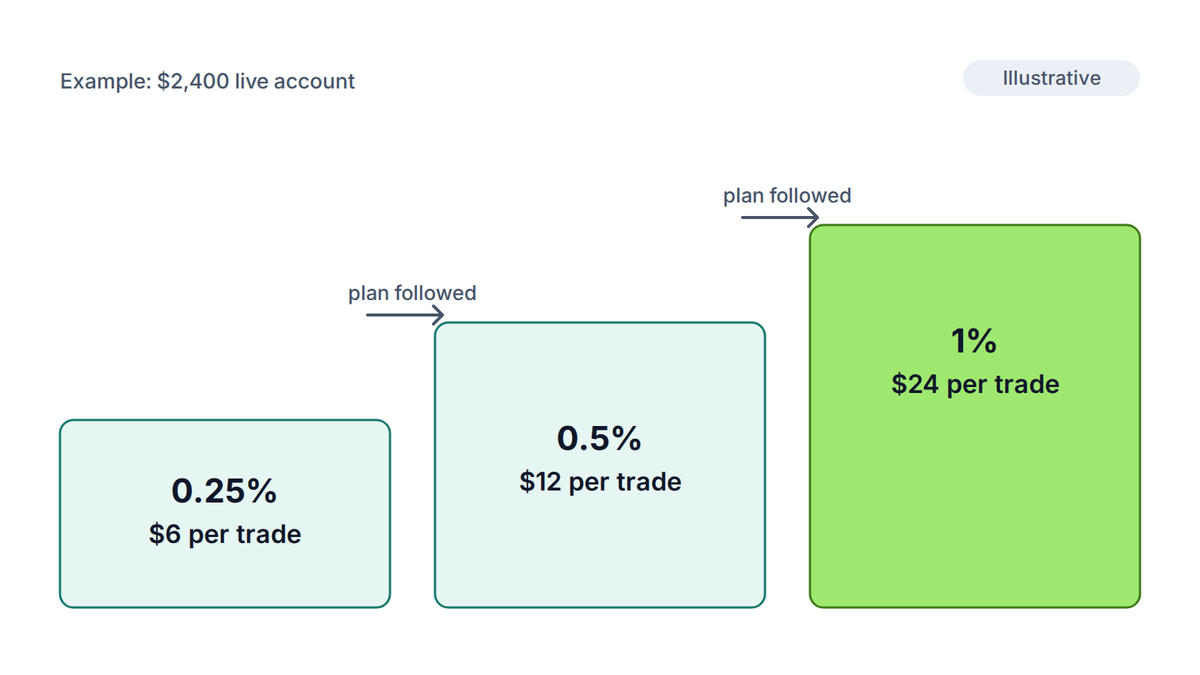
The first live trades are a test of your behavior, not of your strategy. Keep them small so that a mistake teaches you something without hurting you.
On the $2,400 account, start at 0.25% risk per trade. That is $6. With a 25-pip EUR/USD stop, 0.02 lots risks 0.02 × 25 × $10 = $5. Move to 0.5% ($12) after a stretch of trades where you followed the plan, and to 1% ($24) only after that.
Do not throw the demo away. Use it to test a new setup before it touches live money. It is also a place to rehearse after a bad week, which helps if you feel the pull of revenge trading.
Decide in advance what makes you pause: for example, three losses in a row or a 5% drop from the account's peak. Write it down now, while you are calm. The drawdown calculator shows what a given loss means in percent.
Almost always, yes. Brokers give demo accounts away because they want you as a client later. Some expire after a set number of days, and some ask for contact details. You should never have to deposit money to open one.
There is no fixed answer. A useful rule of thumb is at least 50 journaled trades that all followed a written plan and a risk rule, including a losing streak. That usually takes several weeks. Time alone is not the test.
No. Prices are real but fills, spreads and balances can differ, and you feel no pressure. A good demo record shows you can follow a process. It does not prove you will do so when the money is yours.
Use the amount you plan to fund live. If you plan $2,400, set the demo to $2,400 and size every trade to that figure. A larger default balance trains you on lot sizes your real account cannot support.
No. Demo money is virtual and cannot be withdrawn. Be wary of any offer that promises real prizes or profits for demo trading, and read the conditions before you join.
The PipsMorrow Team
A team of writers covering XAU/USD gold trading education. We focus on explaining the mechanics and risk management in a structured way, with no trade signals and no promotion of any specific broker.
Last updated
How to start trading gold in 2026 in seven steps: read the specs, check the broker, practice on demo, size your first trade and review it every week.
10 min read
Read more →Revenge trading is trading to win back a loss instead of following a plan. Learn the warning signs of tilt, what it costs and the rules that stop it.
10 min read
Read more →Lot size in forex is the trade size you choose. See what standard, mini and micro lots are, what 1 lot is worth per pip, and how to pick one for your risk.
8 min read
Read more →Build on this article with the full gold trading curriculum, ordered from the basics to advanced topics, free.

