Hedging in forex means holding an opposite position to offset risk. See what a hedge does to losses and costs, and why it is no exit from a losing trade.
By the PipsMorrow TeamUpdated 11 min read
Hedging in forex means holding a second position that moves against the first, so that a gain on one offsets a loss on the other. It sounds like insurance. For a trader who is already losing, though, a hedge usually freezes the loss in place rather than removing it.
This guide explains what a hedge is, works through one example with real numbers, and shows what it costs to keep one open. It also covers the US rule on offsetting positions, which answers the common question of whether hedging is legal.
Key takeaways
A hedge is a position that moves opposite to another one. Hedging in forex trading reduces exposure to price moves, and it does not create profit.
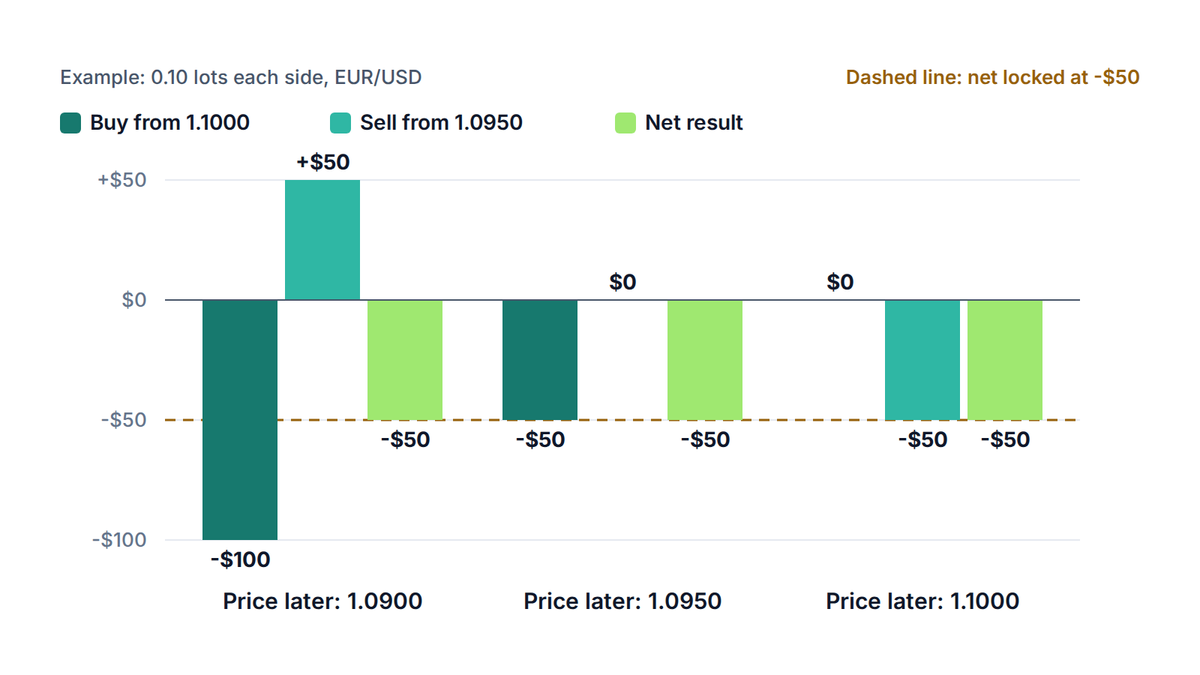
A direct hedge of equal size locks your result. On EUR/USD, a 0.10 lot buy that is down 50 pips stays at a $50 loss whether price then rises or falls.
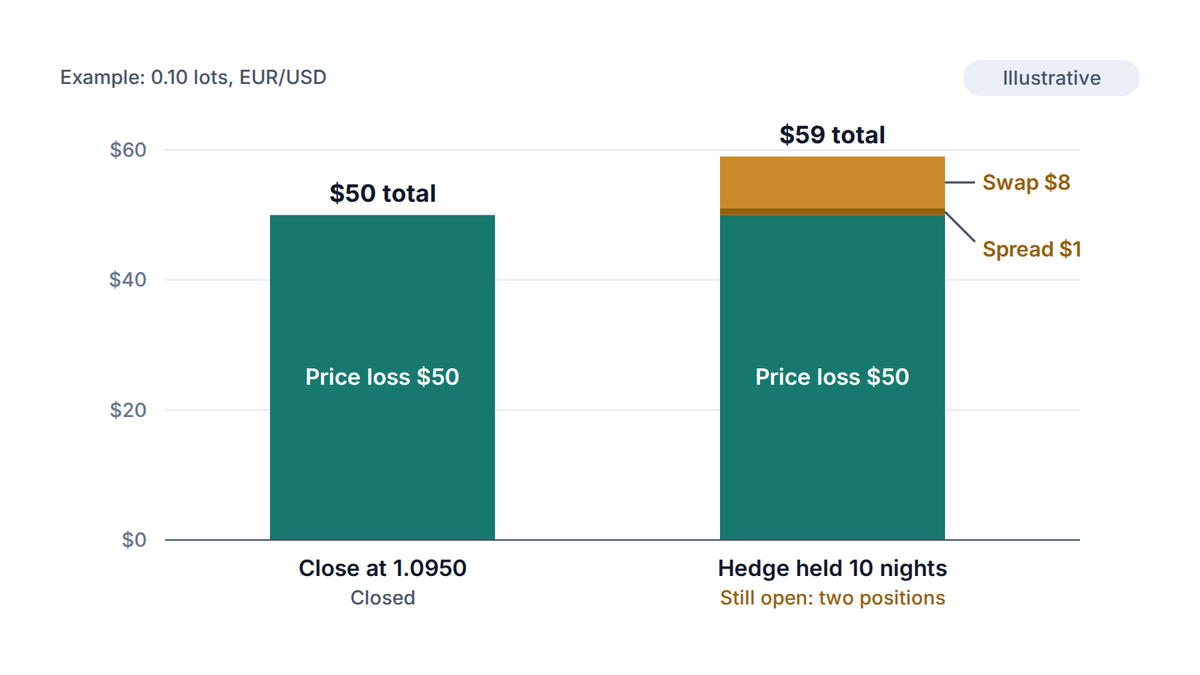
Holding both sides costs more than closing the loser. In the example, a 1-pip spread and 10 nights of assumed swap lift the $50 loss to $59, and the trade is still open.
Closing only one side of a hedge turns it back into an ordinary directional trade, so the decision you were avoiding is still waiting.
In the United States, retail forex dealers must close offsetting positions first-in, first-out, which effectively bars a direct hedge in one account. Other countries have their own rules.
Real hedging is about managing a known exposure, such as a business that will receive euros. A stop loss placed before you enter is the cleaner tool for a trader's mistake.
What hedging in forex means
A hedge is a position taken to offset the risk of another position. If you own something that loses money when a price falls, you add something that makes money when the price falls. The two partly or fully cancel out.
In forex, the simplest version is a direct hedge. You hold a buy and a sell on the same pair at the same time. The buy gains when price rises, the sell gains when it falls, and your net exposure shrinks toward zero.
Nobody hedges for free. A hedge removes risk and removes the matching reward, and it adds costs while it is open. That trade-off is the whole subject, and it is why the idea is often misunderstood.
Two very different meanings
The phrase foreign exchange hedging covers two activities that share a name. Businesses and investors hedge to fix the value of money they know they will pay or receive. Retail traders usually mean something else: opening an opposite trade on a position that has gone wrong.
The same word covers a planned risk-management tool and an unplanned reaction to a losing trade.
Business hedge
Trader's direct hedge
Why it exists
Protect a known future payment or receipt
Pause the damage on a trade that is losing
Typical example
An exporter selling euros it will receive in 90 days
Selling 0.10 lots of EUR/USD against an open 0.10 lot buy
Goal
Remove an uncertainty that is not the business's main bet
Avoid taking the loss yet
Main risk
Giving up a favorable move
Paying costs and still facing the original decision
This article spends most of its time on the second kind, because that is the one beginners reach for. We return to the first kind near the end.
What a direct hedge does to a losing trade
Take a $2,400 account on EUR/USD. You buy 0.10 lots at 1.1000. A lot is a standard trade size, and 0.10 lots is 10,000 units of the base currency, so one pip (the fourth decimal place, 0.0001) is worth $1.00. The figures come from the site's profit and loss calculator.
Price falls 50 pips to 1.0950, and your buy is down $50. You are unhappy to close it, so you sell 0.10 lots at 1.0950 as a hedge. Now you hold two equal and opposite positions.
0.10 lots each side on EUR/USD, $1.00 per pip per side. Spread and swap are left out of this table.
Price later
Buy P/L (opened 1.1000)
Sell P/L (opened 1.0950)
Net result
1.0900
-$100
+$50
-$50
1.0950
-$50
$0
-$50
1.1000
$0
-$50
-$50
Read the last column. The net result is -$50 whether price falls another 50 pips or recovers all the way to 1.1000. The hedge did not fix the loss. It stopped the loss from growing, and it also stopped it from shrinking.
With equal and opposite positions, the net result stays at -$50 at every later price. The spread and swap are not included.
That is the honest description of a hedge on a losing trade: a pause button. Some traders like a pause, and sometimes it buys time to think. The problem comes from treating the pause as a solution.
Why a hedge is not a way out of a losing trade
A loss only ends when a position is closed. While both sides are open, the original loss is still on the books, and you have added a second position that can also go wrong. You have two trades to manage instead of one.
The costs keep running
Opening the hedge means paying the spread (the gap between the buy price and the sell price) a second time. Holding both sides also means paying or receiving swap (the overnight interest charge on a position held past the daily rollover) on each of them. Our guide to what a trade really costs covers both in more detail.
Here is an assumed example. The spread is 1.0 pip, which costs $1.00 on 0.10 lots. Swap is $0.50 a night on the buy and $0.30 a night on the sell, and both are costs. Those figures are illustrations, not any broker's rates, and real swap can be a credit on one side. Over 10 nights the swap adds $8.00.
Extra cost is the hedge's 1-pip spread ($1.00) plus assumed swap of $0.80 a night for 10 nights ($8.00). Illustrative figures.
Choice
Loss at the moment of decision
Extra cost over 10 nights
Total loss
Still open?
Close with a stop loss at 1.0950
$50.00
$0.00
$50.00
No
Open an equal hedge and hold it
$50.00
$9.00
$59.00
Yes, two positions
The same $50 price loss costs $59 after 10 nights of holding a hedge, and the trade is still open. Spread and swap are assumed figures.
Margin may be held twice
Each position needs margin (the deposit your broker holds against an open position). On 0.10 lots of EUR/USD at 1.0950 with 1:500 leverage (trading a position larger than your deposit), each side needs $21.90. Some brokers charge margin on both sides and some charge a reduced amount on the hedged part, so check your broker's terms. Our guide to leverage in forex explains how margin is calculated.
Getting out is harder than getting in
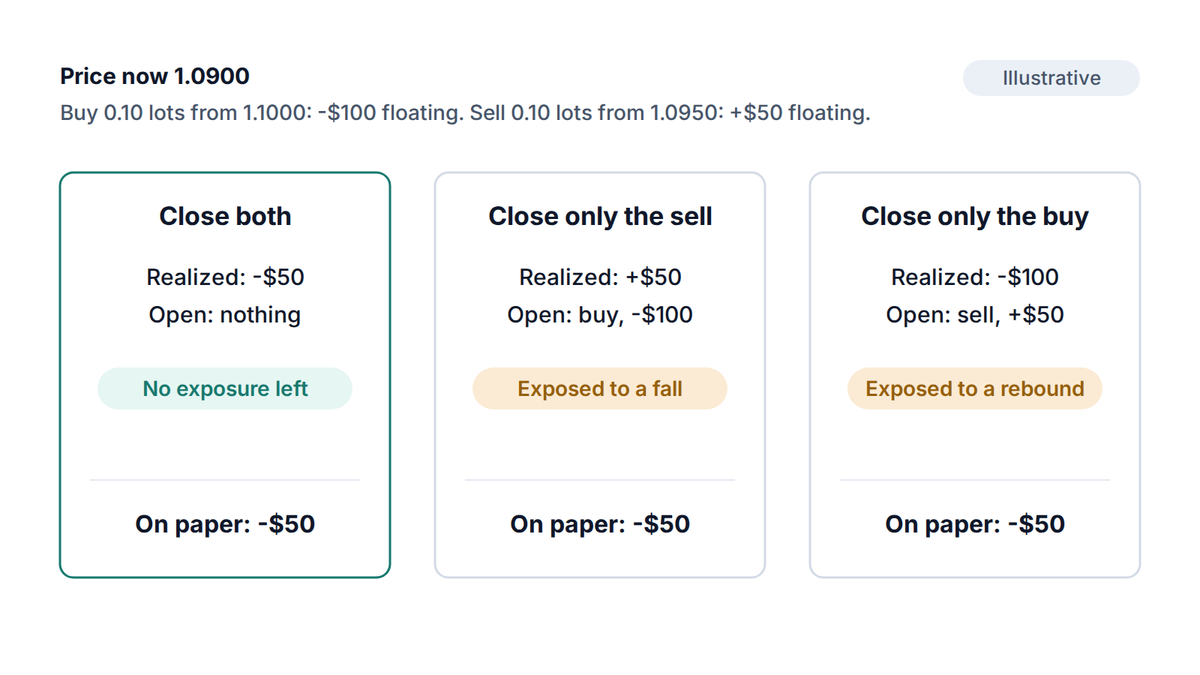
Eventually you must close the hedge, and that means closing one side first. Say price reaches 1.0900 and you decide to end it. You have three choices, and none of them removes the decision.
At 1.0900 every route totals -$50. Closing only one side leaves you holding a directional trade again.
If you close both, you take the $50 loss you tried to avoid, plus the extra costs. If you close one, you are back to a single position and a fresh guess about direction. Most traders who hedge a loss end up here, now with a worse mental account and less certainty about what they are holding.
A hedge can hide a plan problem
Opening a hedge instead of closing is often the same impulse as moving a stop: not wanting to be wrong. If you notice it, read our piece on revenge trading. The cure is deciding the exit before you enter.
The cleaner tool is a stop loss set at the start. In the example, a stop at 1.0950 ends the trade at $50 with no extra spread, no swap and no second position. See stop loss in trading for how to place one.
Is hedging in forex illegal?
In most places hedging is allowed, and in some it is restricted by regulators or by how a broker sets up an account. The best-known restriction is in the United States.
The US first-in, first-out rule
National Futures Association (NFA) Compliance Rule 2-43(b) applies to forex dealer members that serve US retail customers. It says they may not hold offsetting positions in a customer account and must offset on a first-in, first-out basis (FIFO). In plain terms, a new opposite trade closes your oldest open trade on that pair instead of sitting beside it.
There is a narrow exception. At the customer's request, a dealer may offset same-size transactions even when older transactions of a different size exist, and it must match against the oldest transaction of that same size. The practical result is that a direct hedge of the kind above does not exist for these accounts.
That is a rule about how dealers handle accounts, not a ban on you as a person. It also covers only accounts under that rule. If you are in the US, read your broker's account terms and the NFA rulebook text. If you are elsewhere, your own regulator and broker set the terms.
Hedging accounts and netting accounts
Even without a legal rule, your platform decides whether a hedge is possible. On a hedging account, a buy and a sell on one symbol sit side by side. On a netting account, they merge into one position. Our MT4 vs MT5 guide explains the difference, which is also why a hedge on a netting account simply closes the trade.
Check before you rely on it
Whether a direct hedge is allowed depends on where you live, your broker's regulator and the account type. Confirm it in your account terms rather than assuming it. This article is education and not legal advice.
Indirect hedges and their limits
Some traders offset risk across pairs instead of on one pair. A buy on EUR/USD and a buy on USD/CHF are largely opposite bets on the dollar, so each cushions the other. This is an indirect hedge.
It is looser than a direct hedge. Correlations between pairs move over time, and they can fail on the day you need them. You may end up holding two losing trades at once, or a hedge that is the wrong size. Read the forex correlation guide before treating any pair as an offset.
A hedge is only as good as the link between the two positions.
Direct hedge
Indirect hedge
Same pair?
Yes, opposite direction
No, a related pair
Net exposure
Close to zero when sizes match
Partial and changing
Main risk
Costs, plus the decision you still owe
Correlation breaks down
Allowed?
Depends on your regulator, broker and account
Generally yes, since the pairs differ
When hedging does make sense
Hedging is a tool for known exposure. A company that will receive 1,000,000 euros in 90 days has a currency risk that is not part of its business plan. It can sell euros forward or buy a currency option to fix the rate, giving up upside in return for certainty.
Traders have a version of this too. Before a major event, such as an interest rate decision, you may want to reduce exposure for a short, defined window. Shrinking the position or closing it is usually simpler, cheaper and allowed everywhere, so ask why you need an opposite trade instead.
Define the risk you are hedging, in dollars and in time.
Check that your account type and regulator allow it.
Add up the spread, swap and margin of the extra position.
Write down when the hedge ends and which side you will close first.
If you cannot do those four things in advance, you are probably reacting to a loss, and closing or reducing the original position is the better move. Use the site's calculators to price a hedge before you place it.
Try it now
Enter the pair, lots, open and close prices to see profit or loss on each side of a position. Add the margin figure for both legs to see what the pair costs together.
For the cost side in detail, the spread guide shows how a spread turns into dollars on any position size.
Frequently asked questions
What does hedging mean in forex?
It means holding a position that offsets the risk of another one, so a gain on one side cancels part or all of a loss on the other. It reduces exposure to price moves. It does not create profit by itself.
Is hedging in forex illegal?
Not in general. Rules differ by country and by account. In the US, NFA Compliance Rule 2-43(b) requires forex dealers to offset positions first-in, first-out, which effectively bars a direct hedge in one account. Check your broker's terms.
Does a hedge stop a loss?
It stops the loss from changing with price, but it does not remove it. With equal and opposite positions, the net result is locked while both are open, and the spread and swap keep adding costs.
Is a hedge better than a stop loss?
For a trader managing a losing position, usually not. A stop loss ends the risk at a loss you chose in advance. A hedge leaves two positions open and still needs a decision about how to close them.
◆
The PipsMorrow Team
A team of writers covering XAU/USD gold trading education. We focus on explaining the mechanics and risk management in a structured way, with no trade signals and no promotion of any specific broker.
Swing trading vs day trading compared with numbers: screen time, account size, spreads and swaps on a $2,400 example, and why neither style is more profitable.
What is spread in forex? Learn how to read bid and ask, calculate the spread in dollars, judge a good spread, and add commission and swap to the total.