
Brokers
Gold Contract Specifications: 7 Lines That Set Your Costs
Gold contract specifications, line by line: contract size, digits, spread, swap, margin and hours, with each one turned into dollars per trade.
9 min read
Read more →
Swing trading vs day trading compared with numbers: screen time, account size, spreads and swaps on a $2,400 example, and why neither style is more profitable.
Swing trading vs day trading comes down to how long you hold a position. A day trader closes everything before the session ends. A swing trader holds for several days to a few weeks. That one difference changes how much time you need, how big each position is and how much of your account the broker's costs consume.
This article compares the two with one worked example on an assumed EUR/USD chart, using a $2,400 account and 1% risk per trade. Every price and cost is made up for illustration, and nothing here is a trade signal or a promise of profit.
Day trading means opening and closing positions within the same day, so you never hold overnight. Swing trading means holding a position for several days to catch one move, or swing, in the market. Position trading, the third common style, holds for weeks or months and follows the larger trend.
| Day trading | Swing trading | Position trading | |
|---|---|---|---|
| Typical hold | Minutes to hours | 2 days to 3 weeks | Weeks to months |
| Main charts | H1, M15, M5 | Daily, H4, H1 | Weekly, daily |
| Trades per month | 40 to 100 | 3 to 8 | 1 to 3 |
| Stop distance (EUR/USD) | 5 to 15 pips | 40 to 100 pips | 150 pips or more |
| Screen time | 2 to 6 hours a day | 30 to 60 minutes a day | A few hours a week |
| Holds overnight | No | Yes | Yes |
| Main cost | Spread, paid often | Swap (overnight interest), plus gap risk | Swap, over a long time |
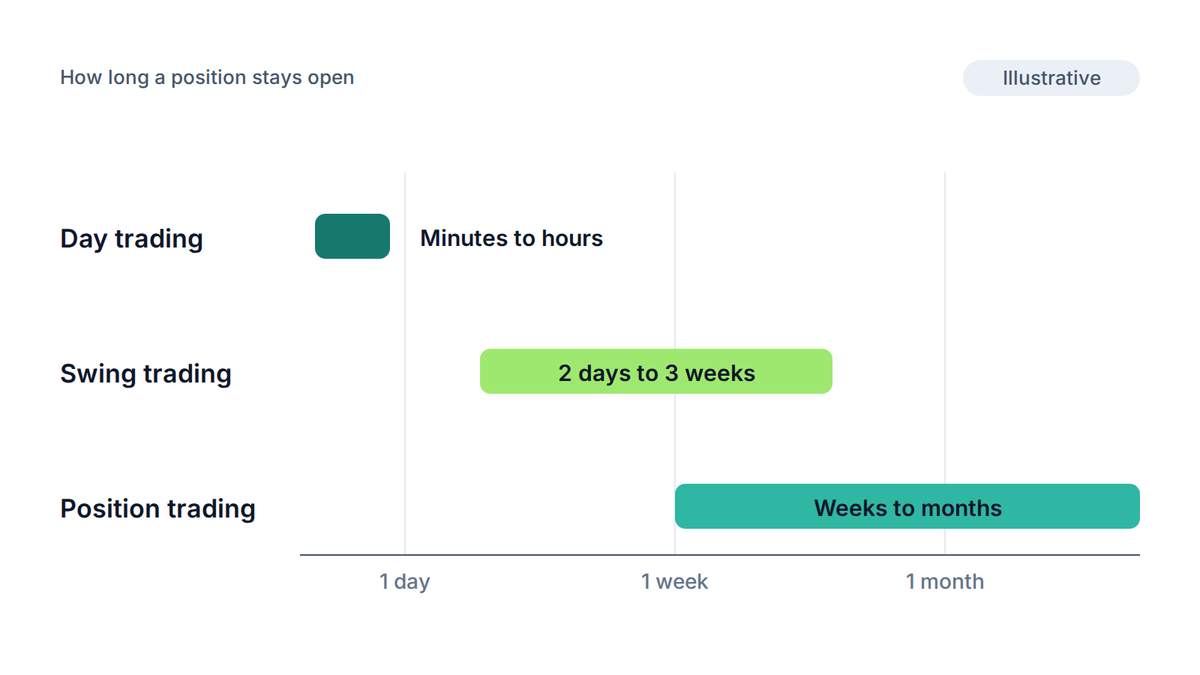
If you want to read about timeframes in more detail, our article on multi timeframe analysis shows which charts suit each holding period. The lesson on choosing a trading style that fits your life goes deeper on matching style to routine.
Time is where most beginners misjudge the choice. Day trading is not just the trades. It is the hours of attention on a live chart, because a 10-pip stop can be hit in minutes. You also need to be present at the right hours. Our guide to forex session times shows when the busiest hours are.
Swing trading moves the work to before and after the session. You read the daily and H4 charts once or twice a day, place a pending order (an order that waits for a price) and set a stop loss and target. Then you leave it. The price can move against you while you sleep, which is why the stop is set when you place the trade.
Time is also about emotion. Constant screen time makes it easy to overtrade after a loss. If you are prone to that, read about revenge trading before choosing a faster style.
People often say day trading needs a big account. The truth in forex is more precise. There is no fixed minimum for either style, but the size of your stop decides your position size, and the position size decides how much a spread costs you. Day trading rules for US stocks, such as the pattern day trader rule, are a different market and do not apply to spot forex the same way. Check the rules in your own country.
Take the shared example account of $2,400 and 1% risk, which is $24 per trade. On EUR/USD one pip (the smallest usual price step, 0.0001) is worth about $10 per standard lot (a lot is 100,000 units of the base currency). Divide the $24 by the stop in pips and by $10, then round down to the next 0.01 lots. The position sizing lesson covers the formula.
| Style | Stop | Lot size | Money at risk |
|---|---|---|---|
| Day trading | 10 pips | 0.24 | $24.00 |
| Swing trading | 60 pips | 0.04 | $24.00 |
| Position trading | 200 pips | 0.01 | $20.00 |
Two things stand out. The dollar risk is the same for the first two, so account size does not stop you from using either style. And a long stop on a small account hits a floor. At 200 pips the smallest lot of 0.01 already risks $20, so a position trader with a much smaller account would have to risk more than 1%. You can run your own numbers in the lot size calculator.
What about leverage?
Leverage (borrowed buying power) lets you open a position larger than your cash. It affects the margin (the deposit your broker holds) needed to open each trade, not how much you risk. Risk comes from your stop and lot size. A day trader opening 0.24 lots needs more margin than a swing trader opening 0.04 lots, but both risk $24.
Every trade pays the spread (the gap between the buy and sell price), whether it wins or loses. Holding overnight can add a swap (interest charged or paid for carrying a position past the daily rollover). Day trading pays the spread many times and no swap. Swing trading pays the spread rarely and a swap for each night.
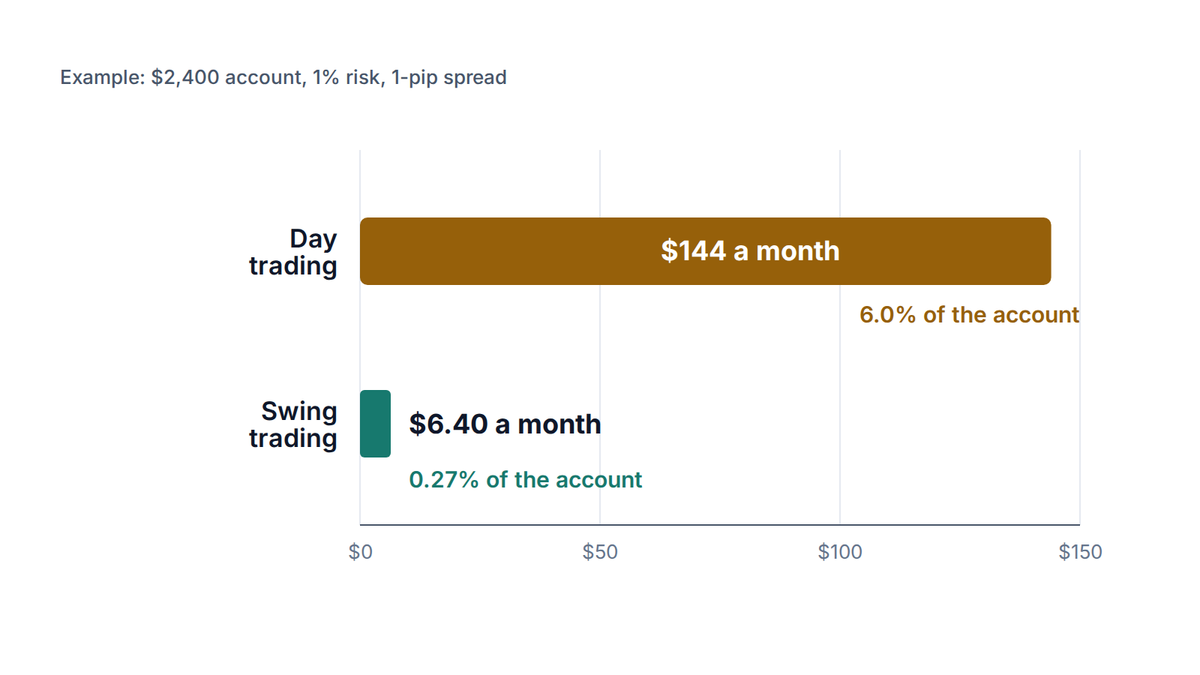
Assume a 1-pip spread on EUR/USD and a swap cost of $6 per standard lot per night. Both are assumed, because real spreads and swaps vary by broker, time of day and market. The first step is cost per trade, in dollars and as a share of the $24 risk.
| Day trade | Swing trade | |
|---|---|---|
| Lot size | 0.24 | 0.04 |
| Spread cost per trade | $2.40 | $0.40 |
| Swap per trade (5 nights) | $0 | $1.20 |
| Total per trade | $2.40 | $1.60 |
| Spread as share of the stop | 10% | 1.7% |
| Trades per month (assumed) | 60 | 4 |
| Total cost per month | $144.00 | $6.40 |
| Share of a $2,400 account | 6.0% | 0.27% |
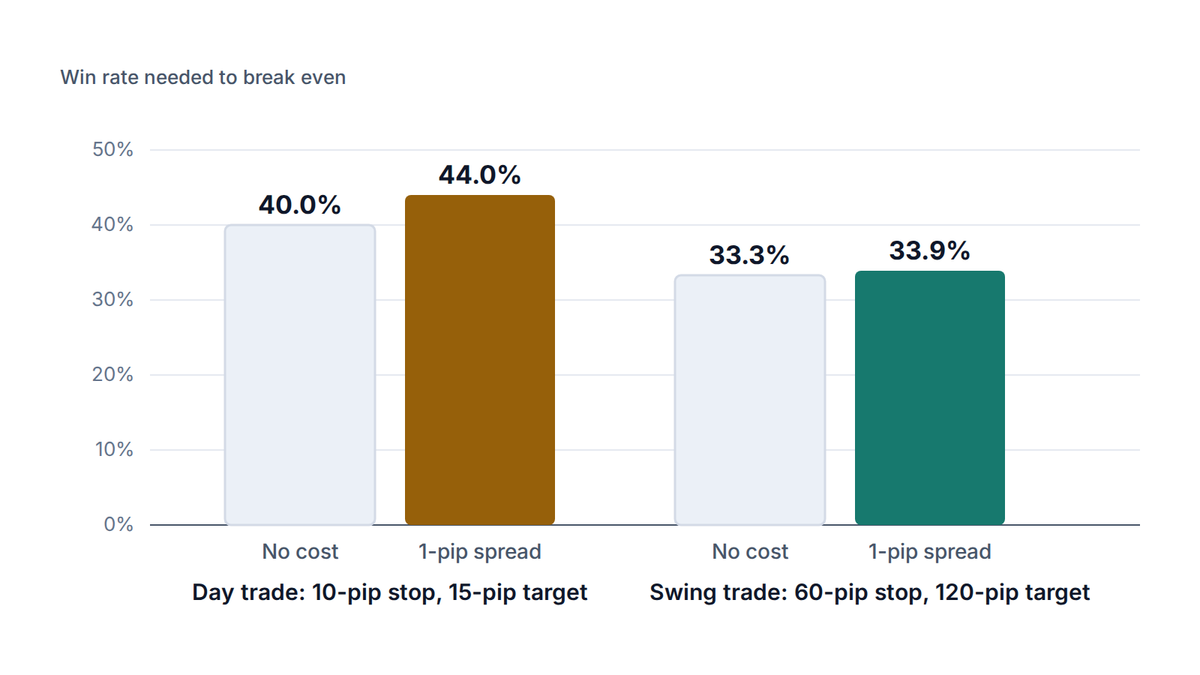
The costs also change how often you must win. If a day trade risks 10 pips to make 15, the 1-pip spread makes the real loss 11 pips and the real gain 14. Your break-even win rate (the share of trades you must win to cover costs) is 11 divided by 25, or 44%, not the 40% the stop and target suggest. A swing trade risking 60 pips for 120 needs 61 divided by 180, or 33.9%, against 33.3% with no cost.
These costs are why the lesson on what a trade really costs matters, and the article on the spread explains how it varies. Swing traders face a different cost, which is risk. A position held overnight and over a weekend can open at a different price after news or a gap (a jump between one close and the next open), and your stop may fill beyond its level.
Neither, by itself. Profit depends on whether your method has a positive expectancy (the average result per trade after costs), and on whether you follow it. A style is a container for a method, not an edge. Many day traders and many swing traders lose money, and the style does not change that.
What the style does change is the number of chances to be right or wrong. A day trader with a small edge gets many trades to express it, but pays the cost on each one. A swing trader has fewer trades, so the result takes months to judge and one loss matters more to your mood. Our article on trading expectancy shows how to measure your own edge.
Risk note
Leveraged trading can lose money quickly, and a shorter holding period does not make a trade safer. Size every trade from your stop loss, risk only an amount you can afford to lose, and test any style on a demo account first.
Start from your week, not from what looks exciting online. Ask when you can actually look at a chart and how you feel about a trade open while you sleep. Then test the style with small risk before you commit.
You can also mix them. Many traders swing trade the main idea and use a lower chart for a better entry. Whichever you pick, keep the risk per trade the same, as the numbers above show it is the stop that sets your size.
Day trading opens and closes positions on the same day, with no overnight holding. Swing trading holds a position for several days to a few weeks to capture one move. The main differences are the time needed, the stop size and the costs.
Swing trading is often easier to start with, because it needs less screen time, pays fewer spreads and gives you time to think. But better depends on your schedule and temperament. Practice either one on a demo account first.
In forex, neither has a fixed minimum. A day trade with a tight stop allows a larger lot size for the same risk, so costs matter more. A small account can run either style, but check that the smallest lot does not push your risk above your limit.
They differ by holding time. Day trades last minutes to hours, swing trades last days to weeks and position trades last weeks to months. Longer holds use wider stops, smaller lot sizes and fewer trades.
Yes. The method is the same on gold (XAU/USD). Gold moves in larger dollar amounts and its swap differs from forex, so check the contract and your stop distance before you set your lot size.
The PipsMorrow Team
A team of writers covering XAU/USD gold trading education. We focus on explaining the mechanics and risk management in a structured way, with no trade signals and no promotion of any specific broker.
Last updated
Gold contract specifications, line by line: contract size, digits, spread, swap, margin and hours, with each one turned into dollars per trade.
9 min read
Read more →How to size a position on gold to the risk you can afford: a five-step routine, worked numbers on a $2,400 account and the traps that turn 1% into 10%.
8 min read
Read more →A forex demo account is practice with fake money. Learn what it teaches, where it misleads, and the checklist to pass before you trade real money.
9 min read
Read more →Build on this article with the full gold trading curriculum, ordered from the basics to advanced topics, free.

