
Getting started
Revenge Trading: How to Spot Tilt and Stop It
Revenge trading is trading to win back a loss instead of following a plan. Learn the warning signs of tilt, what it costs and the rules that stop it.
10 min read
Read more →
Trading psychology is how emotion and bias shape your trades. See the biases that cost money and the written rules that take mood out of the decision.
Trading psychology is the study of how your emotions and mental shortcuts shape what you do with money in the market. It matters because most of the damage a new trader does to an account comes from choices, not from bad luck: a stop moved, a position oversized, a good setup skipped.
This guide skips the slogans. It names the specific biases that cost money, shows the dollar effect on a $2,400 account and then gives you rules that take the decision away from mood. It is education about behavior, not a signal to place any trade.
When people ask what trading psychology is, the useful answer is narrow: it is the gap between the plan you wrote and the trade you took. Your analysis may be fine. The psychology of trading is about what happens between the idea and the click.
Two things make the gap wide in markets. First, results arrive fast and in money, so every price tick triggers a feeling. Second, leverage (borrowing that lets you control a large position with a small deposit) lets you act on a feeling at a size that a feeling should never get to choose.
A bias is a predictable error in judgment, one that most people share. That is good news, because a predictable error can be planned around. You do not need to be calm. You need a process that still works when you are not.
Experienced traders feel fear and greed too. The difference is that they have turned most of their decisions into rules, so a feeling has fewer places to act. If you read a trader saying they just stay calm, they are probably describing the rules working.
Each bias below is described by the behavior it produces, because behavior is something you can see in your journal. The lesson on the biases that cost traders money goes deeper on the theory.
Most people feel a loss more strongly than a gain of the same size. In trading this shows up as holding a losing position because closing it makes the loss real, and moving the stop loss (the order that closes a trade at a set loss) further away to avoid that feeling.
The flip side is closing a winning trade early to lock in the good feeling. Together the two habits shrink your average win and grow your average loss. That is the opposite of what a profitable plan needs, as the next section shows with numbers.
A few wins in a row feel like proof that you have it figured out. But small samples are noisy. If a strategy truly wins half its trades, you still see seven or more wins in a set of ten about 17% of the time. A good week is weak evidence.
The cost appears when confidence raises your size. A trader who risks 1% per trade and, feeling sharp, moves to 3% has made one loss worth three. The market did not change. Only the exposure did.
After several losses, many traders feel a win is due. Independent trades do not work that way, because the last result does not change the odds of the next. The belief leads to bigger size, on the theory that the turn must come now. For the angry version of this, see revenge trading.
The psychology of greed in trading looks like a trade that is already good but is not closed, because it might go further. Fear of missing out (FOMO) is the mirror image: you chase a move that has already run because watching it feels worse than being wrong. Both replace your entry and exit rules with the feeling of the moment.
Greed also hides inside size. Doubling the lot size (the volume of a position, where 1 standard lot is 100,000 units of the base currency) after a win is greed, even when it is described as confidence. The gain you were chasing is usually smaller than the loss that one oversized trade can cause.
| Bias | What you do | What it costs |
|---|---|---|
| Loss aversion | Hold or widen a losing trade | Larger average loss |
| Disposition effect | Close winners early | Smaller average win |
| Overconfidence | Raise size after wins | One loss erases several wins |
| Gambler's fallacy | Size up because a win is due | Bigger drawdowns |
| Greed and FOMO | Chase entries, skip exits | Poor prices, no plan |
Take the site's shared example: a $2,400 account risking 1% per trade, so 1R (one unit of risk) is $24. Suppose your plan sets a target at twice the risk, so a winner earns $48 and a loser costs $24. Over 100 trades, 50 win and 50 lose.
The expectancy (the average result per trade) is 0.5 x $48 minus 0.5 x $24, which is $12 per trade, or $1,200 across the 100. The trading expectancy article explains the formula. The plan has an edge, but only if you let the winners reach the target.
Now apply the disposition effect. You close every winner at $12 because it feels good to bank, and you let every loser run to the full $24 because you hope it comes back. The record is the same 50 wins and 50 losses. The result is 0.5 x $12 minus 0.5 x $24, which is minus $6 per trade, or a $600 loss.
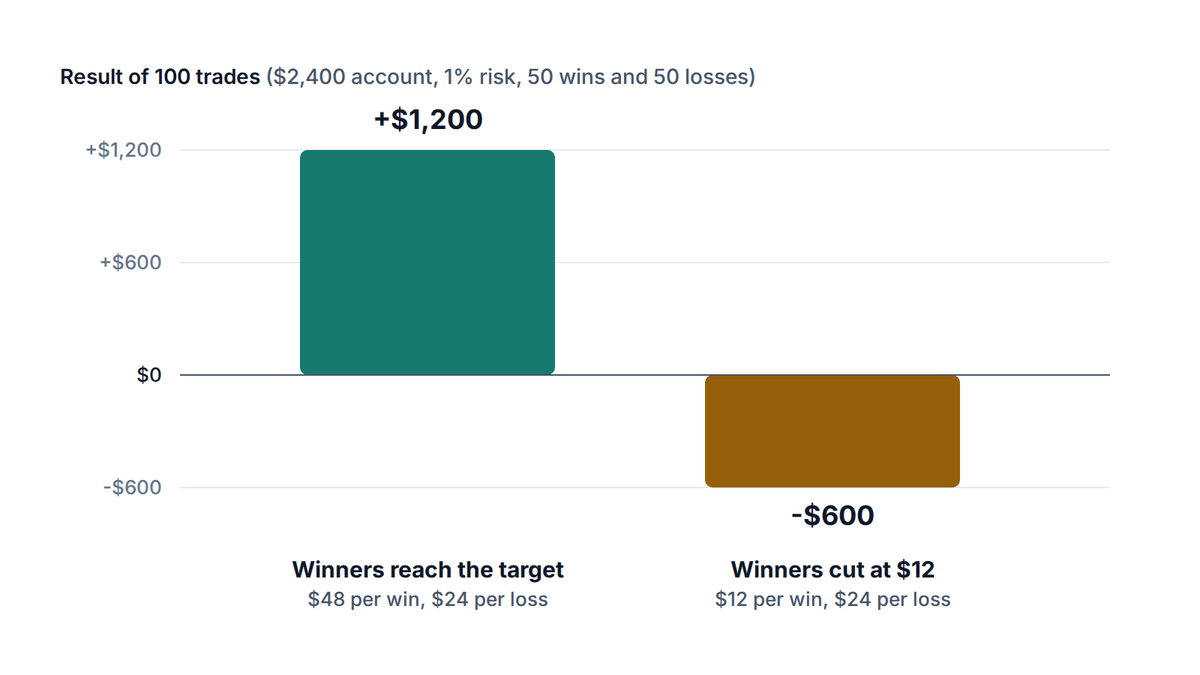
Nothing about the market changed between those two results. The only difference is what you did when a winning trade made you feel relief. That is why a bias is expensive: it works quietly on every trade. A rule such as "exit at the target or the stop, and nowhere else" costs nothing to write.
Streaks are normal
Biases feed on streaks, so know what normal looks like. At a 50% win rate, the chance that a given set of five trades is all losses is 3.1%. But across 100 trades, at least one run of five losses appears about 81% of the time, and a run of seven about 32%. A losing streak alone is not evidence that the plan broke.
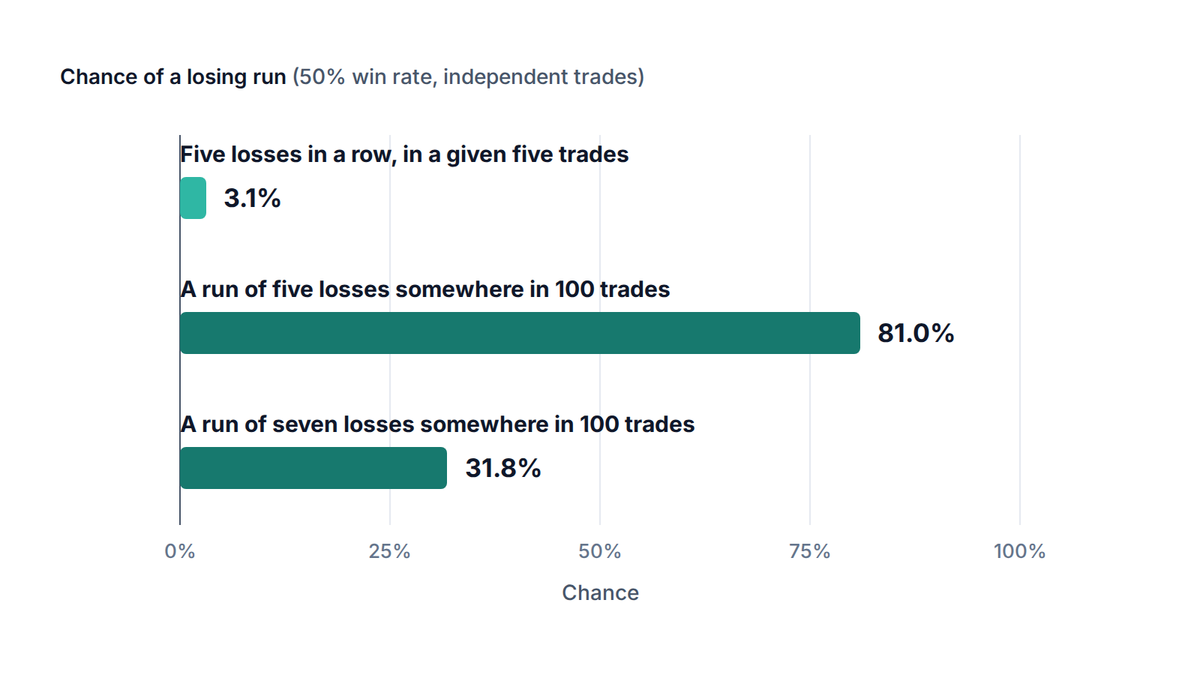
The answer to how to improve trading psychology is mostly engineering, not mindset. You decide in advance, in writing, and then the trade only asks you to follow instructions. Each rule below answers one bias from the table.
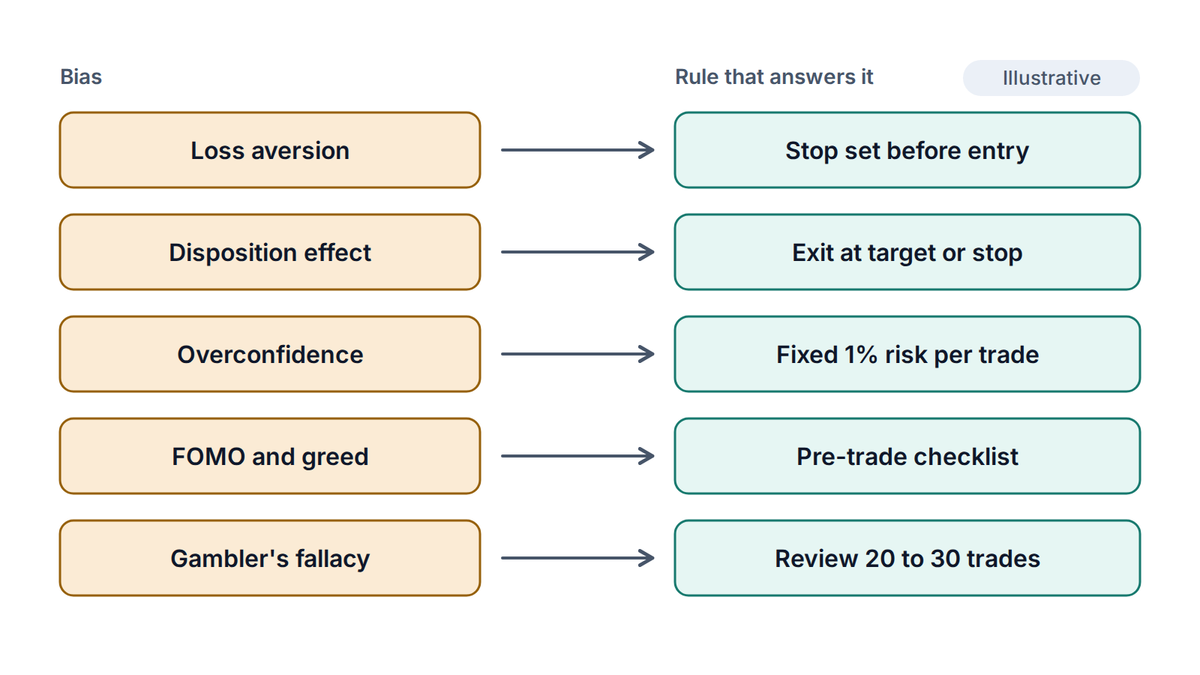
Write the rules down
A rule that lives in your head bends under pressure. A rule on one page, checked before every trade, is much harder to talk yourself out of. Keep the page next to your chart.
Rules handle the moment. A routine handles the conditions around it, which is where most mistakes start. Trading tired, rushed or upset raises the odds of every bias above, so a simple daily structure is part of the psychology of trading.
The journal turns a vague feeling such as "I trade badly" into a fact such as "my rule-breaking trades happen after 3 p.m. New York time (20:00 UTC) and cost $190 last month". Facts can be fixed. If one bad trade has already pulled you into a spiral, the lesson on tilt and the reset covers what to do next.
Finally, keep expectations honest. A plan with a sensible risk-reward ratio does not need to win every trade, so there is less pressure to protect each result. Less pressure means fewer emotional decisions.
Try it now
Test what a bad run would do to your own balance before it happens. Enter your balance, the number of losses and the loss per trade to see the ending balance and the gain needed to recover.
Trading psychology is how emotions, habits and mental biases affect your trading decisions. It covers things such as fear, greed, overconfidence and discipline, and it explains why traders break their own rules.
Turn your decisions into written rules: a fixed risk per trade, a stop and target set before entry, a checklist and a daily loss limit. Then keep a journal and review it weekly, so you can see which rules you break and why.
Greed is the pull to take more from a trade or a good run: holding past your target, adding size after wins or chasing a move. It feels like confidence, but it replaces your exit and sizing rules with a feeling.
Not really, and you do not have to. The aim is to make emotions irrelevant to the decision by deciding size, stop and exit before the trade. You may still feel fear or excitement, but the rules do the choosing.
The PipsMorrow Team
A team of writers covering XAU/USD gold trading education. We focus on explaining the mechanics and risk management in a structured way, with no trade signals and no promotion of any specific broker.
Last updated
Revenge trading is trading to win back a loss instead of following a plan. Learn the warning signs of tilt, what it costs and the rules that stop it.
10 min read
Read more →Overtrading is taking more trades than your plan supports. Learn how to tell it from an active strategy, what it costs and the limits that stop it.
9 min read
Read more →A forex demo account is practice with fake money. Learn what it teaches, where it misleads, and the checklist to pass before you trade real money.
9 min read
Read more →Build on this article with the full gold trading curriculum, ordered from the basics to advanced topics, free.
