
Getting started
Revenge Trading: How to Spot Tilt and Stop It
Revenge trading is trading to win back a loss instead of following a plan. Learn the warning signs of tilt, what it costs and the rules that stop it.
10 min read
Read more →
Overtrading is taking more trades than your plan supports. Learn how to tell it from an active strategy, what it costs and the limits that stop it.
Overtrading means taking more trades, or bigger trades, than your plan and your account can support. The count alone does not define it. A scalper can place 20 trades a day and follow the plan every time, while a swing trader can overtrade with three. What matters is whether each trade has a reason.
This guide explains what overtrading is, how to tell it from an active strategy and what it costs on a $2,400 account. It then covers how to stop overtrading with limits you set before the session starts. It is education, not a signal to place any trade.
When people ask what overtrading is, the short answer is trading more than your edge (the small statistical advantage your strategy has) justifies. Every trade costs money in spread (the gap between the buy and sell price) and carries risk. A trade without an edge pays those costs and gives nothing back.
Overtrading shows up in three forms, and they often travel together.
It is a close cousin of revenge trading, but the trigger differs. Revenge trading follows a loss and wants it back. Overtrading can start from boredom, excitement after a win, fear of missing out or simply a screen that is always open.
Clicking buttons feels like work, and work feels like it should earn money. Markets do not pay for effort, though. They pay for good entries, sound risk and patience. Doing nothing while you wait for a setup is part of the job, not a gap in it.
Forex also invites it. The market runs around the clock on weekdays, so the next chance is always minutes away. And leverage (borrowing that lets you control a large position with a small deposit) makes it easy to open one more trade without feeling the weight of it.
Some strategies are busy by design. A day trader (someone who opens and closes positions within the same day) may take many trades legitimately. The comparison of swing and day trading shows how normal frequency varies by style. So frequency is the wrong yardstick.
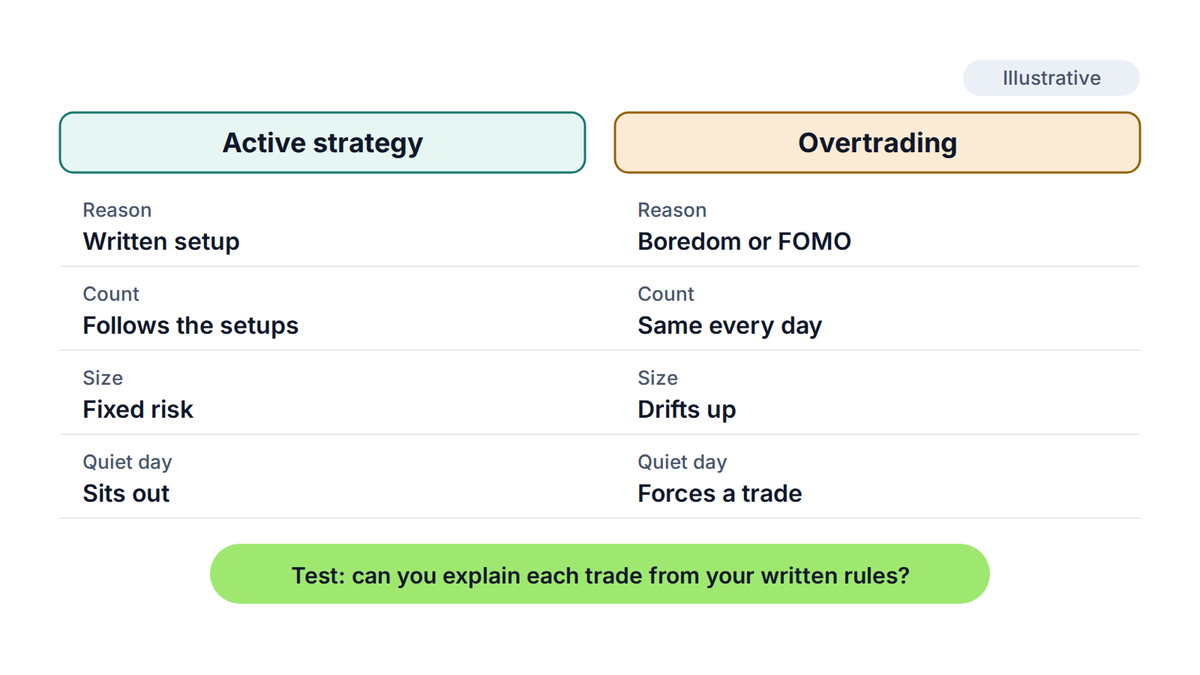
Use this test instead: could you explain each trade, in one sentence, using rules you wrote before the session? An active strategy can. Overtrading cannot, because the real reason was "it was moving" or "I had to be in".
| Active strategy | Overtrading | |
|---|---|---|
| Why trades are placed | A written setup appeared | Boredom, excitement or fear of missing out |
| Trade count | Varies with how many setups form | Steady no matter what the market does |
| Size | Same risk per trade as the rule says | Drifts up after wins or losses |
| Quiet markets | Fewer trades, or none | Forces trades anyway |
| Review | Most trades match the plan | Many trades match no plan |
To make the test measurable, count your trades over a week. For each one, check whether it met every entry rule in your plan. Divide the matches by the total. That is your plan-match rate.
Say you took 40 trades and 18 met every rule. Your plan-match rate is 45%. The other 22 trades were extra, and they are the ones to remove. There is no magic percentage, but an honest strategy trader usually sees it near 100%.
The cost is not only the losing trades. Even a flat, break-even trade costs the spread. Take the site's shared $2,400 account, a 1% risk rule ($24) and a 20-pip stop loss on EUR/USD. The lot size calculator gives 0.12 lots for that setup.
At 0.12 lots one pip (the smallest standard price move, 0.0001 on EUR/USD) is worth $1.20. Suppose your broker's spread is 1.0 pip, an assumed figure for this example. Each trade then costs $1.20 the moment you open it. Read more in what the spread is.
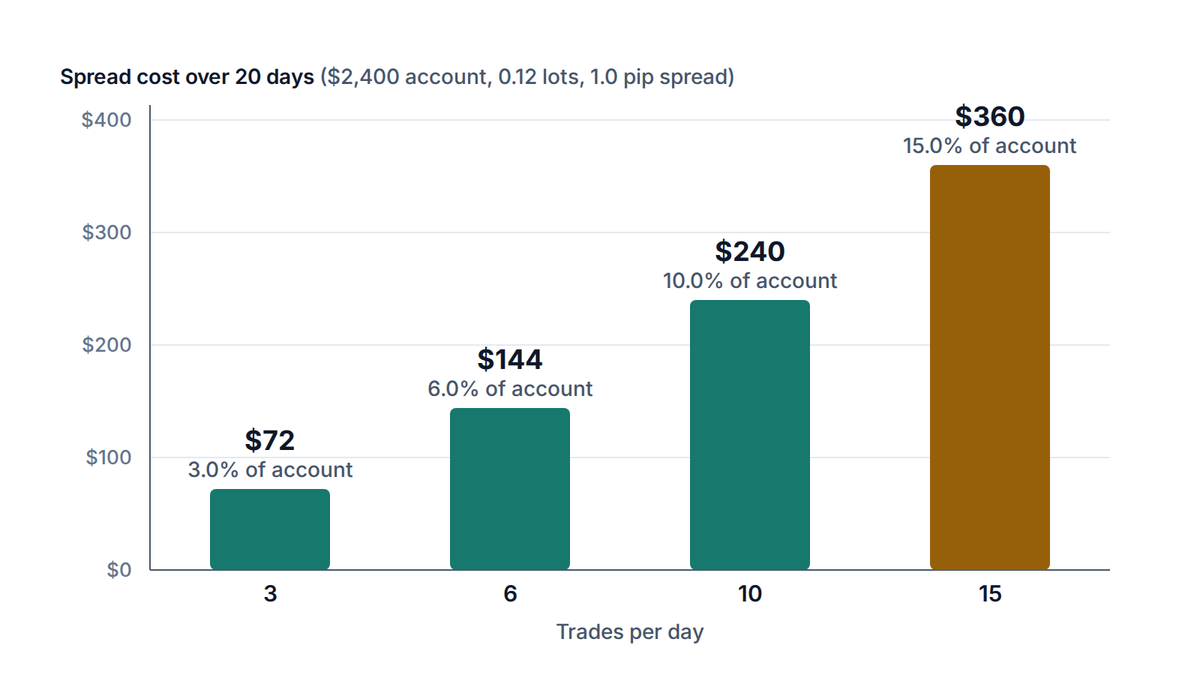
Now compare how many trades you take. Over 20 trading days the spread bill grows in a straight line, but your account feels it as a share of the balance.
| Trades per day | Trades in 20 days | Spread cost | Share of $2,400 |
|---|---|---|---|
| 3 | 60 | $72 | 3.0% |
| 6 | 120 | $144 | 6.0% |
| 10 | 200 | $240 | 10.0% |
| 15 | 300 | $360 | 15.0% |
At 15 trades a day your strategy must earn $360 a month before it makes a cent. Many of those extra trades also lack a real edge, so the total is likely worse once the losses are counted.
Size makes it worse
Overtrading with bigger size also speeds up drawdown (the fall from a peak to a later low). Ten losses in a row at a steady 1% risk leave $2,170.52 from $2,400, down 9.6%. The article on what drawdown is explains why the gain needed to recover grows faster than the loss.
Overtrading feels like being engaged, which is why it hides well. These signs are behaviors you can check, not moods.
Tilt (an emotional state where frustration drives your decisions) is a common trigger. The lesson on tilt, revenge trading and the reset covers it in more detail.
Willpower is weakest in the middle of a session, so the answer to how to stop overtrading is to decide the limits earlier. Write them down when you are calm. Then, in the moment, you follow a list rather than argue with yourself.
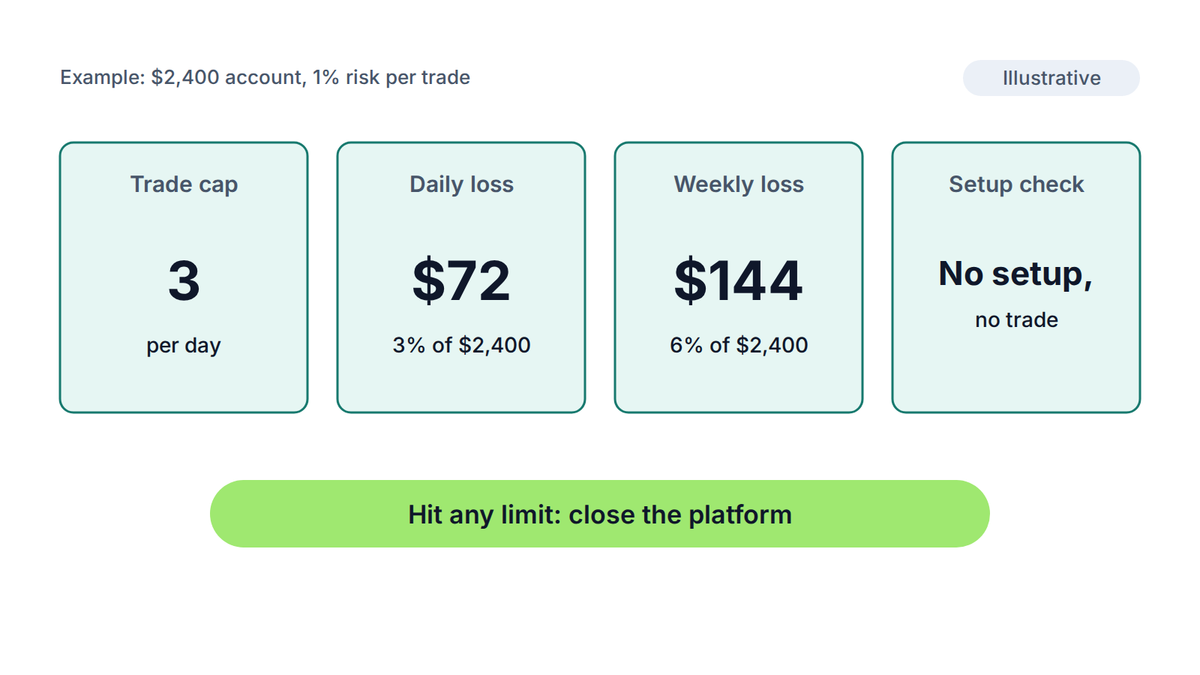
Hitting a limit is the system working, not a failure. Close the platform, not only the chart, and step away. Do not look for "one last trade" on another pair. That is the same urge in a new place.
Limits catch the damage. Habits stop it forming. If you want to know how to avoid overtrading in the first place, change the setting you trade in, not just the rules.
Expect to slip. Every trader overtrades sometimes. Success is spotting it within a few trades, not a few weeks. The expected value of each trade also matters, as the piece on trading expectancy shows, and extra trades without an edge pull your average down.
Try it now
Before the session, size the position from your stop and see what a losing run would do to your balance. Both take under a minute and make a limit feel real.
Overtrading is trading more than your plan and account support. It can mean too many trades, positions that are too large or trades with no valid setup. It is judged by the reason behind each trade, not just the count.
Set limits before you trade: a daily trade cap, a daily loss limit and a rule of no setup, no trade. When you hit one, close the platform. A journal that marks each trade as plan or not plan shows you where the extra trades come from.
There is no universal number. A scalper may take many trades and still follow the plan, while a swing trader may overtrade with three. If you cannot explain each trade with a written rule, it is too many for you.
No, though they overlap. Revenge trading is driven by a loss and the urge to win it back. Overtrading has other triggers, such as boredom or excitement after a win. Both come from breaking your own rules.
The PipsMorrow Team
A team of writers covering XAU/USD gold trading education. We focus on explaining the mechanics and risk management in a structured way, with no trade signals and no promotion of any specific broker.
Last updated
Revenge trading is trading to win back a loss instead of following a plan. Learn the warning signs of tilt, what it costs and the rules that stop it.
10 min read
Read more →Trading psychology is how emotion and bias shape your trades. See the biases that cost money and the written rules that take mood out of the decision.
10 min read
Read more →A forex demo account is practice with fake money. Learn what it teaches, where it misleads, and the checklist to pass before you trade real money.
9 min read
Read more →Build on this article with the full gold trading curriculum, ordered from the basics to advanced topics, free.
